

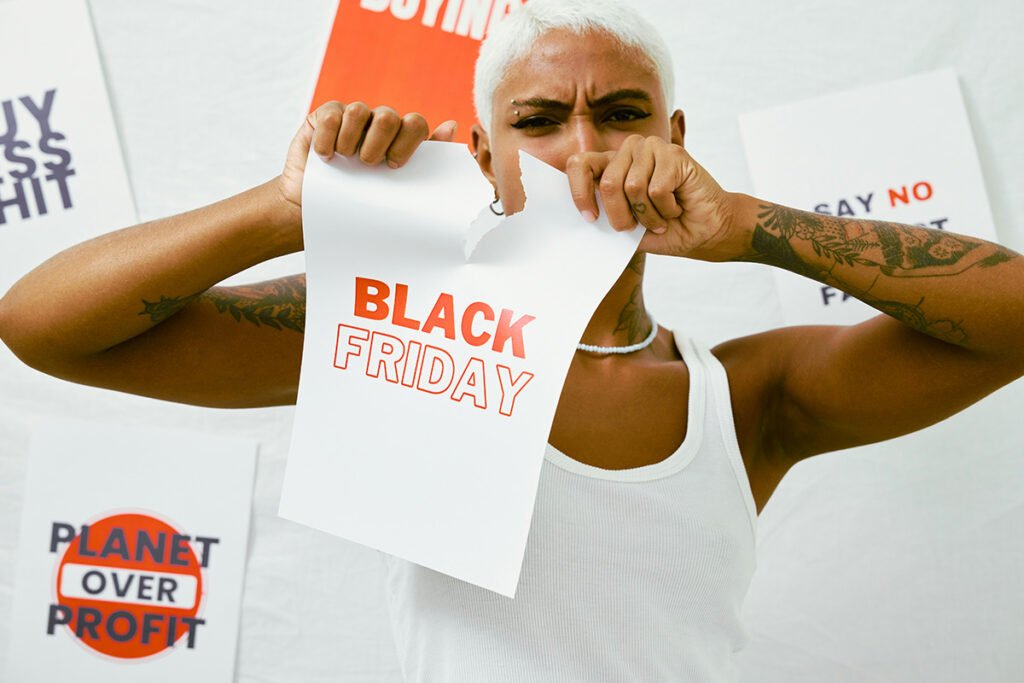
The language behind the call was dramatic. As one website last month declared, “The Mass Blackout is a coordinated, nationwide economic shutdown campaign launched by a coalition of grassroots organizations demanding an end to corporate rule, political corruption, and the removal of the Trump administration.”
Newsweek described the campaign as an effort to “completely withdraw from the consumer economy from November 25 to December 2.”
Did this happen? In a word: No.
Black Friday sales volume this year rose 4.1 percent overall—about 1 percent above the inflation rate. (Specific store data is not yet available.)
A similar one-day blackout on February 28, 2025, for which there is store-specific data, showed a 6 percent decline in sales at 100 top e-retailers over the preceding year, with comparable declines in online, app, and walk-in traffic numbers at big box retailers such as Target and Walmart. This represents only a “mild impact” according to industry observers, but it is a noticeable effect.
Of course, the stated goals of the organizers are more far-reaching. Evidently, despite the boycott campaigns, US corporate rule and political corruption have been largely unaffected. But rather than evaluate single actions in isolation, the role of boycotts should be considered within a larger, more long-term movement framework.
Two Kinds of Boycotts
Broadly speaking, there are two kinds of boycotts: targeted and general. Targeted boycotts are the classic form of boycott against a specific company, issue, or practice. The word “boycott” comes from an 1880 campaign against a specific landlord in Ireland, Charles Boycott, who was overcharging tenant farmers for rent.
Of course, while the Irish gifted the world the word boycott, the strategy of refusing a specific product as a means of gaining political and economic leverage did not begin in Ireland in 1880. For instance, when tea was dropped into the harbor in Boston in 1773, that effectively began one of the first major boycotts in prerevolutionary US history.
There are many other prominent examples of successful boycotts in US history. The bus boycott of 1955–1956 in Montgomery, AL, for example, which lasted 381 days, not only succeeded in integrating the city’s bus system but helped lift Dr. Martin Luther King, Jr. to national prominence and became the start of what is widely known in US history as the “modern civil rights movement.”
It is often the case that boycotts are most effective when connected to a broader movement, such as an alliance with unions.
We have seen targeted boycotts in 2025 too. Most notably, Target Corporation has conceded that a targeted boycott for ending its diversity, equity, and inclusion programs led to reduced store sales. Another example: when Disney Corporation, responding to government pressure, suspended Jimmy Kimmel Live, millions of consumers responded by unsubscribing from Disney+ streaming services, leading the company to quickly reverse course and reinstate the program. (A public letter from over 400 Hollywood artists played an important assist role as well.)
Also over the Black Friday period, the campaign We Ain’t Buying It led a targeted boycott against three major corporations: Amazon, Home Depot, and Target.
Peter Levine, political science and philosophy professor at Tufts University, writing after the February 28 single-day general boycott, outlined the conditions that enable targeted boycotts to succeed:
- A goal: what the boycott aims to achieve.
- A target: a decision-maker who is capable of doing something relevant to the goal.
- A demand: something that the target could agree to do.
- A cost: something that the target will lose if they don’t meet the demand.
- Negotiators: individuals who can credibly agree to stop the boycott if the target complies sufficiently.
- A message: a description of the boycott that is aimed at relevant third parties, such as observers who are undecided about the issue.
- Accountable leaders: people who decide on the previous six points and are answerable to those who actually boycott.
Although Levine does not raise this point, it is often the case that boycotts are most effective when connected to a broader movement, such as an alliance with unions. For instance, the grape boycott of 1965–1970 was linked to labor organizing among farm workers. Similarly, the current call for consumers to boycott Starbucks is linked to a campaign by workers from within to achieve union contracts for baristas.
So, why would anyone organize a general boycott or “buy nothing day,” which has hardly any of the features of targeted boycotts? Levine, for the record, mentions that he himself participated in the February 28 blackout, so he’s not disparaging general boycotts. It is simply that the goals of such actions should be understood differently.
General boycotts are less about seeking leverage to change policy, and more about spreading basic political education—like raising awareness that corporations do in fact dominate the US economy—as well as building at least the rudiments of a common sense among participants that they are part of a larger movement.
Sign up for our free newsletters
Subscribe to NPQ's newsletters to have our top stories delivered directly to your inbox.
By signing up, you agree to our privacy policy and terms of use, and to receive messages from NPQ and our partners.
While buy nothing days are likely to be an inadequate means for directly affecting policy, they can certainly be a valuable form of outreach to large groups of people. And if there is appropriate post-event follow-up, they can begin to motivate people to build the deep person-to-person connections and organizational infrastructure necessary for sustained social change.
Organizing…involves building deep personal connections and an institutional infrastructure that sustains movement between peak mobilizational moments.
Mobilizing Versus Organizing
The distinction between targeted boycotts and general boycotts is merely one manifestation of a broader movement challenge. Borrowing from the social movement scholar Marshall Ganz, it helps to understand the difference between mobilizing and organizing. Mobilizing is flashy. A march or a buy nothing boycott or a get out the vote drive are all forms of mobilizing—in all of these cases, people are mobilized to take one specific action. It is transactional by design.
Transactional does not always mean ineffective. For example, at No Kings rallies held across the United States on October 18 this year, millions of people showed up—and that was important. Large rallies function somewhat similarly to general “buy nothing” style boycotts. They show commitment. They provide some basic political education. They help people feel less isolated and part of a larger whole. These are good and important things. But they are not the same as organizing.
Organizing is not transactional but transformational in design and involves building deep personal connections and an institutional infrastructure that sustains movement between peak mobilization moments. It is through the patient building of connections and common-bond association that a deeper sense of identity, purpose, and solidarity is created, as well as the associational netting that allows for sustained action (the kind that, as with the case of targeted boycotts, can be turned on or off as conditions warrant).
Ganz noted that mobilization without organizing can lead to a situation similar to that of “the cartoon figure, Wile E. Coyote, who runs off the cliff, looks down, and [sees that] there is nothing there.”
It is infrastructure that makes possible the creation of teams of movement-accountable leaders who can, for example, credibly serve as negotiators who have the authority within their movements to be able to agree on behalf of the groups involved—including, as Levine put it, acting “to stop the boycott if the target complies sufficiently.”
When it comes to nonviolent resistance, which tactics make the most sense will vary tremendously depending on the context.
With the modern civil rights movement, the 1963 march on Washington of 250,000 people, and Dr. King’s speech at that event get the most attention, but the march was successful in ultimately moving policy because it was connected to deep organizing and extensive networks rooted in Black church networks throughout the US South and beyond.
The “Big Six” organizations behind the protest—namely, the Brotherhood of Sleeping Car Porters, the NAACP, the Southern Christian Leadership Conference (Dr. King’s group), the Congress of Racial Equality, the Student Nonviolent Coordinating Committee, and the National Urban League—did not always have the same views, but the infrastructure that these organizations represented is a big part of the reason why the 1963 march led to the 1964 Civil Rights Act and the 1965 Voting Rights Act.
Tactics and Strategy
The bottom line: When it comes to nonviolent resistance, which tactics make the most sense will vary tremendously depending on the context. What’s important is that tactics align with strategy, something that may sound simple, but is anything but. Strategy in nonprofit circles today is often referred to as a “theory of change.” Tactics are the actions you take that (hopefully) advance that theory into practice.
As Ganz noted, both strategy and tactics are words derived from classical Greek military theory. “The general, the strategos, is up on the mountaintop overlooking the field. He develops a theory of change about how to deploy. And the soldiers in the field, they are called taktikos. That’s where you get strategy and tactics. When a cloud gets in between the two, that’s when you have problems.”
We live in cloudy times, a fragmented condition Harvard sociologist Robert Putnam famously illustrated through the image of “bowling alone.”
In his November 2022 essay, “Building Resilient Organizations: Toward Joy and Durable Power in a Time of Crisis,” Working Families Party National Director Maurice Mitchell detailed some of the leading causes of how this movement disorganization or fragmentation happened. As Mitchell writes, “Leaders have been jailed, killed, or co-opted; organizations have been invaded, dismantled, or neutralized. We have inherited this traumatic and often bloody legacy.” The War on Drugs and the mass incarceration regime that resulted from it are part of the legacy to which Mitchell refers.
Movement reconstruction is happening, even if progress is often hidden from view. The growing efforts to build a solidarity economy are one illustration of this. And of course sometimes the top of the iceberg becomes visible, as was the case in New York City with the recent mayoral election of Zohran Mamdani.
Still, movement building work is often far from flashy. The group Choose Democracy, for instance, suggests organizing or participating in potlucks, affinity groups, and weekly study groups as a few possible low-risk points of entry. The important thing, in short, is not to do everything, but something. And support others to do their something too.