
State of the Movements is a recurring NPQ column dedicated to tracking the pulse of social movements and the solidarity economy in 2025.
This November, in over a dozen locations across the Americas, a network of Next System Teach-Ins drew scholars, activists, and community members together to develop practical actions that can advance democratic practice, even amid an international tide of rising authoritarianism.
Organizers are consciously seeking to build the foundations for what they call a “third force” based in communities rather than nation-states or global corporations. Backing the effort are the Department of Next System Studies at George Mason University in Virginia, the US Solidarity Economy Network, Leadership for the Ecozoic, Presente.org, and the Global Tapestry of Alternatives.
Teach-ins happened across the United States, in places such as Arlington, VA; Chicago, IL; and Eureka, CA; and extended to Puerto Rico, Argentina, and México. Each teach-in took on the “color” or unique priorities and character of its place and its organizers, yet they all had an underlying mission of cultivating spaces of co-learning, collaboration, and collective responsibility to understand the limitations of current systems and develop ways to co-create more just ones.
The value of the gatherings was expressed well by Chicago panelist and executive director of the Co-op Ed Center, Xochitl Espinosa, who shared, “We know that this moment is not just one moment of crisis. We know it’s a consequence of the systems that have been in place for a very, very long time. And so, I think we need a lot of spaces for us to keep reflecting on that.”
Growing Community Power in Chicago
In Chicago, organizers drew on the long legacy of community organizing to host a participatory “Community Power Convergence” featuring Chicago-born organizer Prexy Nesbitt.
Nesbitt—a veteran of Africa solidarity struggles and a former specialist assistant to Harold Washington, Chicago’s first Black mayor—praised attendees for organizing against the anti-immigrant attacks of the administration of US President Donald Trump. He warned that the very forces that a global anti-apartheid movement had helped overthrow are today at work seeking to implement a vision of segregation and exploitation once again: “I’m speaking as somebody who’s been part of the struggle in South Africa, the struggle in Mozambique, the struggle in Namibia, the struggle in Zimbabwe, struggles all over the world. We’ve got to export more our capacity to come together and to struggle together, to be together.”
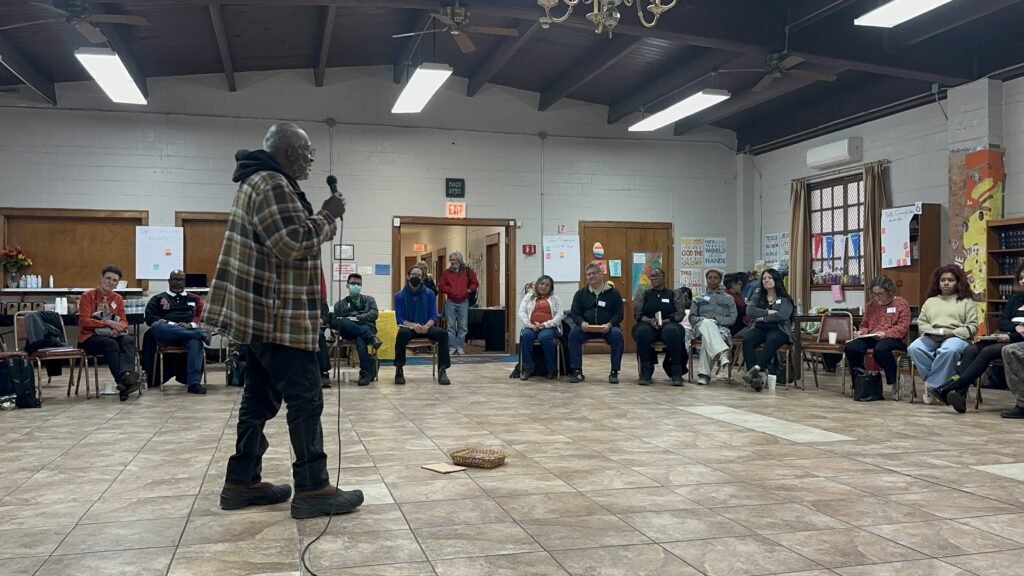
Inspired by the community-building approach known as asset-based community development, also born in Chicago, participants co-created an asset map that linked areas of movement strength and innovation. Pre-programmed workshop topics included community self-determination, mutual aid and community defense, building trusting partnerships in neighborhoods, restorative economics, youth leadership, digital cooperatives, the “vital conditions” framework, and cooperative family structures.
Five additional topics were self-organized by participants through the open space agenda-building process, including discussions on “Tribal Cultures” and “Organizing a Chicago Civic Week.”
Organizers and innovators who joined reported that the event served as a much-needed opportunity to step back from the day-to-day, gain perspective, and feel affirmed and less isolated in their work. Many, including experienced organizers, encountered other organizations, groups, and frameworks for the first time, and exchanged contact information and made plans to continue exploring ways to synthesize their thinking, assets, and efforts beyond the gathering.
Similar to other teach-ins, those gathered in Chicago incorporated the idea of restoring ancestral and Indigenous practices as a key to imagining and prefiguring a “next” system. As Espinosa shared, this is especially critical for those living in the United States, which she described as the “belly of the beast”:
We’re living the world that [Dr. King] warned us about when machines and computers, profit motives, and property rights are considered more important than people. We are talking about systems that really were never for us, and more and more people are going to be left out, and we’re seeing the consequences. And for many of us, we’re in the belly of the beast.
In response, Espinosa argue for returning to Indigenous wisdom: “I think what the moment is calling for is for us to go back to those traditions.”
Other US gatherings took on similar themes. In Duluth, MN, over 200 faculty, students, and community leaders and members gathered in person and virtually to listen to a talk from economist, environmentalist, and two-time vice-presidential candidate Winona LaDuke. LaDuke lifted up practical, real-world examples of next system practices rooted in Ojibwe traditions being practiced in the region.
In Syracuse, NY, organizers centered their teach-in on pressing local issues and available solutions. Suren Moodliar, a founding board member of Syracuse Action for Land and Transformation, emphasized, “We are inspired by emerging systemic change movements worldwide, yet at the same time we are also turning to this region’s history of social innovation to recover our community’s wealth.”
Sign up for our free newsletters
Subscribe to NPQ's newsletters to have our top stories delivered directly to your inbox.
By signing up, you agree to our privacy policy and terms of use, and to receive messages from NPQ and our partners.
International Engagement
With the teach-ins extending throughout the Americas, Alice Poma, a professor at the National Autonomous University of Mexico (Universidad Nacional Autónoma de México or UNAM) noted that it is important to learn how to create bridges between formal education spaces and popular-education spaces.
As Poma said, “A better world is also built by sharing scientific knowledge to improve the quality of life for the global majority,” but that should be balanced with other types of knowledge and education spaces where people have multiple ways of learning.
An example of sharing knowledge and redefining education as a communal matter took place in Buenos Aires, Argentina. Ana Inés Heras, a professor at San Martin University (Universidad Nacional de San Martín), collaborated with students to create an engaging activity that brought together neighbors, children, community leaders, educators, and researchers to participate in collective composting.

In Puebla, Mexico, Poma organized a workshop to identify, name, and reflect on the emotions we experience living through the climate crisis. The workshop took place in a self-managed cultural space in Zacatlán. Poma facilitated the workshop, offering participants a pamphlet as support material and asking them to write on small colored papers the emotions they felt regarding the effects, causes, and responses to the climate crisis.

These activities not only allowed women to learn about and share their feelings but also helped them cope with the emotions provoked by the climate crisis, such as pain, sadness, and helplessness.
Additionally, they provided spaces for learning, co-constructing knowledge, and potentially inspiring new actions. Participants could see that others had similar feelings, which helped break down isolation and allowed them to channel their emotions into action and avoid paralysis.
Lessons and Next Steps
With an initial set of teach-ins completed and several additional ones planned for the spring, organizers have learned many valuable lessons.
First, the call for teach-ins was a valuable movement and system-building process in and of itself. On both global and regional scales, teams began by pooling their knowledge of which promising practitioners, scholars, innovators, and networks already existed that were spearheading next system work—perhaps using different terminology but fundamentally aligned. And this process developed new relationships to a space of shared learning and thinking forward together about how to put ideas and possibilities into practice.
This integration occurred not only nationally and regionally, but within host institutions as well. Minnesota’s gathering, for instance, served to pull faculty together from departments that rarely talk to each other. Institutionally, these faculty were isolated from each other, but the teach-in provided a vehicle for collaboration that the university itself had not.
Second, globally and regionally, teams have found a refreshing appetite for these conversations and intersectional spaces. Many who joined the planning process or the events themselves have been seeking, and in many cases innovating their own frameworks and spaces to name our current crises as systemic while calling for interlinking solutions of an equally systemic nature. The next system framing and invitation has provided a welcome “frame of frames,” which not only allows but affirms the inclusion of often siloed fields of work and thought such as solidarity economy, participatory politics, ecological sustainability, just transition, and abolition, among others.
Finally, the effort has produced an exciting pathway for bridging the worlds of academia and that of communities and activists. As Ben Manski, founder of Next System Studies at George Mason University, wrote:
Can the academy contribute to a better world beyond capitalism? Arguably, it already has. But let’s accept that universities and colleges can be and usually are simultaneously: pillars of the state, predatory corporations, and agents of social reconstruction. The best counter to academic institutions doing the wrong thing may be to build their capacity to do the right thing.
Systemic change is by nature a long-term, evolving field of working, thinking, and exchange across sectors, traditions, and cultures. By tapping into the leadership of activist scholars and the resources of academic institutions to hold spaces open to the community for knowledge exchange, relationship building, and activating real-world solutions, the teach-in process offers a promising vehicle for pulling together “all hands on deck” to not only imagine but concretely build out solutions to address the complex and interlocking crises that we face.