
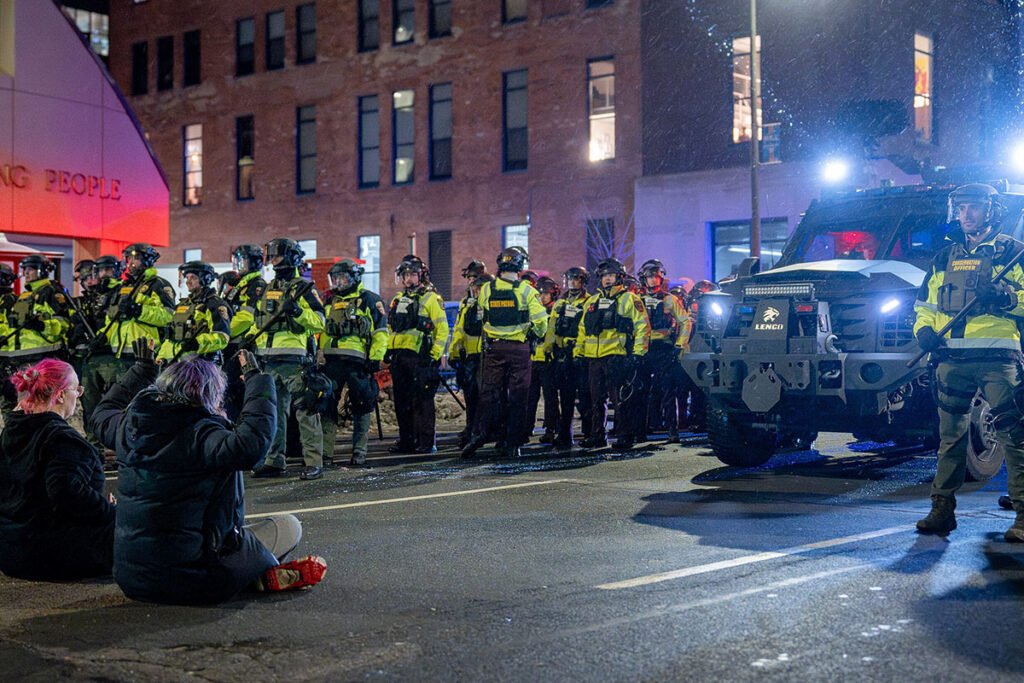
“Are you okay?” These were Alex Pretti’s last words, said to a woman after ICE agents had tackled and pepper-sprayed her. Videos from bystanders show Pretti holding up a phone, attempting to document what was happening before he himself was pepper-sprayed, wrestled to the ground, and killed by those officers. He lost his life not for committing violence, but for documenting it, and stepping in to protect someone facing it.
We must catalyze this moment of reckoning into actual justice and safety for our communities.
The killings of Alex Pretti and Renee Nicole Macklin Good, among others, are not isolated tragedies. They are part of a larger pattern—one in which protest, documentation, and dissent are increasingly treated as threats to the current administration’s racist agenda, rather than constitutionally protected rights. It is a stark illustration of what happens when the act of protest and bearing witness becomes not only dangerous but life-threatening.
The Trump administration’s intimidation and violence against ICE protesters are meant to have a chilling effect, to send a warning to others that they should stay home. Instead, more than 34,000 Minnesotans have signed up to defend their immigrant neighbors, with a surge of new “ICE watchers” joining after the fatal shootings of Good and Pretti.
We must catalyze this moment of reckoning into actual justice and safety for our communities. Videos of ICE agents wreaking havoc in our communities have spread widely on social media, eroding the agency’s standing in the eyes of the public and contradicting the Trump administration’s version of events. To date, video of the shooting of Renee Good has been viewed by 70 percent of Americans, underscoring how vital this form of documentation has become in the age of social media and smartphones.
And while Secretary of Homeland Security Kristi Noem announced earlier this week that ICE agents in Minneapolis would begin wearing body cameras, community members must continue documenting interactions independently. By doing so, witnesses can retain community-owned footage that allows the public to view incidents from various angles.
The right to dissent and bear witness is a force for change, which is why we must work hard to guard it.
A Coordinated Crackdown on Dissent
The Trump administration is intensifying its surveillance of people who protest, organize, document government actions, or speak out publicly by using social media monitoring, location tracking, and facial recognition. Under new Department of Justice (DOJ) guidance tied to a sweeping “domestic terrorism” framework, even observing or recording immigration enforcement can be framed as “impeding” law enforcement—recasting constitutionally protected acts as security threats. This deeply problematic framework is already being implemented: Federal prosecutors brought assault charges against protesters and legal observers in Minnesota, an alarming expansion of criminal liability not only for those who demonstrate, but for those who simply watch, document, or attempt to protect others from harm.
In recent weeks, Trump’s DOJ has issued grand jury subpoenas to elected officials who have spoken out forcefully against ICE’s rogue behavior, including Minnesota’s governor, attorney general, and the mayors of Minneapolis and Saint Paul. The administration also announced a baseless investigation into Rep. Ilhan Omar (D-MN), a sitting member of Congress and outspoken critic of ICE’s presence on the ground and the toll it has taken on her Somali community. The very next day, she was attacked at a Minneapolis town hall by a man who sprayed an unidentified liquid substance at her. This comes after years of Trump and his allies smearing and disparaging Omar—yet another example of how their words and policies have dire real-world consequences.
These pressure and intimidation tactics extend beyond public officials to community leaders and protesters. Just days before Alex Pretti was killed, civil rights attorney Nekima Levy Armstrong and Saint Paul School Board member Chauntyll Allen—both women of color and deeply-rooted community leaders—were arrested for organizing a peaceful protest inside a Saint Paul church. They’ve since been released but face criminal charges.
Sign up for our free newsletters
Subscribe to NPQ's newsletters to have our top stories delivered directly to your inbox.
By signing up, you agree to our privacy policy and terms of use, and to receive messages from NPQ and our partners.
Their arrests and others’—including former CNN anchor Don Lemon; National Association of Black Journalists Minnesota chapter Vice President Georgia Fort; and 21-year-old Temple University student Jerome Deangelo Richardson, who was assisting Lemon in his coverage—underscore how existing laws are being bent to criminalize dissent and how that power is wielded disproportionately against people of color.
All this pressure is meant to make people retreat. But what we see instead is persistence. People still show up. Mutual aid continues. Neighbors gather in vigils and marches, even knowing there may be consequences. This is not the absence of fear, but the practice of courage despite it.
Philanthropy must step forward with the same resolve that our neighbors in Minneapolis and beyond are already demonstrating.
What This Means for Philanthropy
The Piper Fund, an initiative of the Proteus Fund, has worked for three decades protecting and advancing democracy. Through this work, we have learned that the public’s understanding of—and mobilization to end—police violence, immigration abuses, labor exploitation, environmental harm, and civil rights violations only happens when people document and protest what they are seeing. Progress depends on that visibility—often at personal risk.
But democracy cannot depend on extraordinary bravery alone, especially when bearing witness and engaging in our constitutionally protected right to protest requires risking one’s freedom or life. That is neither just nor sustainable. This is where philanthropy must step forward with the same resolve that our neighbors in Minneapolis and beyond are already demonstrating. This moment calls for action that is thoughtful, coordinated, and proportional to the challenge.
We urge philanthropic partners to take these steps:
- Recognize that a multiracial democracy is only possible if we protect our constitutional right to protest and dissent. Damon J. Keith, an appellate judge and civil rights icon, famously wrote that “democracies die behind closed doors.”
To keep our democracy alive, we must fund legal defense for people targeted for protest participation, legal observation, or documentation; rapid-response support for organizations facing surveillance or prosecution; and digital security resources for groups under heightened scrutiny. We must also support organizations that defend First Amendment rights in online spaces: Social media platforms have become central arenas for organizing, bearing witness, and shaping public understanding, yet are increasingly subject to content suppression and surveillance. These protections are as fundamental as funding policy research or direct services.
- Fund protest and dissent protection as if your entire mission depends on it, because it does. For too long, protection of protest and dissent has been siloed as the responsibility of “democracy funders.” That framing no longer reflects reality. The suppression of dissent affects every issue area that philanthropy supports. Immigrant justice cannot advance if communities fear documenting raids. Racial equity falters when protesters who stand against violence are criminalized. Labor rights erode when workers are surveilled for organizing. If communities cannot safely speak out, document harm, or challenge power, none of our issue-specific goals are achievable. Protecting these norms is not a separate portfolio—it is the infrastructure that makes all other work possible.
- Invest in the safety, care, and infrastructure of those working on the front lines. Communities closest to the harm are also those carrying the greatest risk, and they need resources that match that reality. Sustained democratic participation requires emotional, physical, and digital safety, legal protection, and the capacity for communities to document their experiences and shape public understanding—not just in moments of crisis, but for the long haul.
Defending the right to protest, to bear witness, and to dissent without fear is not peripheral—it is the foundation of a functioning democracy and essential to protecting our neighbors and ourselves.
Alex Pretti and Renee Good paid a profound price for bearing witness, and their deaths demand immediate and sustained action. Their lives must not be reduced to tragic footnotes, and we must also remember and honor the lives of our immigrant neighbors who have died in ICE custody, where fatalities have reached the highest level in decades. Rippling out are countless others whose lives are being fractured by detention, deportation, family separation, and the fear of leaving their homes. The image of five-year-old Liam Conejo Ramos with his blue bunny hat and Spiderman backpack, surrounded by ICE agents, galvanized the public, whose outrage played a significant part in Liam and his father being returned home to Minneapolis after 10 days in detention. We cannot look past this suffering or treat it as collateral to policy.
Defending the right to protest, to bear witness, and to dissent without fear is not peripheral—it is the foundation of a functioning democracy and essential to protecting our neighbors and ourselves. If we want to safeguard democracy for all who come after us, we must defend it today.