

Editors’ Note: This article was originally written for the Spring 2025 issue of Nonprofit Quarterly Magazine, “How Women of Color in the South Are Reclaiming Space.”
Reclaiming spaces that once confined women against their will…can itself serve as a form of reparations.
Growing up amid the echoes of the antebellum South, the city that I call home is steeped in a troubling heritage, adorned with statues of Confederate soldiers and figures like Jefferson Davis, alongside the notorious Dr. James Marion Sims, who is often referred to as the father of modern gynecology.
This history is not limited to the legacy of slavery. It also connects to the more recent Hill-Burton Act of 1946, in which an Alabama senator, seeking to honor his lineage, crafted “separate-but-equal” healthcare legislation that overlooked the suffering of many.
Reclaiming spaces that once confined women against their will—where they endured unimaginable acts of violence and trauma—can itself serve as a form of reparations.
As a Black woman navigating the streets of downtown Montgomery, AL, I am acutely aware of the ancestral spirits that linger in the air, felt in every crack of the pavement and every name of a cobblestone street, echoing the significance of Black lives that have always mattered.
This reclamation is not just about acknowledging the pain; it is also about celebrating the resilience of Black individuals who, during times of oppression, found ways to experience love, joy, and creativity. This act of reclaiming is a powerful form of resistance, and I feel privileged to serve as a bridge that connects visitors to the historical truths of our past, provoking thought and honoring the memory of those who suffered.
Sign up for our free newsletters
Subscribe to NPQ's newsletters to have our top stories delivered directly to your inbox.
By signing up, you agree to our privacy policy and terms of use, and to receive messages from NPQ and our partners.
I was fortunate enough to acquire the site where, in the late 1840s, Dr. Sims conducted his medical experiments on enslaved girls and women. This location stands as a chilling reminder of the dehumanization and cruelty that were justified in the name of science and health. It embodies the conversations held by White men about Black bodies, which were exploited as economic resources and tools of oppression against Black individuals—women and children alike.
As Nina Simone profoundly stated, “It is an artist’s duty to reflect the times.” I embrace this responsibility wholeheartedly, striving to reclaim spaces that honor and reveal the often brutal dehumanization faced by Black girls and women in the South.
After acquiring the site where these atrocities occurred, my goal has been to honor the unsung Mothers of Gynecology—not only by naming them but also by educating future medical professionals. I aim to amplify the voices of doulas and midwives, highlighting their vital roles in saving lives. A monument on the site was erected in 2022, with the goal of ultimately also housing a museum.
I also felt a deep calling to use art as a means of transforming the narratives we typically associate with women and enslaved girls during the antebellum period. A piece by Robert Thom, commissioned by the pharmaceutical firm Parke-Davis for the collection Great Moments in Medicine, depicts Marion Sims and three male doctors as mere professionals in their field.
I sought to infuse truth into art, resulting in a mural that honors the mothers of gynecology, titled You May Feel a Little Pressure.
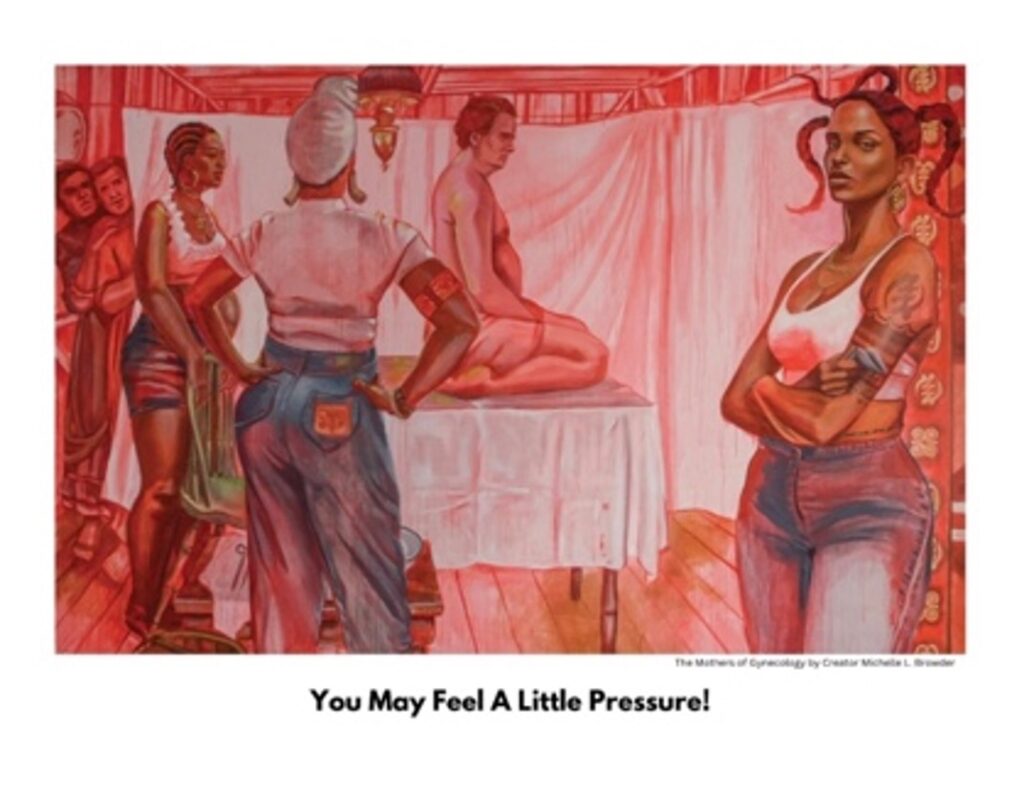
This mural will stand as a powerful reminder for visitors to our city and for students studying this dark chapter in healthcare history, reflecting on the misuse and abuse of Black bodies, particularly those of enslaved women and girls. It serves as a testament to our obligation not only to reclaim these spaces but also to reshape the narrative, providing a new lens through which people can witness the truth and find liberation in that understanding.