This article is part of NPQ’s series, Money in Movements: The Role of Donor Organizing. Co-produced with Solidaire Network, this series offers firsthand narratives from donor organizers deeply embedded in justice struggles to illuminate how individuals with wealth can authentically align with grassroots movements.
That food, that fish, that’s a part of who we are. And we’ve lived here for so long, we are the river.
Rochelle Adams, quoted in Chris Landry’s Yukon River
The last time Rochelle Adams exercised her rights to subsistence fish in her ancestral waters was in 2019. A Gwich’in leader from the villages of Beaver and Fort Yukon, she has been at the forefront of the fight against oil and gas in the Yukon Flats.
Salmon that once returned each year to spawn in their natal streams along the Yukon’s vast tributaries have declined so much that fisheries managers closed all salmon fishing on the Yukon River, a glacier-fed river that has nourished Alaska Native communities with salmon since time immemorial.
This spring, Adams spoke at a rally just outside the governor’s so-called Alaska Sustainable Energy Conference, which featured President Donald Trump’s energy policies and “I love fossil fuels” pins.
Rooted in Indigenous sovereignty and stewardship, Alaska’s grassroots resistance to drilling is a call to imagine a world built on collective care—not extraction.
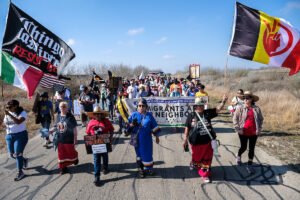
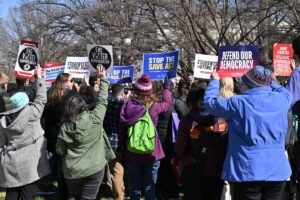
The Fairbanks Climate Action Coalition (FCAC), Native Movement, Stand Up Alaska, Alaska Community Action on Toxics, Northern Alaska Environmental Center, and community members showed up to protest. The wind whipped our hair as we chanted, with banners that read: “Alaska is not for sale” and “Defend the Sacred. Extraction is not our way of life.”
Adam’s voice boomed over the mic:
The Gwich’in Nation has been protecting these lands since I was little, my whole entire life, the Gwich’in People have stood to protect these lands, and we stand today, and we say we don’t want Alaska opened up for [sale] as a warehouse. We want to protect our lands. We want to continue our ways of life. We want to keep fishing….We’ve already had cyanide spilled on the Yukon River. What chance do our salmon have now?
Indigenous, community-led resistance to the Trump administration’s aggressive push to extract oil and gas in the Arctic and along the Yukon draws clear connections between climate justice and local struggles to protect land, water, and food systems. The decline of salmon is linked to broader cascades of harm—from climate change disrupting ocean food webs to industrial practices like overfishing, commercial bycatch, and other extractive practices.
While the fight to protect the Yukon Flats continues, Alaskan movements hold tremendous momentum and potential to lead a just transition away from fossil fuels. Alaska is warming four times faster than much of the world, but rather than a “canary in the coal mine,” I see its grassroots climate justice movement as a bellwether for what’s possible. Rooted in Indigenous sovereignty and stewardship, Alaska’s grassroots resistance to drilling is a call to imagine a world built on collective care—not extraction.
Resourcing Food Sovereignty Through LandBack
Eva Burk, a Dene’ Athabascan from Nenana and Manley Hot Springs, is a tireless advocate for Alaska Native food sovereignty, challenging the state’s mismanagement of salmon fisheries and recently joining the North Pacific Fishery Management Council’s Advisory Panel. In Burk’s words:
Our young people are hungry. What are we going to feed them?…What culture, what knowledge, what stories are we going to feed our people so that they can continue to revitalize their culture, continue to connect with their true identity and be proud of who they are? That’s realizing food sovereignty.
Burk and I teamed up when the state of Alaska auctioned off her family’s ancestral lands in a state “land disposal” sale. Alongside a small group of organizers, we raised over $100,000 and reclaimed two parcels with support from Native Movement, NDN Collective, Alaska Public Interest Research Group, FCAC, and donors I engaged through Solidaire and Resource Generation. Months later, organizers blockaded the only access road—along Eva’s family trapline—to resist a proposed expansion supporting extractive interests.
As a donor organizer, I am reminded that my value to movements is far greater than the money I gave, and I have a deeper commitment to the relationships that matter more than the checks I used to write.
Sign up for our free newsletters
Subscribe to NPQ's newsletters to have our top stories delivered directly to your inbox.
By signing up, you agree to our privacy policy and terms of use, and to receive messages from NPQ and our partners.
With their support, our efforts turned political boondoggles into a landback win. Tlaa Deneldel Community Group, a Nenana-based land reclamation group, now stewards the land with a holistic food systems focus that combines hunting, fishing, trapping, and berry picking with sustainable agriculture, all grounded in rightful Indigenous stewardship.
Fundraising for landback in Alaska was the first time my grassroots and donor organizing came together—and while the task felt daunting, it also felt deeply right. My heart sings when I can bridge frontline organizers and people who hold wealth, especially when redistributing wealth accumulated through extraction becomes part of repairing harm and restoring traditional lifeways.
I served in various leadership roles at Fairbanks Climate Action Coalition (FCAC)—a grassroots, volunteer-led group and leading voice in the fight to keep Alaskan oil and gas in the ground that was founded in 2015—most recently as the co-executive director in 2023 and 2024. FCAC builds long-term people power and works toward a shared vision for a regenerative economy in Alaska—one that is life-affirming and grounded in Indigenous values.
Funding the Future, Repairing the Past
Under Enei Begaye’s visionary leadership, Native Movement has helped build the climate justice movement in Alaska, grounded in solidarity and people power. The group plays a vital role in training and supporting community leaders to self-organize across the state and fosters coalition work. The organization’s Regranting Fund is a key piece of movement infrastructure, allowing donors of all sizes to contribute to a community-directed pool that funds a broader movement ecosystem. This shifts decision-making power from donors to movement leaders—where organizers shape funding priorities and funders engage in shared strategy and accountability.
Begaye has taught me a great deal about relationship-based movement building—and how both organizing and donor organizing can help us all heal. She’s shown me that we each have a role in movements—through the space she holds for allies like me, and in how she navigates her own role as a Diné and Tohono O’odham person with her Gwich’in family in Alaska. Neither of us is indigenous to this beloved place we live, and we seek the right role in protecting our home with humility and care.
As a donor organizer, I am reminded that my value to movements is far greater than the money I gave, and I have a deeper commitment to the relationships that matter more than the checks I used to write.
Guided by three movement leaders, I gave away $3.5 million in inherited wealth—with no strings attached—to Black- and Indigenous-led organizing rooted in connection to land and community. I’ve shared reflections on that process through a blog and podcast titled Liberatory Investments.
I aspire to do some of the healing my ancestors couldn’t in their time, and to heal both backward and forward for my children. I feel affirmed we’re on the right path when my efforts can contribute to others’ healing too, which is why teaming up with Adams, Burk, Begaye, and many others is powerful.
As Burk wrote to me, “It’s been very spiritual to be reconnected to our land in this way. This is our place for healing and gathering together.”
“The more you give, the more that you are wealthy.”
A Future of Abundance and Salmon
I dream of a future where glaciers endure, and salmon return to their natal streams each summer. A future where communities along Alaskan rivers are in direct relationship with their salmon relatives. These dreams move me to tears because they feel so out of reach—and yet they drive my fight for climate justice and have brought me into reciprocal relationships with Alaska Native leaders, who helped me find a movement home.
Indigenous-led efforts to restore food sovereignty and cultural connection show the way forward. The Smokehouse Collective is one powerful example—trading and gifting Bristol Bay salmon with Yukon communities and inviting people to harvest and process fish and other traditional foods on rematriated Curyung land. The project weaves together landback, fishing, and ancestral intertribal reciprocity to reclaim the often-extractive commercial fishing industry of Bristol Bay.
The Smokehouse Collective centers on an ethos of healing and wellness as they work to reinvigorate traditional trade routes as climate adaptation strategies. As codirector Ruth Łchav’aya K’isen Miller, a Curyung tribal member, explained to NPQ:
We have always cared for one another, we have always traded, we have always learned from each other’s ecological wisdom and traditional knowledge….By reawakening our relationships of care, our Native communities will be more climate resilient and reclaim sovereignty over our food systems. Our food is our first medicine, and we know our way back. Sharing abundance, gift-giving, trade. Reciprocal care between strong Native Nations. That is our sovereign path forward. That’s our health and wealth.
Redistributing my inherited wealth took lifeless money out of harmful investments and allowed community organizers to breathe life into some of the most important work I can imagine. As Begaye said on the Liberatory Investments podcast, “The more you give, the more that you are wealthy. Which is backward in the Western colonial understanding, but that is our understanding.”
Movements and donor organizers must overcome the obstacles designed to keep us apart and work together for our collective liberation. Once we have built deep organizing relationships—the same required for any community organizing—then we’ll be equipped to overcome the challenges and realize a future where land is returned, food systems thrive, and we care for each other.