

What if we stopped waiting for permission to own and govern our own economies?
Trailblazing communities are collectively reclaiming agency over fundamental rights, setting a roadmap for development that builds, rather than imposes, power structures.
Reclaiming local power requires bottom-up mobilization, top-down investment, and participatory governance.
Agency is determined by whether or not a community can shape the systems that structure daily life. And restoring agency is not simply about improving community participation—it is about shifting control. Scholars such as Nobel Prize–winning economist Amartya Sen have popularized the notion that economic development should build local community agency and capacity.
Throughout my research at the University of New Hampshire’s Carsey School of Public Policy, I’ve been inspired by many organizations across the country who are reclaiming agency for their communities. However, one case study in particular demonstrates the impact of this collective reclamation of power: Richmond, CA. This example offers a beacon of hope for how a community can develop solidarity-led systems and coalitions to restore agency lost to globalization.
Richmond’s Story
Reclaiming local power requires bottom-up mobilization, top-down investment, and participatory governance to connect public resources with community priorities. By organizing in cooperatives, coalitions, land trusts, and nonprofits, communities are fostering self-reliance and collective power capable of holding larger institutions accountable.
Richmond, CA, a majority–people of color city of 115,000 located about 10 miles north of Oakland and across the bay from San Francisco, is an example of this approach.
The city’s history of organizing dates back to World War II, through the origins of the Black Panther Party in the 60s, and into mass economic devastation and incarceration in the 80s and 90s. In recent decades, Richmond’s collective reclamation of local power has transformed it from one of the nation’s most dangerous cities into one shaped by community voices that effectively counter institutional power.
Since the formation of the Richmond Progressive Alliance (RPA) in 2003, this coalition-led movement has mobilized its members around local issues. As RPA gained representation on Richmond’s City Council, its ability to defend community rights and agency proved effective in the face of institutional threats.
In 2007, amid the national housing crash, the city used its power of eminent domain to purchase underwater mortgages and sell homes back to their owners at market value. From 2008 to 2018, RPA continuously battled Chevron, the city’s biggest employer, over its attempts to handle dirtier crude oil and expand its local refinery, both of which threatened community health.
This struggle wasn’t linear in its progression as election results vacillated and a 2012 Chevron fire compelled 15,000 people to seek medical care. However, organizers have counteracted massive investment in local campaigns by Chevron, despite at times being outspent by 20 to 1.
In 2018, Richmond joined a cross-municipality lawsuit against Chevron and other fossil fuel companies. The case culminated in a 2024 settlement requiring Chevron to pay $500 million to Richmond over a decade.
Not only has this built local power, but it’s fostered a funding and political environment conducive to solidarity building initiatives, including but not limited to:
- Community Choice Energy
The city provides a platform for local energy market alternatives that build households’ control over their energy sources and costs. Microgrids can foster energy sovereignty, reduce reliance on fossil fuels, and create clean energy job opportunities for contractors.
- Co-op Incubator
Cooperation Richmond is a resource center helping residents to establish co-operatives—a powerful mechanism for shared ownership and member-led governance. As internal governance shapes procurement, investments, and shared priorities, participants gain influence over how resources are used in their neighborhoods.
- Community Land Trusts
As organizing bodies, land trusts like Richmond LAND effectively represent communities to investors, permitting bodies, and potential members. In collaboration with housing co-operatives, land trusts can transfer ownership from developers and landlords to residents.
- Trades-Based Training Programs
RichmondBUILD is an example of how local investment is improving class mobility for individuals affected by systems like incarceration and foster care. As individuals build personal capacity through employable skills, their agency over work grows.
The Impact of Local Agency
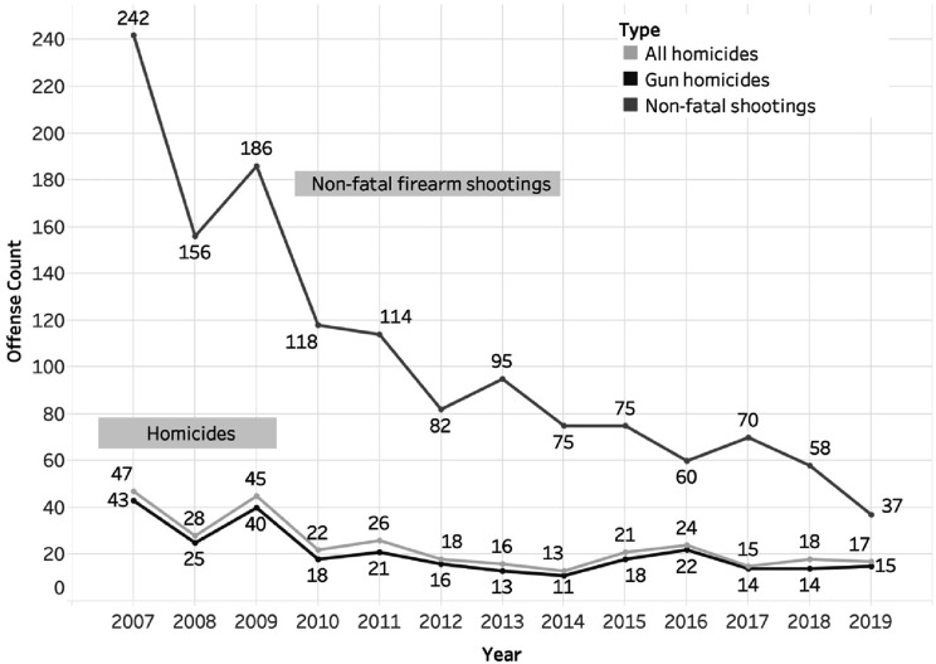
In Richmond, the effects of this community building work show up in quality-of-life measures. One of these is a significant reduction in crime, as the chart below illustrates:
Sign up for our free newsletters
Subscribe to NPQ's newsletters to have our top stories delivered directly to your inbox.
By signing up, you agree to our privacy policy and terms of use, and to receive messages from NPQ and our partners.
The Chevron settlement money also supports city services by providing nearly a quarter of the city’s budget. Through sustained collective action, Richmond has proven that communities, through local action, can impact the extractive flow of capital.
How and Why Does Local Agency Work?
None of Richmond’s progress would have been possible without RPA continuously mobilizing people to advocate in public forums and run for office. Nonprofit groups such as Communities for a Better Environment (CBE), the Asian Pacific Environmental Network (APEN), West County Toxics Coalition, Alliance of Californians for Community Empowerment (ACCE), Reimagine Richmond, and many more have mobilized members for over 20 years to support this vision.
Collective work requires both relational and financial resources. While advocacy movements like RPA can leverage volunteer hours, acquiring property for a cooperative requires capital.
Funding bodies like community development financial institutions (CDFIs), credit unions, green banks, and state-level grants can connect local groups with public investment. These funds can be leveraged to support circular economies, rather than reinforcing the role of philanthropy in alleviating the symptoms of extractive markets.
By decentralizing power and redistributing decision-making, organizations can reduce vulnerability to political volatility.
What Are the Challenges?
This type of work is neither easy nor quick. RPA has seen volunteer participation ebb and flow. By contrast, institutional actors can leverage decades of accumulated capital and political influence. In Richmond, oil and banking lobbying groups have poured millions into fighting local power reclamation, often shaping public narratives and election outcomes.
Across the lifecycle of collective initiatives, funding sources fluctuate with changes in political leadership. Locally, inhospitable policy environments can slow progress and undermine grassroots momentum. Local governments often create permitting and other bureaucratic hurdles that hinder local groups’ autonomy over shared resources.
Despite these challenges, movements like RPA show that long-term persistence and collective structure can pay off. Building trust, communication, and shared goals among groups is just as essential as financial resources. Without this foundation, even well-funded initiatives risk fragmentation and burnout.
As solidarity economies, cooperatives, and coalitions continue to grow, they redefine development as something done with communities rather than to them.
Yet these obstacles also reinforce why community-based ownership and governance matter. By decentralizing power and redistributing decision-making, organizations can reduce vulnerability to political volatility and strengthen their ability to sustain life with localized systems.
Three Pathways to Restoring Agency
Restoring collective agency requires more than advocacy and achieving ownership—it demands alignment among communities, organizers, funders, and public institutions to redirect power toward local self-determination. Building this alignment requires strategies that address power imbalances and intentionally seek to break historic patterns. Agency-oriented development requires:
- Raising Collective Awareness and Power
Without awareness of cooperative ownership’s potential, action remains limited. Spreading this potential strategy is not just about outreach; it also requires rectifying power imbalances in systems.
- Decentering Funder Success Metrics
Building local control requires rethinking how success is measured, particularly by funders. Traditional metrics capture outputs—homes built, jobs created—but not shifts in power. Success metrics should focus on how success is measured by community members. This reflects the true power shift of agency reclamation.
- Empowering Investment Strategies
To truly shift power, investment must move beyond short-term programs toward long-term infrastructure that enables self-governance—redirecting capital to communities that are already engaged in designing their own futures.
Restoring agency, in short, is ultimately about more than any single project, program, or organization—it’s about returning local power to affected communities.
As solidarity economies, cooperatives, and coalitions continue to grow, they redefine development as something done with communities rather than to them. By centering shared collective rights, these movements illuminate a future where local agency is not a privilege but a foundation of development.