
September 11, 2017; MLive
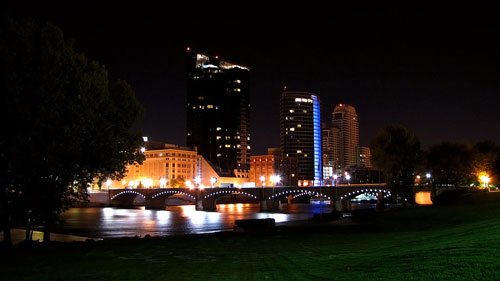
Separated by only 50 miles, Grand Rapids and Kalamazoo are mid-sized college cities in western Michigan known for their philanthropic investment in community economic development. Metro Grand Rapids has about three times the population of metro Kalamazoo (about 1 million versus 350,000), but both have been adept at leveraging philanthropic investment to rebuild their communities.
The similarities don’t stop there. Both cities are also increasingly seen as “hip” and frequently highlighted as community revitalization success stories. Both cities are majority white, but with a sizable (more than 20 percent) Black population. (Kalamazoo has a larger Latinx population.) One trivial but illustrative example of their similarities: Kalamazoo is home to an annual Craft Beer Festival, while Grand Rapids, home to quite a few craft breweries itself, claims to be “Beer City USA.”
In terms of community economic development, Grand Rapids is highly respected for its Local First initiative and its support for women-led business development. Kalamazoo’s most publicized philanthropic effort is its Kalamazoo Promise program, which covers, for qualifying graduates from the public schools, up to four years of tuition (in state) and mandatory fees for post-secondary education. Launched in 2005, in the first decade the program raised $66 million to support student tuition, helping increase the percentage of public school students obtaining a bachelor’s degree within six years of high school graduation from 30 to 40 percent.
Yet despite these similarities, the cities have very different philanthropic cultures, as a 2017 study from Grand Valley State University’s Dorothy A. Johnson Center for Philanthropy explains. It would appear that in philanthropy—as in community organizing, or in sales, as The Music Man makes clear—you gotta know the territory.
So, what are the Grand Rapids and Kalamazoo paths? And do they hold any lessons for the rest of us who live in neither of those Michigan cities?
Addressing the first question is the study’s primary focus. Both Kalamazoo and Grand Rapids prioritize the arts and education, the study’s authors note. But the way they go about their fundraising is vastly different. Fundraising in smaller Kalamazoo, the study notes, is based largely on informal social ties and networks; many donations are made anonymously, in part because people don’t need to be named for the community to know who is donating. By contrast, in Grand Rapids, fundraising occurs much more as might be considered more standard urban-based philanthropy, with buildings named after donors and so on. As Malachi Barrett of the Kalamazoo News explains:
Sign up for our free newsletters
Subscribe to NPQ's newsletters to have our top stories delivered directly to your inbox.
By signing up, you agree to our privacy policy and terms of use, and to receive messages from NPQ and our partners.
Interviewees in the study noted that major givers in Kalamazoo are networked through informal connections—many are related or grew up as family friends. This is in contrast to Grand Rapids, where deep-pocketed donors have more formal networks, attend more fundraising events, and engage more publicly in charity organizations, political groups and clubs.
Other differences follow from this fundamental distinction. Barrett notes, for example, that “while Grand Rapids donors become identified with a single institution—The Richard and Helen DeVos Foundation is closely associated with the Grand Rapids Symphony, the Van Andel Fund with the Grand Rapids Public Museum—major donors in Kalamazoo spread their gifts across diverse organizations.” Barrett adds that among top private foundations in Kalamazoo, higher priority is placed on giving to civil rights and advocacy causes, largely due “to giving by the Arcus Foundation for LGBTQ civil rights causes, and the Ravitz Foundation for advocacy to fight Antisemitism.”
Additional distinctions speak to the importance of local historical and cultural traditions. Grand Rapids is a more religious community, and church-affiliated universities are a major focus of philanthropy. Kalamazoo, by contrast, is marked by corporate giving, “with the former Upjohn Pharmaceutical Company, now under Pfizer, and Stryker Corporation playing standout roles.” The corporate history of Kalamazoo also speaks to the strong presence of “old money.”
For example, a single donor, Jon Stryker, has donated a total of $336.3 million since 2000, with at least $168 million going to a single agency, the Arcus Foundation. This year, two donors gave $70.3 million as “lead donations” for a $500 million fundraising campaign for the Kalamazoo Foundation for Excellence, which aims to support the city government’s ability to provide better public services for city residents. Clearly, not every mid-sized community of 300,000 has available donors with this kind of wealth to invest.
Kalamazoo Community Foundation President Carrie Pickett-Erway underscores the informal peer-based networks central to Kalamazoo philanthropy: “[High-value donors] serve on boards together; their social circles connect; they’re often sharing exciting stories from the investments they make. I think the particular investors in those early stages makes a difference if it aligns with your values and also the size. [A] significant initial investment [makes] you think ‘wow, they really have confidence in the entity and the goal seems worthy.”
The Grand Valley State study authors do not make a claim for either an informal or a formal approach being better—each has plusses and minuses. The informality of Kalamazoo giving may lead to more “transformational” projects (such as the Kalamazoo Promise or the current Foundation for Excellence capital campaign), while the more formal giving structure of Grand Rapids might be more inviting for newcomers, for instance.
But the more important finding is this: Know your community. As the study authors note, “In both Grand Rapids and Kalamazoo, the philanthropic patterns of how, why, and where people give seem to have persisted over time.” This finding, of course, has broad implications that extend far beyond western Michigan. Clearly, funding norms differ depending on community history, region, class, gender, race, and many other factors. Asset mapping isn’t just a useful strategy for community building. It is an essential part of effective fundraising as well.—Steve Dubb