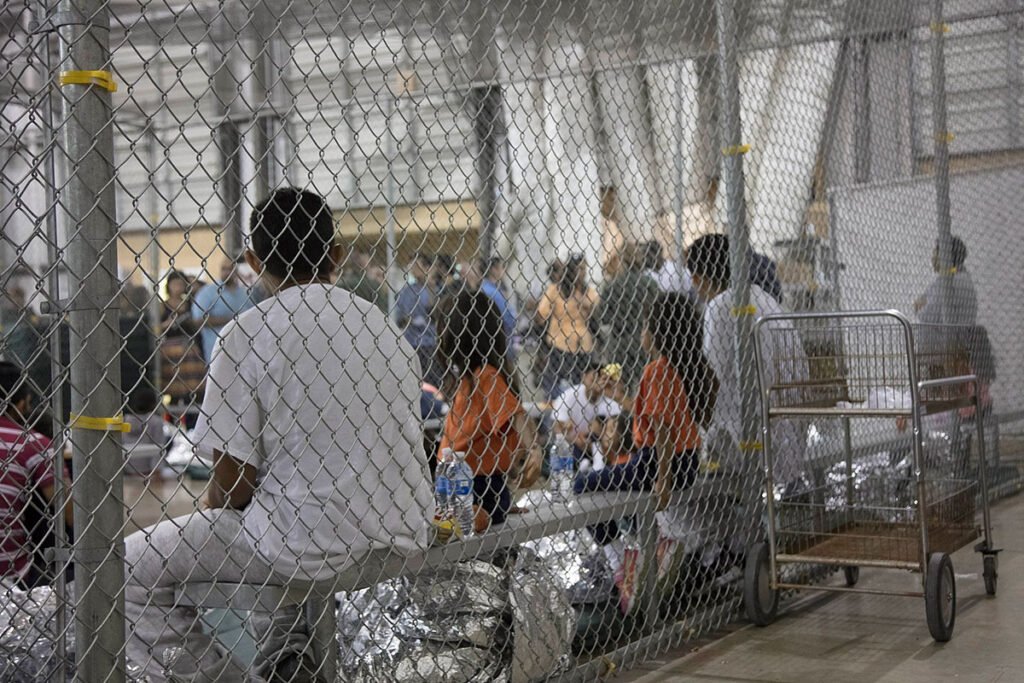
In March 2025, it was 21-year-old Hector, who has developmental disabilities, left confused and unable to communicate in an immigrant detention facility in Tacoma, WA. Then that August, a 15-year-old boy with disabilities was handcuffed by ICE agents in what they now claim was a “mistake” while the child waited for his sister in a car with his mother outside a school. His family is suing the Trump administration for assault.
His story is not an uncommon one. Just this week in Minneapolis, multiple ICE agents pulled a woman from her car and restrained her, while she told them she was disabled and simply trying to get to her doctor’s appointment. Across the country as ICE agents, given more leeway and little to no oversight by the second Trump administration, push into communities, target construction workers at their jobs, and abduct parents at their children’s schools, people with disabilities face an increased threat of violence at the hands of the federal immigration enforcement agency.
A Violent Record
Law enforcement across the board has a violent record when it comes to the treatment of people who are disabled. It has been estimated that half of the people killed by law enforcement officers are disabled. The risk of violence at the hands of law enforcement increases for disabled people of color.
It was 35-year-old Magdiel Sanchez in 2017, shot by police despite bystanders yelling that he couldn’t hear them. It was 65-year-old Yia Xiong in 2023; after his death, protestors held signs and chanted, “I am deaf, don’t shoot.” A year earlier, it was Javarick Gantt, who was murdered by his cellmate while in a Baltimore jail for minor charges. Despite requests, he had not been provided an interpreter and could not understand court proceedings.
All of these victims were deaf or disabled, and all were people of color.
Gantt, 34, was Black and weighed just a little over 100 pounds. When his much larger cellmate, who had a history of severe and random violence as well as mental health issues, attacked him, CBS wrote that Gantt “wasn’t able to call for help because he communicated primarily by sign language.”
The Foundational Framework of Ableism
That Gantt was under the same security considerations as a man in jail for a violent stabbing speaks to serious administrative failures, according to a lawsuit filed by Gantt’s family, arguing the deaf man “should have received special accommodations and safety precautions.”
The lack of communication accommodations or monitoring underscores the ableism in law enforcement, discriminatory views and social prejudice which also run rampant in ICE. As Kristin Garrity Sekerci and Azza Altiraifi wrote in Al Jazeera in 2017, during Trump’s first term: “Ableism and white supremacy form the foundational framework of US immigration policy.”
Sekerci and Altiraifi characterized ableism as the “co-foundational framework for immigration exclusion in the US….Namely, discourses and structures that have created a process and system by which people have been banned based on real and perceived mental and physical disabilities, as well as for prevailing notions of inferiority, deviancy, threat and unproductivity.”
In this cultural context, it is clear that those who are disabled do not receive the same care and consideration as those who are nondisabled. In multiple incidents, disabled people have been denied interpreters, other communication tools, or medical care in ICE custody, according to an August 2025 letter filed by 30 Democratic lawmakers, led by Representatives Julia Brownley and Judy Chu of California.
The letter detailed multiple experiences of mistreatment of disabled people by ICE agents and while in ICE custody. Many of the abused detainees are deaf and were provided no interpreters. In multiple cases, they were eventually allowed interpreters for the wrong language.
One person was not permitted a new hearing aid when theirs broke. Another was not allowed to clean a prosthetic eye, a routine requirement to prevent infection. People with diabetes who were detained were not allowed to monitor their blood sugar or have diabetes-friendly meals.
Answers and Accountability
Denying disabled people accommodations is denying their basic rights. On multiple occasions, ICE has engaged in inhuman treatment when apprehending people who are disabled.
In July of 2025, ICE agents violently threw Vidal Palomar, who uses a cane due to a work-related disability that impacts his ability to walk, onto the ground multiple times.
“It was a brutal thing,” Vanessa Perez, Palomar’s cousin, told ABC.
Palomar was driving himself to a physical therapy appointment when he was apprehended by ICE. In another interview, Perez recalled how ICE agents “broke [Palomar’s] window, pulled him out of the car. They slammed him to the ground (injuring him on the broken glass), they picked him up and slammed him on the hood of their car….He let them know he was disabled, but they didn’t care.”
Sign up for our free newsletters
Subscribe to NPQ's newsletters to have our top stories delivered directly to your inbox.
By signing up, you agree to our privacy policy and terms of use, and to receive messages from NPQ and our partners.
Palomar uses prescription pain medication, but he has not been provided his medication in ICE custody, another common abuse faced by people detained by ICE.
The Guardian reported on overcrowded detention centers, where people face increased risk of illness and infection. Nearly 48,000 people are currently detained across the United States, the highest number since 2019.
One of them is Rodney Taylor, a double amputee. In an immigrant detention center in Georgia, Taylor was not allowed to see a doctor for days. His prosthetic legs ran out of batteries and he was unable to walk, including to get food.
As Taylor’s attorney Sarah Owings told The Guardian about the mistreatment of disabled people like Taylor by immigration enforcement: “It’s all happening in the dark.”
The August 2025 letter calls for answers and accountability from the US Department of Homeland Security on the treatment of disabled people in immigration custody, to provide transparency into the specific conditions detained people are facing.
Multiple nonprofits are assisting people in this time of high detainment, many of them focused on legal rights and representation, including The National Immigrant Justice Center and Amica Center for Immigrant Rights. Both groups work to secure releases or protection for people whose disabilities make detention particularly harmful or unlawful.
Disability Law United’s Immigration Detention Accountability Project focuses specifically on disability justice and immigration detention, using litigation, legal representation, and advocacy to challenge inadequate care, lack of disability accommodations, and unlawful detention.
As Matt Adams, a spokesperson for the Northwest Immigrant Rights Project, told The Seattle Times, “People are arrested and instead of looking at their individual circumstance, they’re just counted as another number. ICE is no longer using common sense in making determinations about who should be locked up.”
For More on This Topic:
What Nonprofits Need to Know About ICE in Schools
School Drop-off and Pickup in the Age of ICE
Disability Under Trump’s Anti-DEI Agenda