

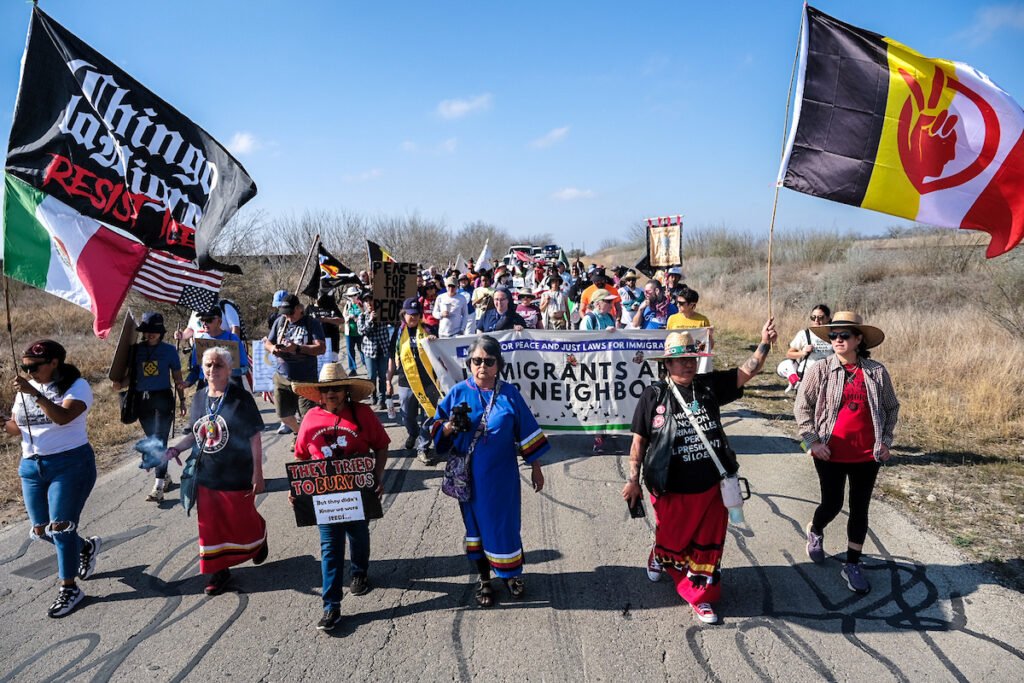
Notes from the Frontlines highlights the stories, needs, and solidarity of organizations on the frontlines in the struggle for a multiracial and equitable democracy in the United States. Each installment will explore how organizations are responding to the current political landscape—and what the entire nonprofit and philanthropic ecosystem can do to support them.
In the beginning of March 2026, Alix Webb and Mike Ishii joined community and faith leaders from around the country on a 90-mile march from the Dilley immigrant detention facility to San Antonio, TX, to raise awareness about the surge in child detention by the Department of Homeland Security (DHS). Webb and Ishii represent organizations that are part of the National Coalition to End Child Detention, a network that evolved from campaigns formed in response to the first Trump administration’s efforts to separate families and children in 2018.
Ishii is the director of Tsuru for Solidarity, a national Japanese American organization that advocates for the end of forced removal and family separation. Webb, chief of staff at the Kairos Center for Religions, Rights, and Social Justice, said that one of the motivations for the march is to ensure that people understand how rapidly the child detention industry is expanding.
“People in Pennsylvania don’t know what’s happening in New Jersey, let alone Kansas or Oregon or Texas,” she told NPQ. “We are bringing faith and community leaders together to spread information about how the situation today is much worse than it was in 2018.”
Under the Trump administration’s “zero-tolerance” policy in 2018, more than 2,300 children were separated from their parents at the US–Mexico border. As of January 2026, the Marshall Project found that ICE is holding around 170 children, a sixfold increase from the Biden administration, with Dilley being the main site for family detention.
At least 3,800 children have been detained since January 2025 with 1,300 of them being held beyond the 20-day limit for child detention, as established under the 1997 Flores settlement agreement. Advocates report abhorrent conditions in detention centers including measles outbreaks, inadequate drinking water and food, lack of medical care, and only one hour of schooling per day.
“For more than 30 years, there had been policies restricting immigration enforcement in sensitive places such as schools, childcare centers, hospitals, and places of worship,” Wendy Cervantes, director of immigration and immigrant families at the Center for Law and Social Policy (CLASP), told NPQ.
“Feeling isolated and hopeless about whether they will ever be released, some children ask to return to the very countries they fled.”
“In our research talking to parents of young children and early childhood providers over the past year, we have heard how the constant worry and fear parents are feeling is trickling down to their kids, with children as young as three exhibiting behavioral changes such as regressions in talking, changes in sleeping and eating habits, and increased anxiety about saying goodbye to their parents,” Cervantes said. “A late pick-up now drives once calm toddlers and kids to panic attacks as they believe their mom or dad has been taken.”
Beyond the Headlines
Cases like that of five-year-old Liam Ramos have drawn public outrage and attention to the effects of immigration enforcement on children. But advocates say that the impact extends far beyond the headlines and affects a wide range of children, from unaccompanied minors navigating the immigration system alone to millions of children living in mixed-status families.
Cory Shindel, deputy director of policy at Kids in Need of Defense (KIND), monitors the treatment of unaccompanied migrant children who arrive in the United States without a parent or legal guardian. In 2024, there were an estimated 87,475 unaccompanied children in the United States.
“What I wish people understood is that immigration enforcement is affecting children who are US citizens and legal permanent residents as well.”
“Many children are now detained for six months or longer in institutional care settings that are not designed for long-term stays,” Shindel told NPQ. “Feeling isolated and hopeless about whether they will ever be released, some children ask to return to the very countries they fled—even when they have serious protection needs.”
Immigration enforcement is also reshaping the lives of children who live in mixed-status families: households that include people with different immigration statuses. According to the policy organization FWD.us, there are nearly 9.7 million US citizens living with one or more undocumented and/or temporarily protected immigrants.
Trudy Taylor Smith, senior administrator for policy and advocacy at the Texas Children’s Defense Fund, works with mixed-status families who are navigating a range of complex concerns. “What I wish people understood is that immigration enforcement is affecting children who are US citizens and legal permanent residents as well,” Taylor Smith told NPQ.
In Texas, the Migration Policy Institute has found that 34 percent of all children have at least one foreign-born parent.
Sign up for our free newsletters
Subscribe to NPQ's newsletters to have our top stories delivered directly to your inbox.
By signing up, you agree to our privacy policy and terms of use, and to receive messages from NPQ and our partners.
“Families with US-citizen children who are eligible for public benefits are disenrolling because they worry that their data is being shared with ICE, or they are declining to enroll in the first place,” Taylor Smith said. “This means children are deprived of healthcare and proper nutrition at crucial stages in their development. It’s going to impact their physical and emotional wellbeing and lifelong academic achievement.”
The Toll on Nonprofit Organizations
As families confront these realities, the nonprofit groups that support them are also facing increasing strain.
“Over the last year, interruptions to and uncertainty about federal funding supporting legal services for unaccompanied children, as provided for by congressional appropriations and federal antitrafficking law, have created significant challenges for children and organizations alike at a time when these services have never been more necessary,” noted Shindel.
As a result of federal funding blocks, nonprofit organizations from Michigan to Delaware to Texas have had to lay off staff and reduce vital programs. Organizations are also shifting resources to align their materials and trainings with the current climate.
“What gives me hope in these very dark times are the many ways communities are showing up.”
“In our work with parents, it has been particularly devastating,” said Cervantes. “Many parents were asking how to talk to their kids about deportation, so we published a resource on that, specific to how to talk to kids of various ages and developmental abilities. Another painful shift has been moving our conversations around family preparedness planning to when—not if—a parent is deported.”
Solidarity as Hope
One development advocates noticed is that the response is no longer limited to them. Pediatricians, mental health providers, social workers, educators, and faith leaders, as well as everyday people, are increasingly raising the alarm and speaking out about the consequences of immigration enforcement on the wellbeing of children and families.
“What gives me hope in these very dark times are the many ways communities are showing up for kids and families who are being harmed,” Cervantes said. “In every community I’ve been in, I have seen the moms and teachers delivering food to homes, organizing carpools, and watching guard over routes to school.”
The community care being practiced in cities around the country also extends to institutions. “This is absolutely a moment for deepening solidarity across movements so we can build the power needed to shift systems and end the practice of family and child detention for good,” Kristin Kumpf, the coordinator of the National Coalition to End Family and Child Detention, told NPQ.
For Mike Ishii of Tsuru for Solidarity, the work carries a deeply personal resonance. His mother was 10 years old when she and 20 members of their family were forcibly removed from their home in Seattle, WA, to an incarceration camp during World War II.
“Half of the 125,000 Japanese Americans who were incarcerated during the war were children,” Ishii told NPQ. “What country claims to be a democratic champion of human rights and runs the largest federal carceral system in the world, rife with violence and the denial of civil liberties?”
For More on This Topic:
What Nonprofits Need to Know About ICE in Schools
Giving Birth Under Surveillance: Migrants, ICE, and Obstetric Violence
School Drop-off and Pickup in the Age of ICE