

“This story was originally published by Grist. Sign up for Grist’s weekly newsletter here.”
Scientists are pretty sure that Earth is hotter than at any time in the last 125,000 years, but the news media is moving on, trying to keep on top of a fire hose of pressing news — from the daily chaos of the Trump administration to the breaking developments in the war on Iran. The shift in attention started during the COVID-19 pandemic and, despite a temporary rebound, has gathered pace in recent years: Since its peak in 2021, global news coverage of climate change has dropped 38 percent, according to data from the University of Colorado Boulder’s Media and Climate Change Observatory.
Many journalists have been busy digging through 3 million pages of the Epstein files rather than the latest scientific report, though you can still find news about some of the biggest recent findings, including that estimates of sea level rise have been dramatically underestimated and that global warming has accelerated “significantly” over the past decade.
Last year, the first of Trump’s second term, major broadcast networks in the U.S. cut their climate coverage 35 percent compared to the year before, according to a recent report by Media Matters, a watchdog organization. “The competition, the ‘flood the zone’ strategy from the administration, is making it very difficult for anything that’s not super urgent in this moment,” said Allison Fisher, director of the climate and energy program at the nonprofit.
The change in focus has real-world consequences. When media coverage of a topic dies down, it can be hard to drum up enthusiasm for protests and policy changes. It’s out of sight, out of mind, said Anthony Leiserowitz, director of the Yale Program on Climate Change Communication. Normal people don’t spend their time reading scientific papers or talking to a climate scientist over their backyard fence. “Like, literally, billions of people know about climate change only because the media has reported it,” Leiserowitz said.
When writers and editors prioritize — or deprioritize — a particular subject, that sends a signal to both policymakers and the public. “They exercise one of the very most powerful tools in politics, which is to define what topics are talked about and what topics are not talked about, and within that, what range of opinion is ventilated on those topics,” said Mark Hertsgaard, the co-founder and executive director of Covering Climate Now, a nonprofit pushing for more rigorous coverage of climate change. “So of course, when we stop talking about climate change in the press, the public figures, ‘Oh, well, I guess it’s not that important anymore,’ or ‘Maybe they figured it out’ or whatever.”
You can see the recent downswing in climate coverage in the U.S. by looking at some of the country’s biggest legacy newspapers: The New York Times, The Wall Street Journal, The Washington Post, and the Los Angeles Times. While the New York Times has published an enormous volume of articles about global warming, its coverage has plunged, declining by 66 percent since its peak in October 2021, when it published 646 articles mentioning the subject, and this January, when it published 221.
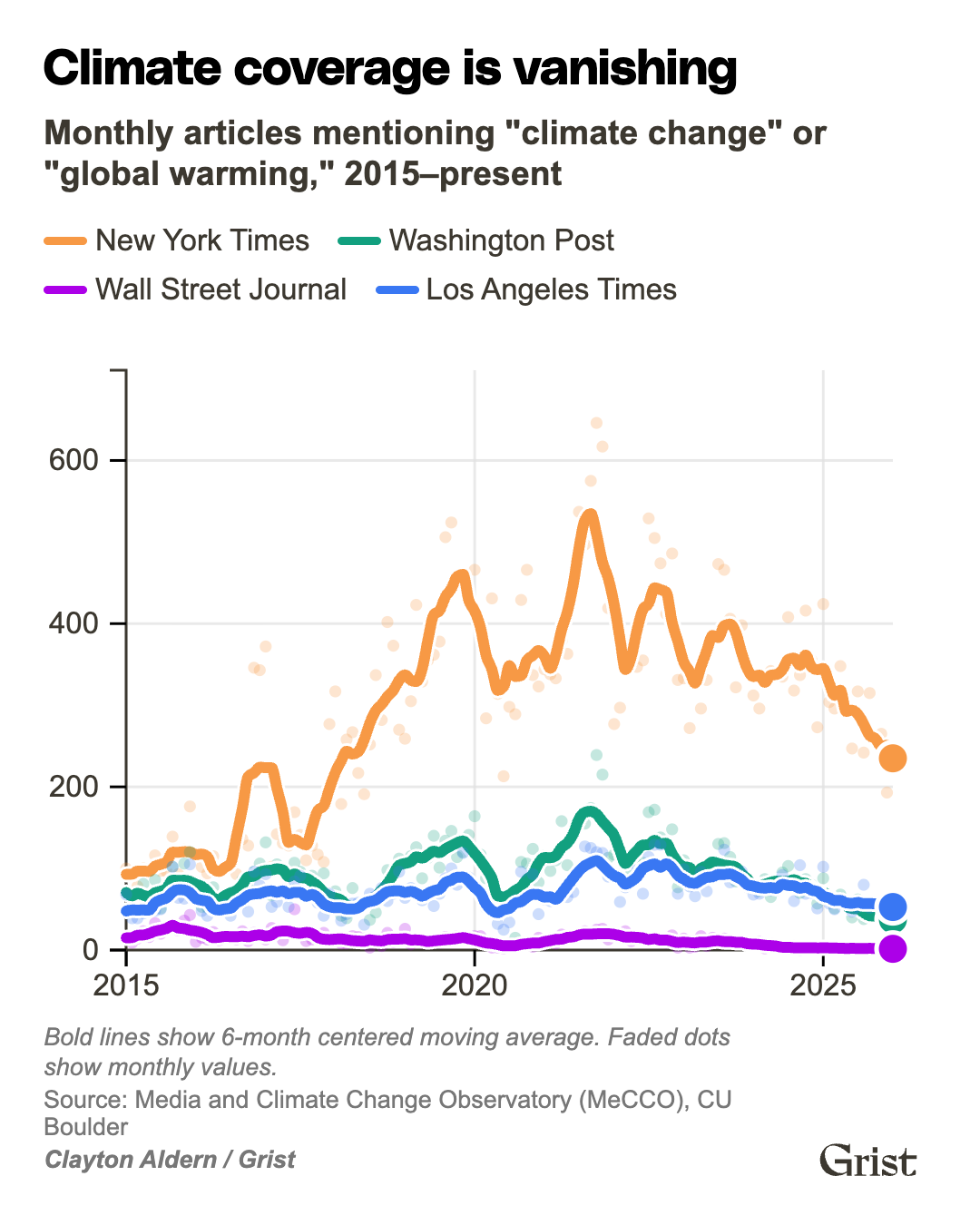
Layoffs have swept across the news industry, with The Washington Post dismissing the majority of its climate team last month, more than a dozen reporters and editors, as part of extensive cuts. Max Boykoff, an environmental studies professor at the University of Colorado Boulder who tracks media coverage, suggested that newsroom decisions to shift their attention away from climate change could be driven by a sense that there’s “climate fatigue” among the public — a weariness around a long-running crisis with no easy solutions. “Editors may be assessing that and putting people on different beats,” he said. The waning enthusiasm from outlets to highlight climate stories has frustrated some journalists: The longtime NBC climate reporter Chase Cain recently resigned from his role, saying he was exhausted from fighting to get his stories on air.
Leiserowitz, at the Yale Program on Climate Change Communication, stressed that the number of Americans who are worried about climate change and want action to cut emissions hasn’t really budged. Even though climate change is a lower priority for voters than it used to be — number 24 out of 25 issues, according to data from the Yale program — that’s mainly because other issues have risen in importance. For liberal Democrats in particular, that includes the protection of democracy, the treatment of immigrants, and the disruption of government services. “It’s just that all these other issues have now leapfrogged above climate change as a voting issue priority,” Leiserowitz said.
Hertsgaard argues that there’s a huge audience out there waiting for more articles about life on a warming planet. Some 80 to 89 percent of people globally — and 74 percent in the U.S. — want their governments to take stronger action on climate change, according to surveys. Outlets around the world are leaning into climate coverage, gaining audiences and making money from it, he argued, pointing to The Guardian and France Télévisions, the French public broadcaster, which saw its ratings improve after incorporating climate change into its weather forecasts. “If you are a smart newsroom, you will recognize that this is a business opportunity, not just a journalistic duty,” Hertsgaard said.
Still, experts said that the big-picture trends driving the decline in coverage of the climate will be tough to turn around in the near future, even as extreme weather continues to draw attention to the consequences of a warming planet. As long as Trump’s in office, there’s likely to continue to be intimidation of the media, climate hushing, and a steady stream of chaos in the news crowding out climate stories, Fisher said.
Leiserowitz, though, is hopeful that the public won’t forget what they learned back when the mainstream media started covering the crisis in earnest. “Just because it’s not being talked about in the media,” he said, “doesn’t mean that it suddenly disappeared or it’s been wiped out of their memory banks.”
This article originally appeared in Grist at https://grist.org/language/global-heating-climate-news-drought-chaos/.
Grist is a nonprofit, independent media organization dedicated to telling stories of climate solutions and a just future. Learn more at Grist.org