logo logo
giving banner
Donate
    • Membership
    • Donate
  • Social Justice
    • Racial Justice
    • Climate Justice
    • Disability Justice
    • Economic Justice
    • Food Justice
    • Health Justice
    • Immigration
    • LGBTQ+
  • Civic News
  • Nonprofit Leadership
    • Board Governance
    • Equity-Centered Management
    • Finances
    • Fundraising
    • Human Resources
    • Organizational Culture
    • Philanthropy
    • Power Dynamics
    • Strategic Planning
    • Technology
  • Columns
    • Ask Rhea!
    • Ask a Nonprofit Expert
    • Economy Remix
    • Gathering in Support of Democracy
    • Humans of Nonprofits
    • The Impact Algorithm
    • Living the Question
    • Nonprofit Hiring Trends & Tactics
    • Notes from the Frontlines
    • Parables of Earth
    • Re-imagining Philanthropy
    • State of the Movements
    • We Stood Up
    • The Unexpected Value of Volunteers
  • CONTENT TYPES
  • Leading Edge Membership
  • Newsletters
  • Webinars

Who Is the “Neighborhood” in Neighborhood Improvement Efforts?

Martin Levine
October 3, 2018
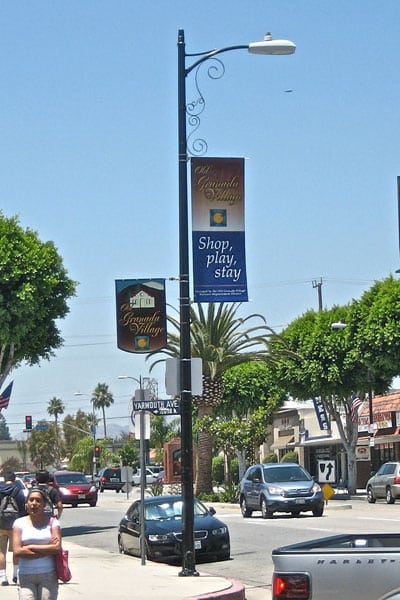
“Granada Village Business Improvement District,” Big City Signs

October 1, 2018; Next City and Reimagine!

We see the essence of vibrant democracy when community members organize to work with—or even to pressure—local government to get civic services they feel they need to improve their neighborhoods. But when community-based nonprofit organizations replace local governments and take on the functions of government, is it a step too far? What about if these organizations represent only a segment of the communities where they exert control? The results of a recently published study of California’s BIDs and CBDs raise this very question.

Business Improvement Districts (BIDs) and Community Benefits Districts (CBDs) comprise business and property owners in designated geographic areas who have organized for neighborhood improvements. They emerged in the 1960s to help struggling urban areas as city governments faced mounting financial challenges and business districts felt the impact of decreasing public services. Organized as 501c3 or 501c4 organizations, they empower their members to levy taxes and special fees within their boundaries and directly allocate these funds with little or no civic oversight for improved street cleaning, increased policing, infrastructure improvements, and other services traditionally within the sole purview of city governments. Unlike city governments, not every resident has a vote and a say in the specific policies and practices of each BID/CBD. Nationally, there are now more than 1,000 BIDs and CBDs, collecting and spending millions of dollars annually.

The new study, conducted by the Policy Advocacy Clinic at UC Berkeley School of Law, found that California’s BIDs and CBDs often work against the interests of those who are homeless. According to Next City’s reading of the study’s findings, “The growth of BIDs ‘correlates strongly’ with the increase of laws like those that ban sitting or lying down on the sidewalk during certain times of day.”

It tracks instances of individual BIDs policing homeless people or coordinating with police to confront people living on the street. And it found in a survey that more than 80 percent of BIDs identified “panhandling and loitering” as an important safety and security concern.

Seth Grossman, founder and director of the Rutgers Institute of Business District Management, told the RP&E journal Reimagine! that he “sees Business Districts as improving government accountability by shifting the taxing and spending decisions about a neighborhood to a level closer to those who have a stake in it—the business owners. They act, in effect, as a political action group.” Representatives of California BIDs and CBDs told Next City that “they want to improve their neighborhoods for the people living on the street as much as for the property owners who pay the assessments…they hire people living on the street for certain jobs and try to help others find services.” NPQ recently spotlighted Chrysalis, a L.A.-based organization serving the homeless that is successfully partnering with a BID to improve lives.

Sign up for our free newsletters

Subscribe to NPQ's newsletters to have our top stories delivered directly to your inbox.

By signing up, you agree to our privacy policy and terms of use, and to receive messages from NPQ and our partners.

But their preferred solution may be to relocate homeless people rather than address the problem of homelessness. From Grossman’s perspective,

BIDs aim to move homeless people out of the districts. “It’s a customer service district. So, they are concerned about customers. They don’t see the homeless people as customers…if they don’t see you as a customer, you are in trouble; you are either a customer or a contagion.”

Paul Boden, executive director of the Western Regional Advocacy Project, which advocates for homeless people, tells Next City that “most BIDs are just paying lip service to helping the homeless, when they really just want them out of sight.”\

BIDs only exist to tidy up downtowns and create more wealth for a select few. The groups that do engage in policy advocacy work should spend less time worrying about street-level quality-of-life issues and more time pressing for investment in permanent, affordable housing for the homeless. Simply referring a homeless person to a shelter is an empty gesture…the shelter waitlist is over 1,200 names long.

It is natural for groups with a common interest to band together, and when the economics of many core cities make effective governance challenging, it is just as natural for business interests to work toward making their businesses succeed. But, allowing them to replace rather than work with the city government risks further marginalizing those who need effective government the most.—Martin Levine


Our Voices Are Our Power.

Journalism, nonprofits, and multiracial democracy are under attack. At NPQ, we fight back by sharing stories and essential insights from nonprofit leaders and workers—and we pay every contributor.

Can you help us protect nonprofit voices?

Your support keeps truth alive when it matters most.
Every single dollar makes a difference.

Donate now
logo logo logo logo logo
About the author
Martin Levine

Martin Levine is a Principal at Levine Partners LLP, a consulting group focusing on organizational change and improvement, realigning service systems to allow them to be more responsive and effective. Before that, he served as the CEO of JCC Chicago, where he was responsible for the development of new facilities in response to the changing demography of the Metropolitan Jewish Community. In addition to his JCC responsibilities, Mr. Levine served as a consultant on organizational change and improvement to school districts and community organizations. Mr. Levine has published several articles on change and has presented at numerous conferences on this subject. A native of New York City, Mr. Levine is a graduate of City College of New York (BS in Biology) and Columbia University (MSW). He has trained with the Future Search and the Deming Institute.

More about: Community DevelopmentNonprofit NewsPolicy
See comments

Call to action
You might also like
Social Enterprise: Lessons from Down Under
Vicki Pozzebon
If Farm School NYC Closes, What Will the City Lose?
Farm School NYC and Iris M. Crawford
A Community Land Trust Movement Rises in New York City: Leadership Lessons
Deyanira Del Rio and Debra Ack
From Tenant Power to Social Housing: Pathways to a Just Housing System
Fernando X. Abarca
Resisting Gentrification in Seattle: The Fight for Community Stewardship of Land
J.M. Wong
Confronting the Private Equity Menace to Restore Housing Affordability
Dr. Seumalu Elora Raymond

Upcoming Webinars

Group Created with Sketch.
January 29th, 2:00 pm ET

Participatory Decision-making

When & How to Apply Inclusive Decision-making Methods

Register
Group Created with Sketch.
February 26th, 2:00 pm ET

Understanding Reduction in Force (RIF) Law

Clear Guidance for Values-centered Nonprofits

Register

    
You might also like
A red circle overlayed on a yellow background with three multi-colored dots on each side. In the center it reads, " Isaiah Thompson: Staff Picks for 2025"
Staff Picks for 2025: Isaiah Thompson
Isaiah Thompson
Staff Picks for 2025: Steve Dubb
Steve Dubb
A red circle overlayed on a yellow background with three multi-colored dots on each side. In the center it reads, "Alison Stine: Staff Picks for 2025"
Staff Picks for 2025: Alison Stine
Alison Stine

Like what you see?

Subscribe to the NPQ newsletter to have our top stories delivered directly to your inbox.

See our newsletters

By signing up, you agree to our privacy policy and terms of use, and to receive messages from NPQ and our partners.

  • About
  • Advertise
  • Careers
  • Contact
  • Copyright
  • Donate
  • Editorial Policy
  • Funders
  • Submissions

We are using cookies to give you the best experience on our website.


Nonprofit Quarterly | Civic News. Empowering Nonprofits. Advancing Justice.
Powered by  GDPR Cookie Compliance
Privacy Overview

This website uses cookies so that we can provide you with the best user experience possible. Cookie information is stored in your browser and performs functions such as recognising you when you return to our website and helping our team to understand which sections of the website you find most interesting and useful.

Strictly Necessary Cookies

Strictly Necessary Cookie should be enabled at all times so that we can save your preferences for cookie settings.