In October, roughly 10,000 people from 109 countries descended on Bordeaux, France, for the Global Social and Solidarity Economy Forum (GSEF)—a gathering dedicated to reimagining economies around cooperation, equality, and sustainability. Banners across the city proclaimed, “Another World Is Already Here.”
The setting—Bordeaux, a global wine capital and a former center of the Atlantic slave trade and colonial wealth—offered both inspiration and irony. The forum showcased a global movement for economic democracy, yet it also exposed the racial and colonial fault lines that persist within it. While many sessions encouraged deep reflection, the makeup of participants underscored whose voices remain sidelined—and whose histories continue to be erased.
US Absence—and Presence
Although President Donald Trump and his regime’s assaults on democracy, human rights, and multilateral cooperation loomed large, US participation at the forum was minimal. Out of 169 workshops and 13 plenaries, only five speakers came from the United States.
US social justice organizers…tend not to appeal beyond their own federal government.…It may be time for US organizers to reconsider that stance.
Organizers noted that US involvement has historically been low. Unlike many nations that maintain dedicated offices for the social and solidarity economy (SSE), the United States has few government entities with such a focus. Cities like Richmond, VA, and Rochester, NY, have set up offices of community wealth building; and New York City, Chicago, Madison, WI, and the San Francisco Bay Area support cooperative initiatives—but comprehensive, people-centered policies linking cooperatives, land trusts, and mutual aid networks remain rare.
This dynamic may partly explain the low US participation rates but it’s likely only a small part of the reason as US social justice organizers tend to participate in global forums at lower rates generally. Another contender for low US turnout that doesn’t get much discussion is the fundamental tendency of US social justice organizers to view international bodies such as the United Nations as incapable of holding the United States accountable, by design, and thus not worth engaging. It is for this reason that while many in the rest of the world fight for human rights and appeal to international bodies to hold their governments accountable, US social justice organizers largely stay within the framework of civil rights and tend not to appeal beyond their own federal government.
With Trump’s consolidation of power, authoritarian militarization of immigration enforcement, and the suppression of dissent, it may be time for US organizers to reconsider that stance—and to seek solidarity beyond the border.
Africa in the House—but Only Partly
Africa’s presence at the forum was strong, at least in numbers. Speakers represented nearly half the nations of the continent, home to over 1.5 billion people. But the overwhelming majority hailed from French-speaking countries—either former colonies such as Senegal, Morocco, and Ivory Coast, or current French colonies like Réunion and Mayotte.
The African Forum for the Social and Solidarity Economy[’s] plans for a network of university-based centers…signal a determination to build an Indigenous knowledge infrastructure for the solidarity economy.
Despite the end of colonial rule for most of the African continent, the influence of Paris still looms large in African economic and political affairs, a fact that has spurred the recent wave of expulsions of the French military from several West African nations. While gaining political and military independence, African countries have largely been unable to break the yoke of economic dependence. If Africa’s point of entry for a global forum aimed at cultivating alternatives to capitalism is its colonizer, where does that leave the continent in its efforts to end the extraction of its wealth?
One hopeful development came from the African Forum for the Social and Solidarity Economy (FORA’ESS), which announced plans for a network of university-based centers that will collect data, elevate African cooperative models, and strengthen intra-African trade, which currently accounts for only 14 percent of the continent’s commerce. The initiative, endorsed by all but two African countries, signals a determination to build an Indigenous knowledge infrastructure for the solidarity economy.
Latin American Erasure of Afrodescendant and Indigenous Peoples
If Africa’s participation in the forum was shaped by colonial relationships, Latin America’s delegations revealed how White supremacy continues to define the region’s public face.
Representatives from Brazil, Colombia, Ecuador, Guatemala, Mexico, Uruguay, Bolivia, Argentina, and Costa Rica were overwhelmingly White, with few visible Indigenous or Afrodescendant participants. This absence mirrors the racial hierarchy that dominates Latin American politics, media, and economics—where Whiteness remains the unspoken norm and Indigenous and Black communities are systematically marginalized.
The omission is particularly troubling because many of the region’s most vibrant cooperative traditions—Rotating Savings and Credit Associations (ROSCAs), communal land management, and mutual aid associations—are central to the lives of Black and Indigenous communities. Their exclusion from the forum, intentional or not, sent a clear message: Even within the solidarity economy, the colonial racial order persists. Those who have practiced cooperation the longest remain the least recognized by global platforms meant to uplift them.
The Denigration of the “Informal”
Throughout the forum, there was a noticeable pervasive bias against the so-called informal economy, including cooperatives operating without state recognition. Despite their complex structures and impacts on the lives of millions of people across Africa, Asia, and the Americas, these “informal” cooperatives—rooted in mutual aid—were often treated as “transitional” rather than legitimate.
ROSCAs, where members pool their savings and take turns distributing those savings equally among themselves, may be “informal,” but they are vital to economic life. Known by many names, ROSCAs make savings possible for those, mostly women, that formal banks typically ignore, using approaches that center building relationships.
But because ROSCAs are not recognized by the state, they are often regarded with suspicion. In Canada’s overpoliced Black immigrant communities, ROSCA members have reported having their savings stolen by police under the assumption that they are laundering money from illegal drug sales. As a result, members of ROSCAs in Toronto came together in 2020 to form the Banker Ladies Council to advocate for the recognition of ROSCAs as cooperatives and a vital form of mutual aid within the Canadian financial sector.
In Colombia’s predominantly Black Pacific Coast region, groups of families collectively mine gold by hand, dividing the yield equally. These shared labor pools have sustained communities for generations without harming the environment. Despite this, they are not recognized as cooperatives, are not represented by cooperative federations, and are left vulnerable to violence and displacement by multinational mining corporations backed by paramilitary forces.
Many such “informal” cooperative practices have endured precisely because they provide a means of survival against systems that have criminalized Black self-determination. From the Garifuna territories of Central America to the Palenques of Colombia, the Maroon villages of Suriname, and Quilombos of Brazil, thousands of collectively managed Black lands continue to thrive by keeping their distance from governments that once sought to erase them.
Sign up for our free newsletters
Subscribe to NPQ's newsletters to have our top stories delivered directly to your inbox.
By signing up, you agree to our privacy policy and terms of use, and to receive messages from NPQ and our partners.
As K’adamawe Knife, a researcher of social entrepreneurship at the University of the West Indies in Jamaica, noted during one session in Bordeaux, “Informality does not mean ‘not good.’ Without the informal sector, the formal economy would crash.”
Yet policymakers often seek to formalize these practices—as reflected in the 2023 GSEF theme, “The Transition from ‘Informal’ Economies to Collective and Sustainable Economies.” Such framing casts the “informal” as incompatible with shared ownership and sustainability, a problem to be solved rather than a system to be valued.
Missing Conversations and Colonial Echoes
In Bordeaux, vital conversations were conspicuously absent. Decolonization was rarely mentioned. Reparations—despite the African Union’s designation of 2025 as the “Year of Reparations”—never surfaced.
It was a glaring silence, particularly in a city that built its fortune on the African slave trade, becoming France’s second-largest slave port after Nantes. Bordeaux’s celebrated 18th-century architecture was financed largely by slavery.
To speak of solidarity and building a just economy in such a city without confronting the legacy of slavery and the demand for reparations is to seek reconciliation without truth.
Walking through Bordeaux, I saw how colonial narratives still permeate the cityscape. In a travel-themed boutique, a vintage poster of Africa displayed arrows pointing from France’s African colonies toward France, each labeled with specific exported raw materials—minerals, cocoa, coffee, sugar, and more.
That image, with its unapologetic centering of Europe, echoed what I witnessed inside the conference halls: a solidarity economy movement that still struggles to decenter Whiteness.
Calling In the Global North
As a plenary speaker, I chose to confront these dynamics directly. Before the entire forum, I challenged the tendency of White cooperators in the Global North to reproduce extractive relationships with the Global South—treating cooperatives there as tools to stabilize their own supply chains rather than redistributing wealth by encouraging local processing of finished goods.
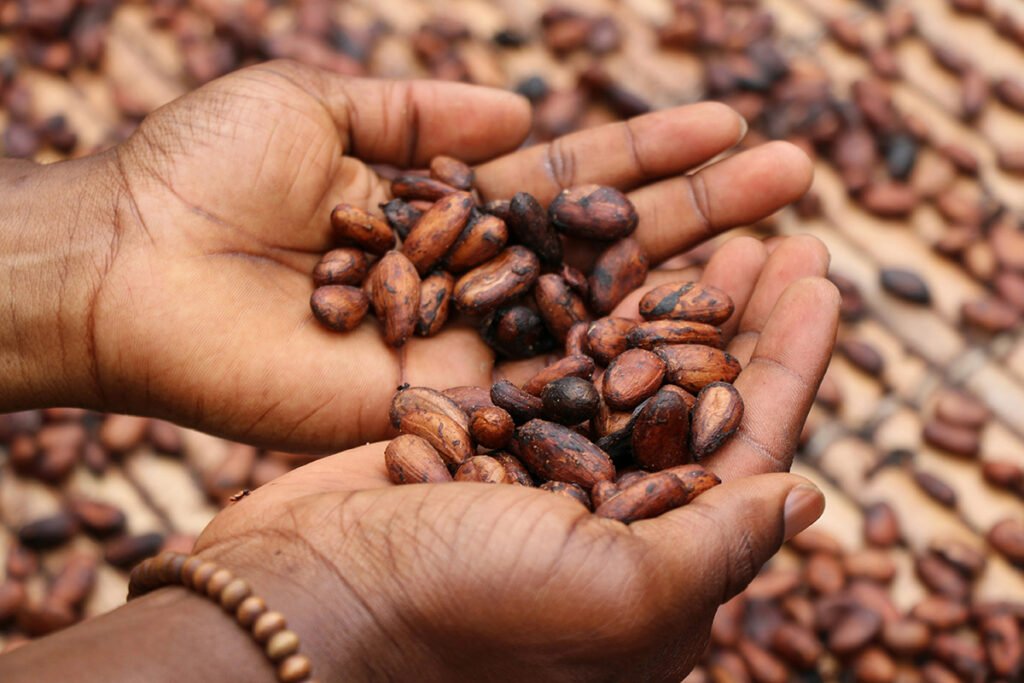
For example, Chocolate Rebellion, a cooperative of cocoa growers across Africa and the Caribbean, equips its members to process and market their own chocolate instead of exporting raw beans to Europe or the United States. This model disrupts centuries of unequal trade, decolonizes chocolate, and offers a vision of solidarity grounded in justice, not charity.
I also pointed to how US and European cooperators routinely ignore the existence of Black and Indigenous cooperators throughout the Americas, and how ROSCAs, shared labor pools, and other “informal” networks remain invisible within official cooperative narratives.
As some attendees later told me, French audiences were unaccustomed to hearing such direct language about race and colonialism. Yet solidarity without truth-telling is performance, not transformation.
What Was Discussed—and What Wasn’t
This year’s conference went to great efforts to bring together a cross section of leaders working on the social and solidarity economy and encourage the exchange of ideas and experiences. Several declarations were generated, including one which I helped draft, the Declaration for lasting peace: The transformative role of the SSE in fostering peace, inclusion, and resilience, affirming that peace is impossible without economic justice and democratic control of resources.
At the forum, cooperative organizers across multiple sectors shared their innovations, networks provided updates, cities shared their policies, and researchers debated impact measurement frameworks.
This year’s conference revealed both how far the solidarity economy has come—and how far it has to go.
But even amid these achievements, the forum’s architecture remained Eurocentric—in language, framing, and imagination. The informal remained delegitimized, race remained unspoken, and colonialism remained unresolved.
If the solidarity economy is to fulfill its promise, it must confront these blind spots head-on.
What’s Next?
The next GSEF, to be held in 2027 in Maricá, Brazil, offers another opportunity. The city—home to a public bank, local currency, and a universal basic income program—has plenty to showcase.
And yet, considering the lack of representation of Afrodescendant and Indigenous majorities in Brazil’s delegation to Bordeaux, the marginalization of Black communities, and high levels of extrajudicial killings of Black Brazilians by police, it will require unprecedented intentionality from organizers to avoid the same pitfalls.
This year’s conference revealed both how far the solidarity economy has come—and how far it has to go. One core challenge remains moving from a solidarity that manages inequality to one that dismantles it.