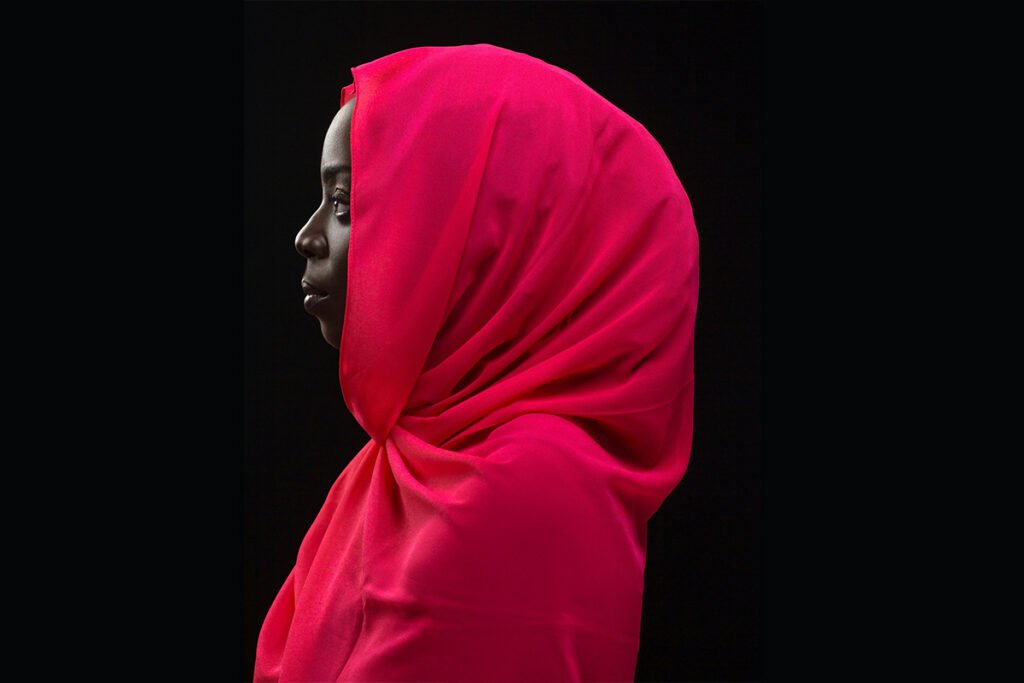
Humans of Nonprofits captures the powerful, often untold stories of nonprofits and the people they impact during crisis. From wildfire response to pandemic recovery, these human-centered narratives reveal how the sector anchors civil society when it matters most.
On a humid Thursday in Doha, Qatar, I opened my laptop and waited for 72 women to log into the online university course I was teaching. Outside my window, life was ordinary. Kids played in yards, and people drove by on their way to work. But the 72 women on my screen were in the middle of a war.
The students were joining our online class from across Sudan. One student joined wearing a white toub in a dark room in Omdurman. Another sat in the street with her laptop in South Darfur. Two young women logged in from a refugee camp in North Kordofan. A few cameras flicked on and off to preserve battery life. Others disappeared when the electricity in Khartoum was cut once again.
Ahfad University for Women, founded in 1907, is Sudan’s first and only women’s university. It is a nonprofit institution built on a simple conviction: Educating women strengthens families, communities, and nations. Yet access to higher education in Sudan remains extremely limited. Available data indicate that less than 10 percent of Sudanese people over the age of 25 obtain a college degree, reflecting broad constraints on access and an overall scarcity of higher education opportunities. Research also indicates that women’s access to higher education in particular is further constrained by conflict, displacement, and persistent gender inequalities. In this context, expanding women’s educational pathways is not only important but urgent.
Crises first reveal themselves in people.
By April 2023, when war erupted between the Sudanese Armed Forces and the Rapid Support Forces, campuses were looted, seized, or abandoned. Families fled with whatever they could carry. By the following year, more than eight million Sudanese had been displaced—one of the largest displacement crises in the world. Hospitals collapsed. Schools shut down. Gender-based violence increased. Over half the country needed humanitarian aid.
And yet, that same month, 72 women still logged in to class.
When Systems Fail, People Carry the Mission
When people discuss nonprofit resilience, they often focus on budgets and survival. But crises first reveal themselves in people.
That morning in April, we did not begin with theory. We began with questions of safety: “Had Rogaia managed to escape safely from the armed groups in Madani?”; “Had Mozan and her family crossed the Ethiopian border without harm?”; “Did Randa manage to find a smartphone after being robbed on the road to Gedaref?”; “Had Islam located a safe clinic on the Libyan border where she could give birth?” As a Sudanese-born woman, I could not see these women just as my students; they were also my fellow citizens.
Before a nonprofit loses revenue, it is steeped in fear. Before an institution restructures, its people carry its uncertainty. That was apparent in our class.
My students apologized in advance for poor internet, background noise, or leaving suddenly when armed groups passed nearby. One student left mid-lecture to seek shelter when a drone delivering explosives targeted the area.
Crisis, at the human level, amplifies emotional labor. It demands that students concentrate on coursework while figuring out escape routes for their families. It requires faculty to teach while grieving.
I was there to teach about public services, but I was also holding together a fragile community through a flickering Wi-Fi signal.
The Cost of Keeping the Core
As the war spread, my country’s higher education system fractured. Campuses were damaged or occupied. Faculty were scattered, either internally displaced, made refugees, or stranded abroad. Salaries were delayed for months and later paid in devalued currency. Rents rose sharply in safer cities. Families depended on financial support from relatives overseas, who were themselves overwhelmed.
Many faculty members lost everything: homes, savings, research, decades of lecture notes. Few had backups of their work in cloud servers. Almost no one expected to lose both their house and their intellectual archives simultaneously.
In times of crisis, nonprofits often cut “extras” to maintain essential services. However, in Sudan, there were no extras left to cut. Education itself became the fragile core.
Students wrote to me privately: “Professor, my assignment is late because we were crossing the border.” “We are sharing one phone.” “There is no electricity in our area today.”
In nonprofit work, resilience often depends on the workforce’s willingness to absorb shock. But that absorption has limits.
Some students climbed hills every day just to get a signal. Other women got jobs for the first time in their lives to support displaced families. Several had lost loved ones. Some had suffered violence.
The classroom felt heavier. Not because of the theory—because of the grief.
The Hidden Workforce Crisis
The students were not the only ones carrying the war.
My colleagues were exhausted, traumatized, and financially strained. One lost her husband after displacement shattered his health. Others died while trying to reach safety. Core courses suddenly had no professors.
Sign up for our free newsletters
Subscribe to NPQ's newsletters to have our top stories delivered directly to your inbox.
By signing up, you agree to our privacy policy and terms of use, and to receive messages from NPQ and our partners.
In nonprofit work, resilience often depends on the workforce’s willingness to absorb shock. But that absorption has limits. Organizations’ frontline workers often become informal therapists. We listened to stories of loss, hunger, assault, and fear. We carried those stories home to our children. I was not trained as a psychologist. Yet I was holding space for trauma every week while also managing my own loss and uncertainty.
Nonprofits can weather financial crises with reserves and diversification. But nonprofits are made up of people, and people need more: care infrastructure, mental health support, stable pay, and functioning systems.
Humanity depends on nonprofits, yet nonprofits rely on humans.
Improvising Resilience
The Unnamable, Samuel Beckett’s 1953 novel, ends with the line: “You must go on. I can’t go on. I’ll go on.”
We had to go on. There was no other option.
Humanity depends on nonprofits, yet nonprofits rely on humans.
I offered alternatives, softened deadlines, and started each class with a check-in to help students feel acknowledged. I brought Joyce Always, a librarian at Hamad Bin Khalifa University in Qatar, to speak virtually with the students about open-access educational resources: free certifications, online tools, and ways to develop skills without tuition. We discussed research as documentation, as voice, as resistance.
I tried to remind my students that their education was not abstract and that Sudan would need them.
In crises, the university becomes more than just an academic institution and nonprofits act as a bridge—fragile, thin connections between survival and possibility.
Persevering did not look like returning to “normal.” It meant adapting without abandoning the mission. It looked like teaching and learning, despite the drones strapped with bombs flying overhead.
Learning as Liberation
War is often described as a temporary disruption. In academic language, we might call it a human-created exogenous shock. But for Sudan’s students and faculty, war is no longer a temporary disruption. It is daily life.
Listening to these women reshaped how I understand a nonprofit’s resilience in the face of war.
Resilience is not about whether an institution survives on paper. It is what keeps core services running when everything else collapses. It is dignity held fast as borders shift and homes burn. More than anything, it is a young woman claiming her future—and working to make that future brighter for everyone.
Sometimes, resilience looks like 72 names appearing on a Zoom screen in the middle of a violent war.
And it is Ahfad University, unwavering in its mission to educate women in a crumbling nation, so that when the fighting stops, women will be ready to rebuild what war tried to erase.
The women of Sudan already understand this. In songs sung across campuses and protests, they describe education not simply as learning, but as liberation. One verse from a traditional Sudanese women’s chant celebrating women’s education (translated from Arabic) captures the spirit of what I witnessed far better than any academic definition ever could:
Rise from beneath the rubble and smoke,
Break free from your prison and tear down its walls.
Through knowledge, Eve has risen and shone, never giving up.
With hard work she moved forward, and at the heights of progress she appeared.
How much effort she gave, how much she suffered,
Yet she never bowed, not even once.
For More on This Topic:
“We’re Not Meant to Do Life Alone”: The Invisible Network of Nonprofits
On the Front Lines: How Campus Organizing Can Inform Movements Today
How an International NGO Plans to Fight the Digital Divide with a Satellite Company