In recent years, many of the rights and protections that women have fought to secure over the past half-century have come under sustained, coordinated attack. Gains once considered settled are being actively rolled back. The overturning of the US Supreme Court’s Roe v. Wade case in Dobbs v. Jackson Women’s Health Organization was not simply a legal setback for reproductive freedom and health. More broadly, the court’s decision was a stark warning that progress is neither inevitable nor permanent.
Other advances in women’s rights—such as equal pay, educational opportunity, and civil rights—are also being threatened. For instance, the gender pay gap has widened for the last two consecutive years, the first time that has happened since the 1960s, when federal data began being reported.
This trend, combined with mounting political and cultural backlash—what Ms. Magazine has labeled an “anti-gender” movement—signals a dangerous erosion of rights that many believed were secure. The optimism and public reckoning of the Me Too movement of the late 2010s now feels far away as the nation confronts a deliberate effort to move backward.
Still, while the federal picture may be grim, state-level action to protect or even advance women’s rights is possible, and the fight for reproductive rights is a case in point. In January 2023, the Guttmacher Institute wrote that 24 states had banned abortion or were likely to do so. Today, only 13 states have outright bans, a clear sign of the power of state-level organizing.
Hostile Sexism
Activists, legal scholars, and women across the political spectrum recognized Dobbs as the opening salvo in a broader attempt to dismantle gender-based protections. The National Organization of Women assembled a long list of policy actions taken by the administration of President Donald Trump, mostly through executive order, that harm women.
“Hostile sexism” operates as a Trojan horse for authoritarianism, using attacks on women to normalize broader antidemocratic impulses.
Catalyst and other advocacy groups warn that retreat from diversity, equity, and inclusion (DEI) initiatives threatens to stall or reverse the fragile progress women have made in accessing top professional roles. Catalyst CEO Jennifer McCollum has described this regression from DEI as a direct risk to women’s advancement.
The broader cultural climate is increasingly hostile. Misogyny—long present but often coded—is now expressed openly in public life, with Donald Trump deriding women journalists and public figures in language that normalizes contempt.
Princeton University Press Researcher Cynthia Miller-Idriss, founder of the Polarization and Extremism Research and Innovation Lab (PERIL) and author of Man Up: The New Misogyny and the Rise of Violent Extremism, warns that this “hostile sexism” operates as a Trojan horse for authoritarianism, using attacks on women to normalize broader antidemocratic impulses.
While reproductive rights draw national attention, labor market data show that women are also losing pay compared to men.
These attacks, argued Noreen Farrell, executive director of Equal Rights Advocates (ERA), also create a climate that encourages “political violence targeting women’s rights advocates.” She cites the June 2025 assassination of Minnesota House Speaker Melissa Hortman, a champion of reproductive rights, as a chilling example of how anti-choice extremism can and does turn violent.
The Gender Pay Gap Widens
While reproductive rights draw national attention, labor market data show that women are also losing pay compared to men. Gloria L. Blackwell, CEO of the American Association of University Women (AAUW), denounced this outcome in a press statement.
“For the second year in a row, Census data shows the gender pay gap is widening,” Blackwell said. AAUW further warned that these inequities are systemic, not the product of individual choices.
Deborah Vagins, director of ERA’s Equal Pay Today campaign, a national coalition of more than 50 nonprofit and advocacy organizations that advocate for pay equity for women and LGBTQIA+ people, especially women of color, noted in a press statement that “these numbers show us the persistence of the devastating gender and racial wage gaps that women continue to face.”
The group’s policy agenda centers on implementing transparent pay practices and accountability mechanisms; strengthening current equal pay laws and passing new legislation to increase equity, ban workplace harassment, eliminate the subminimum wage for tipped workers and other vulnerable workers; and supporting paid family leave, paid sick and safe leave, and other workplace protections.
Farrell told NPQ that local policy can make a difference: “For the first time in 20 years, the gender gap is widening, except in states passing the kind of wage justice laws and childcare paid family benefits ERA is championing.”
Sign up for our free newsletters
Subscribe to NPQ's newsletters to have our top stories delivered directly to your inbox.
By signing up, you agree to our privacy policy and terms of use, and to receive messages from NPQ and our partners.
How Advocates Are Fighting Back
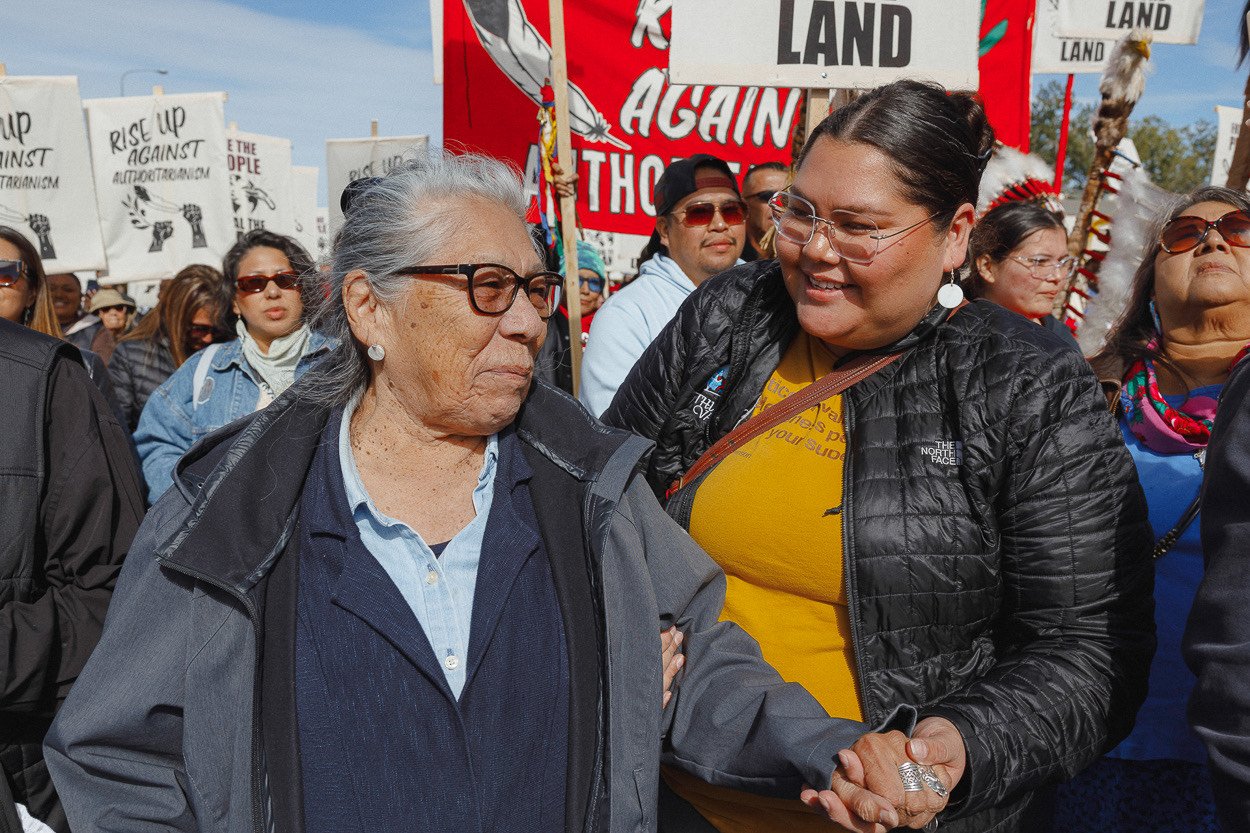
Katherine Spillar, executive editor of Ms. Magazine, has described the past year as one in which “every day [brought] a fresh outrage,” but also one that has seen a surge of resistance, from mass protests to legal challenges and electoral victories. Across the country, women are transforming grief and anger into strategic, multifront organizing.
At the state level, some leaders are expanding rights rather than restricting them. In Michigan, Governor Gretchen Whitmer signed legislation broadening reproductive freedom, including allowing pharmacists to prescribe and dispense contraceptives directly. New Jersey, Massachusetts, and California have begun stockpiling mifepristone, one of the two drugs commonly used in medication abortions, in anticipation of legal threats to its availability. And a growing group of women donors, including Phoebe Gates, daughter of Melinda French Gates and Bill Gates, is stepping up with financial support for reproductive freedom campaigns and providers.
Republican women, too, have sometimes put on the brakes: For example, Vagins told NPQ that a South Carolina bill that would have become one of the nation’s most extreme abortion bans, allowing women to be imprisoned for receiving an abortion, failed to advance in part because of divisions among Republicans over how far they are willing to go in restricting reproductive rights. Women’s voices made it clear that there was a political risk to criminalizing women’s medical decisions.
In workplaces, women are documenting harassment, sharing their stories, filing formal complaints, demanding fair pay and salary transparency, leaving abusive environments, boycotting discriminatory companies, and supporting women-owned and women-led businesses. A 2023 report from the National Women’s Law Center noted that between 2017 and 2023, “25 states and the District of Columbia have passed a total of more than 80 workplace antiharassment bills, many with bipartisan support.”
Women’s movements are converting individual outrage into institutional change. Organizations like Equality Now work to end violence and discrimination against women and girls through legal advocacy, assisting tens of millions of people worldwide on issues from child marriage to constitutional equality. The Global Fund for Women invests in grassroots feminist movements through art, activism, and international pressure, explicitly recognizing grassroots “people power” as one of the most effective mechanisms for lasting social transformation. These groups not only channel resources but also help local leaders access the financial and legal tools they need to succeed.
Cultural pushback has been equally vigorous. Gloria Steinem, still active at 91, recently gathered a circle of women in her home to discuss women’s health, linking personal experience to political action. Women writers, scholars, and journalists are publicly naming the backlash, demonstrating resilience and inspiring confidence that progress is possible, as they trace connections among attacks on reproductive care, pay equity, childcare, and women’s political participation so that no front of the assault remains hidden.
Women in media and politics are building networks to confront escalating harassment, insisting on stronger institutional protections and refusing to normalize sexist attacks from public figures. Women’s leadership programs, including informal ones such as Steinem’s circle, are helping to develop the next generation of elected officials, board members, and STEM innovators, recognizing that who holds power determines whose rights are protected.
“The resistance has been everywhere, all at once”—a testament to the power of women refusing to retreat.
The Resilience of Women’s Rights Advocacy
Despite the hostile climate, advocates insist that progress not be erased. Equal Rights Advocates asserts that the movement will not be intimidated and that there is no gender justice without reproductive freedom—and no reproductive freedom without physical safety for those who defend it. It also identifies actions on its website for supporters to take to defend federal programs.
Similarly, AAUW advocates for “laws and policies to ensure fair pay, relieve the disproportionate burden of student debt on women of color, and provide paid leave and affordable child care.”
Across organizations, a chorus of leaders is refocusing the discussion on solutions, accountability, and hope—insisting that every setback be met with stronger organizing and clearer demands.
The impact of relentless attacks has been chilling, but the US women’s movement remains undaunted. Activists are making their voices impossible to ignore—marching, voting, suing, organizing, mentoring, writing op-eds, and building local networks to safeguard past gains and push for bold new measures. Their message is clear: women have come too far to go back.
This historic crossroads is about more than laws or paychecks; it’s about every woman and girl’s right to determine her own future, participate fully in society, be safe from violence, and be compensated fairly for her labor. Each act of violence or legislative assault has been matched by a surge in organizing, advocacy, and resilience, making it clear that progress will not quietly reverse. As Ms. Magazine observed of this moment, “the resistance has been everywhere, all at once”—a testament to the power of women refusing to retreat.
If historians look back on this era with clarity, they will see not only the intensity of the attacks on women’s rights but also the determination of advocates to resist them.