
June 26, 2017; Brennan Center for Justice
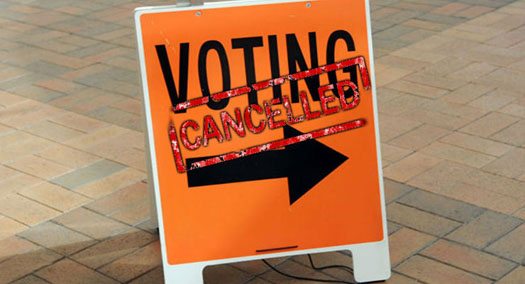
While President Trump, despite the lack of any evidence, continues to shout that his election victory was marred by a large number of unregistered and duplicate voters who were able to cast ballots, this is not the real danger we face. The growing number of states that have passed laws making it harder to register and vote has resulted in hundreds of thousands of Americans losing a basic right of citizenship. What’s more, in many states, the ability of legislatures to redistrict has turned into a powerful tool for devaluing targeted voters.
In state houses across the country, the debate over what comprises the real threat to our democracy rages as legislatures consider proposals to make it easier or harder to register and vote. According to New York University’s Brennan Center for Justice, “At least 99 bills to restrict access to registration and voting have been introduced in 31 states. Thirty-five such bills saw significant legislative action (meaning they have at least been approved at the committee level or beyond) in 17 states.” At the same time, “at least 531 bills to enhance voting access have been introduced in 45 states. One hundred fifty-six bills have at least been considered and approved by a legislative committee in 30 states.”
At the national level, President Trump has formed the Advisory Commission on Election Integrity, chaired by Vice President Pence and co-chaired by a noted believer in rampant voter fraud, Kansas Secretary of State Kris Kobach. The Commission is charged to study voter suppression and report back to him in 2018. While this debate goes on, the impact of redistricting and gerrymandering gets less attention but may be more critical.
North Carolina provides an example of a legislature using every possible tool to disenfranchise and devalue targeted voters. In 2013, the Supreme Court ruled in Shelby v. Holder that the Voting Rights Act’s requirements for preclearance of new voting and districting legislation in jurisdictions with a history of discrimination was no longer needed. According to the court, the data upon which the requirements were based were more than 40 years old, making them no longer responsive to current community needs. This opened the floodgates to states that wanted to make voting harder and control election results more tightly. Writing for Slate in May, Mark Stern described North Carolina’s approach to strengthening its voter laws following the Shelby decision.
Republicans wrote and passed HB 589. Their bill created stringent requirements for voter ID, excluding IDs most commonly used by black voters; slashed early voting; eliminated same-day registration; killed preregistration for teenagers; and ended out-of-precinct voting for voters who inadvertently showed up at the incorrect precinct in the right county. Republican Gov. Pat McCrory signed the bill without fully reading it.
North Carolina’s legislature also used the power to redistrict to effectively disenfranchise the same voting blocs as their voting laws did. Through creative map drawing, it was possible for Republicans to win a supermajority of seats in the state legislature and win more than their fair share of Congressional seats when overall vote totals did not have such a spread between Democrats and Republicans. While 46 percent of North Carolinians who voted for a congressional candidate in 2016 voted Democratic, only three out of the state’s 13 seats were filled by Democrats. Gerrymandering resulted in Republican votes becoming much more valuable than those cast for Democrats.
Sign up for our free newsletters
Subscribe to NPQ's newsletters to have our top stories delivered directly to your inbox.
By signing up, you agree to our privacy policy and terms of use, and to receive messages from NPQ and our partners.
According to the Brennan Center, North Carolina is not alone.
There is strong evidence that the bias in this decade’s congressional maps is not accidental. With the exception of Texas, all of the most biased maps are in battleground states. These states routinely have close statewide elections and a fairly even distribution of partisanship across most of the state—two factors that do not naturally suggest that there should be a large and durable underrepresentation of one political party.
For North Carolina’s Rev. William Barber, who has taken on leadership of a rejuvenated Poor People’s Campaign, there is no question that voting rights has become the most critical issue of the day. While concerns about Russian hacking have drawn much attention, he sees this as secondary to the repressive actions of state governments. Rev. Barber recently said, according to New America Media, that, “We’re looking at Putin’s strongman tactics and not at our own race-based voter suppression tactics. But we have to demand attention. What the states with the highest voter suppression have in common is that they also have the highest rates of poverty.”
North Carolina, at least, may have gone too far. The Supreme Court ruled in May that both of the state’s new district maps were unconstitutional and left standing an appellate court ruling that many of the changes made to North Carolina’s voting systems were unconstitutional and would have to be redrafted. But the court did not force this to happen before the 2016 election, leaving the results as they are.
For Rev. Barber, this left a disturbing reality. “This ruling means we have an unconstitutionally constituted legislature that has been passing unconstitutional laws. This legislature is not legitimate because they cheated and would not be in office. We would not have this extremist supermajority in the state legislature. We also have people in Congress who would not be there if we did not have this race-based redistricting plan. Yet they’re there.”
In the coming months, we will see how these statehouse struggles play out. In the wake of the 2020 census, we will see how each state approaches redistricting. And we will learn more about how the Supreme Court, now with a full nine justices, really feels about a state’s right to discriminate. In the balance hangs the meaning of our democracy.—Martin Levine