logo logo
giving banner
Donate
    • Membership
    • Donate
  • Social Justice
    • Racial Justice
    • Climate Justice
    • Disability Justice
    • Economic Justice
    • Food Justice
    • Health Justice
    • Immigration
    • LGBTQ+
  • Civic News
  • Nonprofit Leadership
    • Board Governance
    • Equity-Centered Management
    • Finances
    • Fundraising
    • Human Resources
    • Organizational Culture
    • Philanthropy
    • Power Dynamics
    • Strategic Planning
    • Technology
  • Columns
    • Ask Rhea!
    • Ask a Nonprofit Expert
    • Gathering in Support of Democracy
    • Humans of Nonprofits
    • The Impact Algorithm
    • Living the Question
    • Nonprofit Hiring Trends & Tactics
    • Notes from the Frontlines
    • Parables of Earth
    • Reimagining Philanthropy
    • State of the Movements
    • We Stood Up
    • The Unexpected Value of Volunteers
  • Leading Edge Membership
  • Newsletters
  • Online Events
  • CONTENT TYPES

As Highways Age, Urban Planners Consider a Landscape Without Them

Martin Levine
October 25, 2017
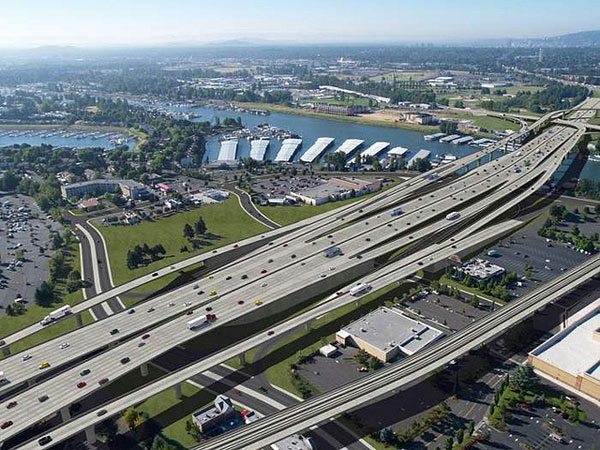
“Columbia River Crossing over Hayden Island” by Michael Andersen

October 21, 2017; New York Times

Has the time come to radically revise how we think of cities? The fabric of urban and suburban life has been woven with thick strands of highways that connect and separate communities and neighborhoods. Some urban planners see this as the right moment to rip them out and rebuild cities with less of an eye toward their ability to move traffic and more emphasis on quality of life for their residents.

According to the Congress for the New Urbanism, these urban planners envision “the restoration of existing urban centers and towns within coherent metropolitan regions, the reconfiguration of sprawling suburbs into communities of real neighborhoods and diverse districts, the conservation of natural environments, and the preservation of our built legacy.”

Steven Kurtz, writing in the New York Times about the place of highways in this new urban landscape, says, “If it sounds counterintuitive, if not crazy, to tear down a highway that still carries thousands of cars and trucks each day, there are a number of case studies to point to.” Supporting the removal of freeways also has an economic rationale that is quite attractive with tight city, state, and national budgets:

Perhaps the greatest argument that removal advocates have is that so much of this infrastructure is nearing the end of its life span. In this era of tight budgets and political gridlock, it may be cheaper for local and state governments to remove a freeway rather than repair or build a new one.

Sign up for our free newsletters

Subscribe to NPQ's newsletters to have our top stories delivered directly to your inbox.

By signing up, you agree to our privacy policy and terms of use, and to receive messages from NPQ and our partners.

By removing lanes of concrete, city planners hope to encourage the development of new and improved mixed-use communities that will attract new residents and spur economic growth. As an example, proponents point to the removal in 2002 of a length of highway leading into central Milwaukee that was once thought critical. John Norquist, Milwaukee’s mayor at the time and the spearhead for this effort, told the Times, “The bill to demolish the Park East and restore the street grid was around $30 million, significantly less than the $80 to $100 million estimated cost to rebuild the 40-year-old freeway.” Norquist pointed to “the rising land values and the slow-but-steady development along the 26-acre corridor in the years since—and the lack of a traffic apocalypse—as signs of success.”

Angelo Trichilo, deputy chief engineer for the New York State Transportation Department, imagines “an urban boulevard that allows all modes of transportation—pedestrians, bicyclists, and cars—to use that facility” once offered by the multi-lane highways.

Making large, urban communities take on more of a small-town feel sounds appealing, but will it actually solve any of the difficult problems our cities face? In many cases, our highway systems provided mechanisms to allow white communities to wall off black and poor neighborhoods and to allow whites to flee cities for the suburbs. Removing these barriers might create a way to undo some of the harmful impacts of segregation against which urban schools and police departments still struggle.

However, there’s also the danger that these efforts will accelerate gentrification, bringing younger, whiter, and wealthier residents back into central cities at the expense of longtime older, poorer, and less mobile populations. Ensuring enough affordable housing is available in our urban centers would only be made more difficult by an uncontrolled process of renewal. And without highways to connect suburbs to cities, there is a real danger that “undesirables” will be further isolated and disconnected from economic and social opportunity.

Rick Cohen, writing for NPQ, saw the downside of uncontrolled gentrification in Chattanooga, Tennessee, as “the deepening of income and racial inequities in the midst of metropolitan progress.” For policymakers and urban planners, the challenge will be to balance the interests of all residents and not just follow the allure of the potential economic benefits from gentrification. Can they hear and value the voices of those with limited financial and political clout? The answer may be seen where the rubber currently meets the road.—Marty Levine


Our Voices Are Our Power.

Journalism, nonprofits, and multiracial democracy are under attack. At NPQ, we fight back by sharing stories and essential insights from nonprofit leaders and workers—and we pay every contributor.

Can you help us protect nonprofit voices?

Your support keeps truth alive when it matters most.
Every single dollar makes a difference.

Donate now
logo logo logo logo logo
About the author
Martin Levine

Martin Levine is a Principal at Levine Partners LLP, a consulting group focusing on organizational change and improvement, realigning service systems to allow them to be more responsive and effective. Before that, he served as the CEO of JCC Chicago, where he was responsible for the development of new facilities in response to the changing demography of the Metropolitan Jewish Community. In addition to his JCC responsibilities, Mr. Levine served as a consultant on organizational change and improvement to school districts and community organizations. Mr. Levine has published several articles on change and has presented at numerous conferences on this subject. A native of New York City, Mr. Levine is a graduate of City College of New York (BS in Biology) and Columbia University (MSW). He has trained with the Future Search and the Deming Institute.

More about: Community DevelopmentNonprofit NewsPolicy
See comments

You might also like
How to Undermine Authoritarian Control: On Empowering Parallel Institutions
Gretchen Goldman and Saul Levin
What Is the SAVE America Act?
Marissa Martinez
Disability Groups Are Standing United for Trans Rights. That Hasn’t Always Been the Case.
Sara Luterman
New Student Loan Limits Could Threaten Diversity in Nursing and Public Health Programs
Lauren Nuttall
‘I’m Heartbroken’: Trans Kansans Reckon with Their Driver’s Licenses Being Invalidated
Sherman Smith and Morgan Chilson
After Years of Waiting, She Wanted to Start Gender-Affirming Care. Politics Interfered.
Orion Rummler

Upcoming Webinars

Group Created with Sketch.
April 23, 2:00 pm ET

Receiving & Giving Feedback

Essential Practices for Healthy Organizations and Communities

Register
Group Created with Sketch.
May 14, 2:00 pm ET

Equitable Compensation in Practice

A New Values-Aligned Toolkit & Discussion Guide

Register
Group Created with Sketch.
May 28, 2:00 pm ET

Learn Out Loud

Revisiting Maurice Mitchell's "Building Resilient Organizations"

Register

    
You might also like
A pair of red and blue zippers, with tracks intertwined to reveal a small gap in between them. Where one zipper stops, the other zipper starts.
How to Undermine Authoritarian Control: On Empowering...
Gretchen Goldman and Saul Levin
A crowd of people hold signs that read "Stop the SAVE Act", "End Voter Suppression" and "Defend Our Democracy"
What Is the SAVE America Act?
Marissa Martinez
A person at a march holds a sign with the blue, pink, and white trans flag that reads “We See You, We’ve Got You”
Disability Groups Are Standing United for Trans Rights. That...
Sara Luterman

Like what you see?

Subscribe to the NPQ newsletter to have our top stories delivered directly to your inbox.

See our newsletters

By signing up, you agree to our privacy policy and terms of use, and to receive messages from NPQ and our partners.

  • About
  • Advertise
  • Careers
  • Contact
  • Copyright
  • Donate
  • Editorial Policy
  • Privacy Policy
  • Funders
  • Submissions

We are using cookies to give you the best experience on our website.


Nonprofit Quarterly | Civic News. Empowering Nonprofits. Advancing Justice.
Powered by  GDPR Cookie Compliance
Privacy Overview

This website uses cookies so that we can provide you with the best user experience possible. Cookie information is stored in your browser and performs functions such as recognising you when you return to our website and helping our team to understand which sections of the website you find most interesting and useful.

Strictly Necessary Cookies

Strictly Necessary Cookie should be enabled at all times so that we can save your preferences for cookie settings.