logo logo
giving banner
Donate
    • Membership
    • Donate
  • Social Justice
    • Racial Justice
    • Climate Justice
    • Disability Justice
    • Economic Justice
    • Food Justice
    • Health Justice
    • Immigration
    • LGBTQ+
  • Civic News
  • Nonprofit Leadership
    • Board Governance
    • Equity-Centered Management
    • Finances
    • Fundraising
    • Human Resources
    • Organizational Culture
    • Philanthropy
    • Power Dynamics
    • Strategic Planning
    • Technology
  • Columns
    • Ask Rhea!
    • Ask a Nonprofit Expert
    • Economy Remix
    • Gathering in Support of Democracy
    • Humans of Nonprofits
    • The Impact Algorithm
    • Living the Question
    • Nonprofit Hiring Trends & Tactics
    • Notes from the Frontlines
    • Parables of Earth
    • Re-imagining Philanthropy
    • State of the Movements
    • We Stood Up
    • The Unexpected Value of Volunteers
  • CONTENT TYPES
  • Leading Edge Membership
  • Newsletters
  • Webinars

Donations against Hate: Could This Scheme Work?

Carole Levine
February 12, 2018
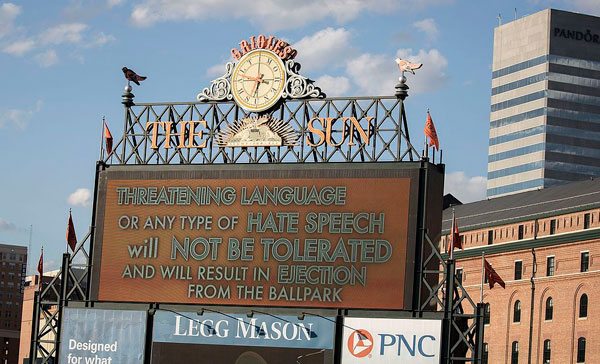
By Keith Allison from Hanover, MD, USA (MLB Hate Speech Prohibited) [CC BY-SA 2.0], via Wikimedia Commons

February 9, 2018; Ad Week

The speed at which social media can “spread the word” has increased dramatically. While this can be a boon for those seeking help for what they deem a worthy cause, it has also increased the spread of hate speech and caused consternation for Agency Possible and its partners at the social media marketing software company Spredfast. Working together, they launched WeCounterHate, a campaign to cancel out hate messages on Twitter with a donation to a nonprofit fighting hate for every hateful retweet.

While it sounds simple, getting from concept to execution was not. The ideas grew from a story of how the people of the Bavarian town of Wunsiedel organized to turn an annual neo-Nazi march into a fundraising effort for an anti-extremist organization. The question was raised as to how Possible could apply the same approach on a wider scale. Twitter became the focus.

Spredfast CMO Jim Rudden described Twitter as “the tool of the moment to reach broad audiences and get messages out there. Any digital platform built in that context can be used for good or ill.”

“In addition to the rules that are being set up by the platforms themselves, there are also social norms. It’s up to the people who use the platforms to set those up and we want to be at the forefront of doing that,” added Possible global chief data officer Jason Carmel.

Sign up for our free newsletters

Subscribe to NPQ's newsletters to have our top stories delivered directly to your inbox.

By signing up, you agree to our privacy policy and terms of use, and to receive messages from NPQ and our partners.

“That’s when we reached out to Life After Hate, because of the way they approach reforming and trying to remove people from these extremist groups,” [Agency Possible creative director Ray] Page explained. “It felt like their sensibilities matched with ours and what we wanted to do with the platform.”

Life After Hate is a nonprofit, founded in 2011 to help people exit hate groups and provide supports for family and friends. It received federal funding under the Obama administration, but those funds were rescinded under the current administration.

It would seem that with these partnerships, this “platform” should now be good to go—but again, it’s not so simple. Even with all the programming abilities of Possible, they initially couldn’t meet the challenge of identifying hate speech and then programming an artificial intelligence engine to classify tweets on how hateful they were. Hate speech has evolved; while people are still saying radically hateful things online, they use different language than they once did. But, with the help of Life After Hate, the two groups worked with former far-right extremists to program the WeCounterHate engine. The combination of the right technology and the programming capability with the insights of those who knew the field built a strong engine. As Page said, “The machine has been getting smarter ever since.”

Does knowing that your retweet of a hateful message could trigger a donation to Life After Hate stop you from retweeting it? According to WeCounterHate, around 20 percent of hate influencers delete targeted tweets, shrinking the number of retweets by over 50 percent. Perhaps the idea that people will stop and think before they hit the retweet button on something hateful is a great start. And, it will bring a social benefit, either way.—Carole Levine


Our Voices Are Our Power.

Journalism, nonprofits, and multiracial democracy are under attack. At NPQ, we fight back by sharing stories and essential insights from nonprofit leaders and workers—and we pay every contributor.

Can you help us protect nonprofit voices?

Your support keeps truth alive when it matters most.
Every single dollar makes a difference.

Donate now
logo logo logo logo logo
About the author
Carole Levine

Carole Levine is a principal consultant at Levine Partners, providing consulting services to small and medium-sized nonprofit organizations. She has held senior management positions in four national nonprofits: The National PTA (Deputy Executive Director); Communities in Schools (Vice President of Expansion and Technical Assistance); The Family Resource Coalition (Director of Technical Assistance); and National Lekotek Center (Director of Development). Carole holds a BA in education and political science from Washington University, and an M.Ed. in Early Childhood Leadership and Advocacy from National Louis University. Carole has served on the boards of numerous organizations, holding national positions on the board of National Council of Jewish Women and on the International Council of Jewish Women. She is currently the Chair of Courts Matter Illinois, serves on the board of Chicago Women Take Action and is active on the Promote the Vote Illinois Coalition. Carole is passionate about purposeful work, justice for all, advocacy and her family (which includes 6 amazing grandchildren!).

More about: Nonprofit NewsPhilanthropySocial Media
See comments

You might also like
Making Sense of GivingTuesday 2025
Isaiah Thompson
Blocking Authoritarianism: Steps Nonprofits and Foundations Must Take
Saqib Bhatti
The Power of Direct Community Funding
Ana Valéria Araújo
Equitable Intermediaries: Power, Protection, Partnership
Frank Gargione and Andrea Granda
GivingTuesday: Mobilizing Grassroots Donors
Isaiah Thompson
Four Ways Philanthropy Can Support the Movement for a Third Reconstruction
Richard Besser and Carmen Rojas

Upcoming Webinars

Group Created with Sketch.
January 29th, 2:00 pm ET

Participatory Decision-making

When & How to Apply Inclusive Decision-making Methods

Register
Group Created with Sketch.
February 26th, 2:00 pm ET

Understanding Reduction in Force (RIF) Law

Clear Guidance for Values-centered Nonprofits

Register

    
You might also like
A group of people standing and smiling together while holding up signs with the Giving Tuesday logo and that say, “I Give Time”
Making Sense of GivingTuesday 2025
Isaiah Thompson
In 2013, I was working with local Detroit organizers to protect essential community services during the city’s bankruptcy. When we sat down with the organizers, one of my mentors asked them, “Who are the people that can pick up the phone, call the governor, and know that, nine times out of ten, he will do whatever they ask?” A man in the background controlling strings attached to a pair of hands in the foreground, symbolizing the puppet-like control that billionaires have over President Trump.
Blocking Authoritarianism: Steps Nonprofits and Foundations...
Saqib Bhatti
A afro-Brazilian man waving a Brazilian flag joyfully, symbolizing the positive effect that direct funding can have on communities.
The Power of Direct Community Funding
Ana Valéria Araújo

Like what you see?

Subscribe to the NPQ newsletter to have our top stories delivered directly to your inbox.

See our newsletters

By signing up, you agree to our privacy policy and terms of use, and to receive messages from NPQ and our partners.

  • About
  • Advertise
  • Careers
  • Contact
  • Copyright
  • Donate
  • Editorial Policy
  • Funders
  • Submissions

We are using cookies to give you the best experience on our website.


Nonprofit Quarterly | Civic News. Empowering Nonprofits. Advancing Justice.
Powered by  GDPR Cookie Compliance
Privacy Overview

This website uses cookies so that we can provide you with the best user experience possible. Cookie information is stored in your browser and performs functions such as recognising you when you return to our website and helping our team to understand which sections of the website you find most interesting and useful.

Strictly Necessary Cookies

Strictly Necessary Cookie should be enabled at all times so that we can save your preferences for cookie settings.