logo logo
giving banner
Donate
    • Membership
    • Donate
  • Social Justice
    • Racial Justice
    • Climate Justice
    • Disability Justice
    • Economic Justice
    • Food Justice
    • Health Justice
    • Immigration
    • LGBTQ+
  • Civic News
  • Nonprofit Leadership
    • Board Governance
    • Equity-Centered Management
    • Finances
    • Fundraising
    • Human Resources
    • Organizational Culture
    • Philanthropy
    • Power Dynamics
    • Strategic Planning
    • Technology
  • Columns
    • Ask Rhea!
    • Ask a Nonprofit Expert
    • Economy Remix
    • Gathering in Support of Democracy
    • Humans of Nonprofits
    • The Impact Algorithm
    • Living the Question
    • Nonprofit Hiring Trends & Tactics
    • Notes from the Frontlines
    • Parables of Earth
    • Re-imagining Philanthropy
    • State of the Movements
    • We Stood Up
    • The Unexpected Value of Volunteers
  • CONTENT TYPES
  • Leading Edge Membership
  • Newsletters
  • Webinars

Remembering the Vital Importance of Solidarity in a Time of Violence

Ruth McCambridge and Steve Dubb
October 29, 2018
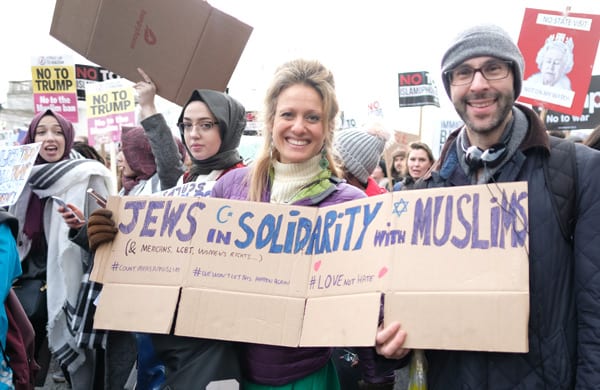
Alisdare Hickson / Jews in solidarity with Muslims ( and Mexicans, LGBT, womens’ rights … )

October 27, 2018; Forward

In the wake of the mass hate-inspired shooting at the Tree of Life synagogue in Pittsburgh, a number of funds have been started, including one campaign hosted by Muslim crowdfunding site LaunchGood. It aims to help shooting victims, “whether it is the injured victims or the Jewish families who have lost loved ones.” The campaign’s original goal of $25,000 was raised within six hours of its launch. As of this morning, $116,000 has been raised, and the goal updated to $125,000, a progression which reminds us of the RAICES campaign that started with a small goal and raised $17 million. Elsewhere, an Iranian immigrant has established a similar effort on GoFundMe which has raised $564,000 from almost 10,000 people.

These expressions of solidarity are particularly on point since, as is reported in The Forward, the gunman had been raving online about the Hebrew Immigrant Aid Society’s National Refugee Shabbat which involves American synagogues, including the Tree of Life, promoting acts to support refugees from around the world, many of whom are from predominately Muslim countries. “HIAS likes to bring invaders in that kill our people,” Bowers said in a post hours before the attack. “I can’t sit by and watch my people get slaughtered. Screw your optics, I’m going in.” The New York Times has described the HIAS network which has been in existence since 1881 and is one of nine national refugee resettlement agencies in the US here. “We used to welcome refugees because they were Jewish,” says Mark Hetfield, president of the group. “Today HIAS welcomes refugees because we are Jewish.”

Perhaps readers are surprised that Muslim communities have shown solidarity to the people who were killed in Pittsburgh, but there is a long history of support for the Jewish people among Muslims in Spain (before the Christian conquest), North Africa, and the Middle East.

The positionality of the Jewish community in the US has long been a complicated one. As Laurie Goodstein in the New York Times notes, while Jews may be feeling “unprecedented acceptance” in the US, the climate has been growing “increasingly hostile.” The Anti-Defamation League logged a 57 percent rise in anti-Semitic incidents in the United States in 2017, notes Goodstein.

Sign up for our free newsletters

Subscribe to NPQ's newsletters to have our top stories delivered directly to your inbox.

By signing up, you agree to our privacy policy and terms of use, and to receive messages from NPQ and our partners.

Goodstein writes that Deborah Lipstadt, professor of Holocaust history at Emory University, likens anti-Semitism to “a herpes infection that lays dormant and re-emerges at times of stress. It doesn’t go away, no matter how ‘acculturated’ Jews have become.”  Chas Danner and Adam K. Raymond write that the times of stress are too often connected to political rhetoric.

Bowers had published numerous posts about HIAS on the Gab social network, and appeared to ascribe to the anti-Semitic conspiracy theory that Jews were financially supporting an invasion of immigrants into the U.S. In particular, Bowers had frequently ranted about the caravan of Honduran migrants which President Trump and his allies on the right have been using to inflame the immigration debate and motivate Trump’s base ahead of the upcoming midterm elections.

Today, we remember the eleven people who were murdered in Pittsburgh. And we remember again the victims of the Black church in Charleston, South Carolina, three years ago; the two victims of the shooting at a Kroger just this past weekend after the gunman tried unsuccessfully just moments before to enter a Black church; and we remember the detained children, and those in caravans, and indeed all who have suffered from exclusionary violence due to their race, gender, religion, immigrant status, or sexuality.

Do we believe that the president’s self-identification as an “old fashioned” nationalist and such hate-incited events are connected? Are we getting out the vote to ensure that hatred does not further infect our national discourse and policies?—Ruth McCambridge and Steve Dubb


Our Voices Are Our Power.

Journalism, nonprofits, and multiracial democracy are under attack. At NPQ, we fight back by sharing stories and essential insights from nonprofit leaders and workers—and we pay every contributor.

Can you help us protect nonprofit voices?

Your support keeps truth alive when it matters most.
Every single dollar makes a difference.

Donate now
logo logo logo logo logo
About the authors
Ruth McCambridge

Ruth is Editor Emerita of the Nonprofit Quarterly. Her background includes forty-five years of experience in nonprofits, primarily in organizations that mix grassroots community work with policy change. Beginning in the mid-1980s, Ruth spent a decade at the Boston Foundation, developing and implementing capacity building programs and advocating for grantmaking attention to constituent involvement.

Steve Dubb

Steve Dubb is senior editor of economic justice at NPQ, where he writes articles (including NPQ’s Economy Remix column), moderates Remaking the Economy webinars, and works to cultivate voices from the field and help them reach a broader audience. In particular, he is always looking for stories that illustrate ways to build a more just economy—whether from the labor movement or from cooperatives and other forms of solidarity economy organizing—as well as articles that offer thoughtful and incisive critiques of capitalism. Prior to coming to NPQ in 2017, Steve worked with cooperatives and nonprofits for over two decades, including twelve years at The Democracy Collaborative and three years as executive director of NASCO (North American Students of Cooperation). In his work, Steve has authored, co-authored, and edited numerous reports; participated in and facilitated learning cohorts; designed community building strategies; and helped build the field of community wealth building. Most recently, Steve coedited (with Raymond Foxworth) Invisible No More: Voices from Native America (Island Press, 2023). Steve is also the lead author of Building Wealth: The Asset-Based Approach to Solving Social and Economic Problems (Aspen 2005) and coauthor (with Rita Hodges) of The Road Half Traveled: University Engagement at a Crossroads, published by MSU Press in 2012. In 2016, Steve curated and authored Conversations on Community Wealth Building, a collection of interviews of community builders that Steve had conducted over the previous decade.

More about: CrowdfundingFundraisingNonprofit NewsReligious / Faith-Based
See comments

You might also like
Making Sense of GivingTuesday 2025
Isaiah Thompson
If Farm School NYC Closes, What Will the City Lose?
Farm School NYC and Iris M. Crawford
Be Bold This GivingTuesday: Lessons from Public Rights Project
Jennifer Johnson
Leading “Against the Current”: A Conversation with Eveline Shen
Isaiah Thompson and Eveline Shen
GivingTuesday: Ride the Wave, Don’t Fight It
Rhea Wong
How to Handle Founder’s Syndrome with Grace
Marian Urquilla

Upcoming Webinars

Group Created with Sketch.
January 29th, 2:00 pm ET

Participatory Decision-making

When & How to Apply Inclusive Decision-making Methods

Register
Group Created with Sketch.
February 26th, 2:00 pm ET

Understanding Reduction in Force (RIF) Law

Clear Guidance for Values-centered Nonprofits

Register

    
You might also like
A red circle overlayed on a yellow background with three multi-colored dots on each side. In the center it reads, " Isaiah Thompson: Staff Picks for 2025"
Staff Picks for 2025: Isaiah Thompson
Isaiah Thompson
Staff Picks for 2025: Steve Dubb
Steve Dubb
A red circle overlayed on a yellow background with three multi-colored dots on each side. In the center it reads, "Alison Stine: Staff Picks for 2025"
Staff Picks for 2025: Alison Stine
Alison Stine

Like what you see?

Subscribe to the NPQ newsletter to have our top stories delivered directly to your inbox.

See our newsletters

By signing up, you agree to our privacy policy and terms of use, and to receive messages from NPQ and our partners.

  • About
  • Advertise
  • Careers
  • Contact
  • Copyright
  • Donate
  • Editorial Policy
  • Funders
  • Submissions

We are using cookies to give you the best experience on our website.


Nonprofit Quarterly | Civic News. Empowering Nonprofits. Advancing Justice.
Powered by  GDPR Cookie Compliance
Privacy Overview

This website uses cookies so that we can provide you with the best user experience possible. Cookie information is stored in your browser and performs functions such as recognising you when you return to our website and helping our team to understand which sections of the website you find most interesting and useful.

Strictly Necessary Cookies

Strictly Necessary Cookie should be enabled at all times so that we can save your preferences for cookie settings.