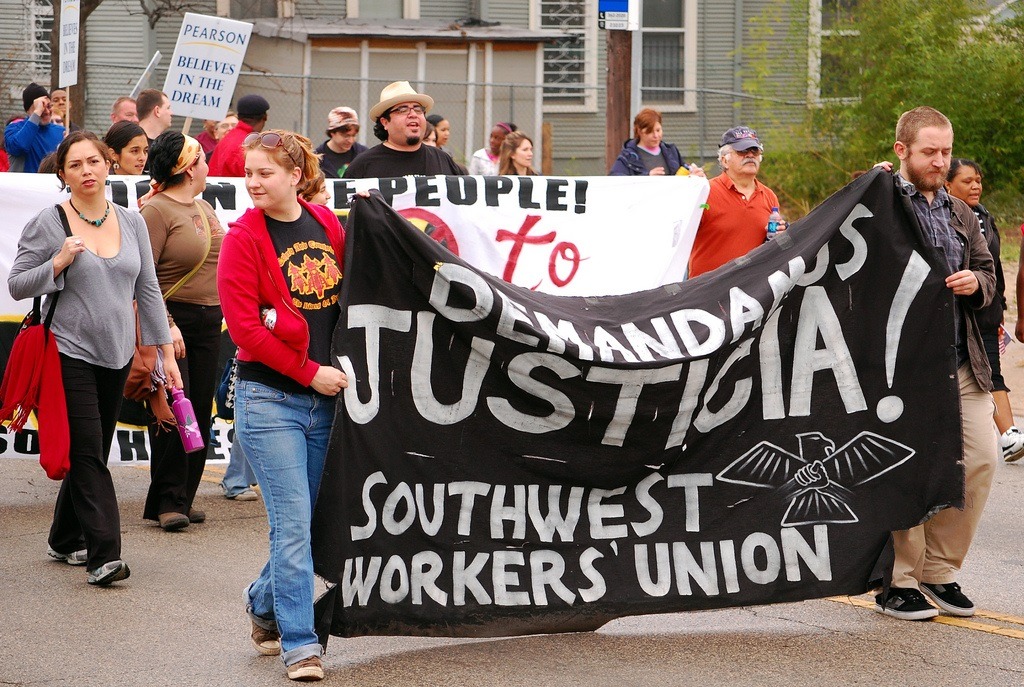
In November 2007, I listened to some of the best community organizers in the country: from Southern Echo in Jackson, Mississippi; from the Southwest Workers Union (SWU) in San Antonio, Texas; and from the Southwest Organizing Project (SWOP) in Albuquerque, New Mexico. Together they are experimenting in a South by Southwest Learning Continuum, “building bridges across traditional race, class, cultural, political and geographic barriers.”
The centerpiece is community governance. In the words of the Southwest Workers Union, “It is the spirit where people get involved to ‘govern’: To make decisions and be involved in the decision-making at local, state and national levels.” It is engagement “in the political process [that] must define the kind of change we expect and want and need.”
As we continue to be buffeted by forces over which we have no control, as workers in China suffer because we no longer have money for basic needs, as we lose jobs because workers in China can make things cheaper than we can, this recommitment to locality and community is more essential than ever.
Community governance underlines community as “stake-owners,” with all of the rights and obligations that come with ownership. No longer should they be identified as “stake-holders,” as they have been for too long—for example, by corporations operating in their communities. This is not only a shift in language; it is also conceptual and practical, recognizing the rights of communities to participate in all decisions—social, environmental, cultural and political—that affect the ways they “live, work, play, and pray.”
What does this have to do with philanthropy? “You never want a serious crisis to go to waste,” opined Rahm Emanuel, President Obama’s chief of staff. The crisis in which we find ourselves is an essential moment to assess philanthropy’s role in society.
The need for effective grantmaking is increasing dramatically as financial markets and governments at all levels lose their ability to provide essential services—just as foundation assets are declining. I believe that foundations should resist the short-term charitable urge to fill in for government. Rather, they should follow their philanthropic purpose for long-term change.
Philanthropy should be supporting community governance for defense of the commonweal. Communities are the bedrock of democracy. Communities are where all things—the silos of health, education, welfare, children, workers and the elderly; the environment—come together in the lives of people. Communities are where a decent society must begin, destroying humiliating institutions and creating self-respect. Excitement about our new president is high. But corporate influence on our legislative, judicial, and administrative bodies continues. Watering down the voices of people, dampening their enthusiasm, should not be tolerated.
Sign up for our free newsletters
Subscribe to NPQ's newsletters to have our top stories delivered directly to your inbox.
By signing up, you agree to our privacy policy and terms of use, and to receive messages from NPQ and our partners.
Community governance is a move to right the balance for previously neglected communities, often poor and comprising people of color. Community organizing is essential in building community governance, but it is a tool too often overlooked by foundations. Community organizing comes from within the community, not advocacy or mobilization by groups outside the community.
Exciting examples of community organizing for community governance are many, breeding further successes as communities organize to exercise their constitutional rights:
- Southern Echo’s leadership in building a strong statewide black/white coalition to fully fund, for the first time in Mississippi’s history, public education for all;
- SWOP’s successful efforts to change Intel’s policies (in New Mexico and in all their other sites) to share environmental information with communities shifted the company’s culture around community involvement;
- SWU holding accountable the Department of Defense for the cleanup of the decommissioned Kelly Air Force Base;
- And the many successful efforts to obtain a living wage
Another tool for foundations is to expand opportunities for community-governed social entrepreneurship, both through grants and program-related investments. Obviously, not all grants need to be made at a community level. But national grants should be made with an assessment of contribution to community governance. Too many policy-related grants focus on national, state, and local actors without thinking of the communities that these governmental and non-governmental actors should be listening to.
For example, the recent grants of the Kaiser Foundation and others to support media in reporting more fully on healthcare reform are important. But the issue is more than just how additional information will be disseminated. More important is how it can and will be put to use, especially to insure that the poor and people of color in their communities have a significant and informed voice in the formulation of health care policies that deeply affects them.
In the words of the Southwest Workers Union, “Foundations should take as their primary role in a democracy the articulation of community governance for the defense of the commonweal.” As SWOP recently observed, there is a new arithmetic in communities: “1+1=10.”