logo logo
giving banner
Donate
    • Membership
    • Donate
  • Social Justice
    • Racial Justice
    • Climate Justice
    • Disability Justice
    • Economic Justice
    • Food Justice
    • Health Justice
    • Immigration
    • LGBTQ+
  • Civic News
  • Nonprofit Leadership
    • Board Governance
    • Equity-Centered Management
    • Finances
    • Fundraising
    • Human Resources
    • Organizational Culture
    • Philanthropy
    • Power Dynamics
    • Strategic Planning
    • Technology
  • Columns
    • Ask Rhea!
    • Ask a Nonprofit Expert
    • Economy Remix
    • Gathering in Support of Democracy
    • Humans of Nonprofits
    • The Impact Algorithm
    • Living the Question
    • Nonprofit Hiring Trends & Tactics
    • Notes from the Frontlines
    • Parables of Earth
    • Re-imagining Philanthropy
    • State of the Movements
    • We Stood Up
    • The Unexpected Value of Volunteers
  • CONTENT TYPES
  • Leading Edge Membership
  • Newsletters
  • Webinars

Another Workplace Campaign Loses Steam: CFC Indicates Ever-Slower Returns

Ruth McCambridge
December 22, 2016
combined_federal_campaign_kickoff_111109-g-vs714-026
By Petty Officer 1st Class Timothy Tamargo (https://www.dvidshub.net/image/1111806) [Public domain], via Wikimedia Commons

Earlier this year, many made a big deal about the fact that last year, for the first time. the Fidelity Charitable Gift Fund as a single entity took in more donor money nationally than the United Way did. With much fanfare, a new “charity champion” was declared. This struck us as not much of a revelation; the two types of fundraising (donor-advised funds and workplace solicitations) as “forms” crossed paths a while back—one ascending and one descending—and Fidelity’s just one among a expanding number of umbrellas for donor-advised funds.

At the time, we suggested the United Way was not the only workplace-solicitation entity experiencing a decline; technology and societal trends make direct giving easier and render more intensive intermediation a potential waste effort and donor dollars. So, as the year went on, we’ve been watching to see what’s occurring elsewhere—for instance, in the workplace giving campaign for federal government employees, operated through the Office of Personnel Management. The Combined Federal Campaign (CFC) was supposed to have wrapped up its 2016 campaign last week.

As one indicator, which may presage the whole national campaign, we note that the Combined Federal Campaign for the National Capital Area set a reduced goal of $47 million this year after it raked in $46.5 million last year against a goal of $50 million. The workplace solicitation campaign for federal workers is international (including the military), but the National Capital Area is its highest giving area. Its campaign was set to run from September 15th through December 15th, but on December 5th, the Federal Times reported that the giving deadline was to be extended through the end of the year. And then on Monday, December 20th, Mike Causey of Federal News Radio reported that pledges as of a day or two before amounted only to $34 million. So, unless that campaign can raise $1 million a day through the end of the year, the campaign will fall short of its more modest 2016 goal.

For some, this will come as a surprise and a decided disappointment. Earlier reports said donations were running about 17 percent ahead of last year, and even before the campaign started, officials heralded their new, more youthful approach to the effort, complete with social media days and the tagline, “Show some love.” It may be that the downward slide is set for now and will be hard or even impossible to change. Additionally, in October President Obama announced by press release that volunteer hours could be counted for their dollar value:

The second improvement allows for Federal employees to volunteer with charitable organizations, and for those hours to count towards CFC goals. For example, many campaigns and Federal agencies set fundraising goals. Instead of being allowed to only contribute money, volunteer hours will be “monetized” and will count toward the total amount raised. In order to monetize volunteer hours, an estimated value will be given to one hour of volunteer time, which will be used to calculate the total value of volunteer time given by a donor.

Sign up for our free newsletters

Subscribe to NPQ's newsletters to have our top stories delivered directly to your inbox.

By signing up, you agree to our privacy policy and terms of use, and to receive messages from NPQ and our partners.

But, as we said, this just seems to be marching down a mega-trend path already set. As Federal News Radio reported in September, “Between 2009 and 2012, Washington-area employees contributed about $60 million a year to the CFC. But in 2013, donations dropped to $51.2 million and $49.5 million in 2014.”

And of course, the problem is not confined to the Washington area. On a national basis, the amount raised by the CFC campaign has plummeted by more than 30 percent in recent years, as this chart from the CFC website suggests:
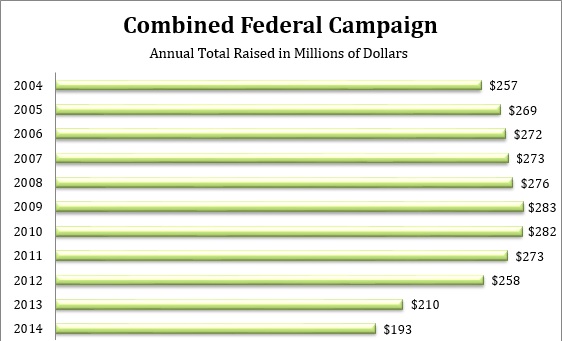
cfc-annual-total-raised

There may be a surge of giving before the end of the year, ensuring all will be well for this year’s CFC campaign. In general, though, I think we may all want to accept that, although many have tried hard to reverse the course of this decades old campaign, the CFC may not be a growth enterprise–type right now.


Our Voices Are Our Power.

Journalism, nonprofits, and multiracial democracy are under attack. At NPQ, we fight back by sharing stories and essential insights from nonprofit leaders and workers—and we pay every contributor.

Can you help us protect nonprofit voices?

Your support keeps truth alive when it matters most.
Every single dollar makes a difference.

Donate now
logo logo logo logo logo
About the author
Ruth McCambridge

Ruth is Editor Emerita of the Nonprofit Quarterly. Her background includes forty-five years of experience in nonprofits, primarily in organizations that mix grassroots community work with policy change. Beginning in the mid-1980s, Ruth spent a decade at the Boston Foundation, developing and implementing capacity building programs and advocating for grantmaking attention to constituent involvement.

More about: FundraisingPhilanthropy
See comments

You might also like
If Farm School NYC Closes, What Will the City Lose?
Farm School NYC and Iris M. Crawford
GivingTuesday: Mobilizing Grassroots Donors
Isaiah Thompson
Be Bold This GivingTuesday: Lessons from Public Rights Project
Jennifer Johnson
Four Ways Philanthropy Can Support the Movement for a Third Reconstruction
Richard Besser and Carmen Rojas
Black Women Claiming Philanthropic Space: A Conversation with LaTosha Brown
Rebekah Barber and LaTosha Brown
Foundations Look to New Models of International Development amid Retrenchment
Ted Siefer

Upcoming Webinars

Group Created with Sketch.
December 9th, 2:00 pm ET

Nonprofit Safety & Security: Protecting Our People, Data, and Organizations in a Time of Unprecedented Threat

Register
Group Created with Sketch.
January 29th, 2:00 pm ET

Future is Collective

Register

    
You might also like
Participants growing garlic at the Farm School NYC. 2025.
If Farm School NYC Closes, What Will the City Lose?
Farm School NYC and Iris M. Crawford
A red heart, formed by a group of people with painted hand palms, symbolizing solidarity in giving among the many.
GivingTuesday: Mobilizing Grassroots Donors
Isaiah Thompson
A group of diverse people volunteering by distributing food off of a truck, representing how Nonprofits across the country are ramping up their GivingTuesday campaigns.
Be Bold This GivingTuesday: Lessons from Public Rights...
Jennifer Johnson

Like what you see?

Subscribe to the NPQ newsletter to have our top stories delivered directly to your inbox.

See our newsletters

By signing up, you agree to our privacy policy and terms of use, and to receive messages from NPQ and our partners.

  • About
  • Advertise
  • Careers
  • Contact
  • Copyright
  • Donate
  • Editorial Policy
  • Funders
  • Submissions

We are using cookies to give you the best experience on our website.


Nonprofit Quarterly | Civic News. Empowering Nonprofits. Advancing Justice.
Powered by  GDPR Cookie Compliance
Privacy Overview

This website uses cookies so that we can provide you with the best user experience possible. Cookie information is stored in your browser and performs functions such as recognising you when you return to our website and helping our team to understand which sections of the website you find most interesting and useful.

Strictly Necessary Cookies

Strictly Necessary Cookie should be enabled at all times so that we can save your preferences for cookie settings.