logo logo
giving banner
Donate
    • Membership
    • Donate
  • Social Justice
    • Racial Justice
    • Climate Justice
    • Disability Justice
    • Economic Justice
    • Food Justice
    • Health Justice
    • Immigration
    • LGBTQ+
  • Civic News
  • Nonprofit Leadership
    • Board Governance
    • Equity-Centered Management
    • Finances
    • Fundraising
    • Human Resources
    • Organizational Culture
    • Philanthropy
    • Power Dynamics
    • Strategic Planning
    • Technology
  • Columns
    • Ask Rhea!
    • Ask a Nonprofit Expert
    • Economy Remix
    • Gathering in Support of Democracy
    • Humans of Nonprofits
    • The Impact Algorithm
    • Living the Question
    • Nonprofit Hiring Trends & Tactics
    • Notes from the Frontlines
    • Parables of Earth
    • Re-imagining Philanthropy
    • State of the Movements
    • We Stood Up
    • The Unexpected Value of Volunteers
  • CONTENT TYPES
  • Leading Edge Membership
  • Newsletters
  • Webinars

Another City Comes Out for Converting Local Businesses into Worker Cooperatives

Ruth McCambridge
August 9, 2017
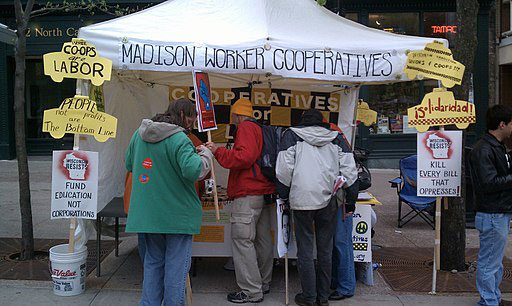
By cometstarmoon from Madison, Wis., United States of Disregard [CC BY 2.0], via Wikimedia Commons

August 7, 2017; Voice of OC

Over the years, NPQ has covered several stories where a city declares itself as open and ready to actively support worker cooperatives. Some examples are Rochester, N.Y., New York City, and Madison, Wisconsin. Now, top officials in the city of Santa Ana, California, have unanimously passed a resolution to support small business development through worker cooperatives.

Last week, the city council said that establishment of cooperatives keeps wealth flowing more broadly within the community. They suggested that when local business owners begin to consider if they may want to retire, conversions to worker cooperatives should be encouraged.

In 2015, advocates helped push a bill through the California Legislature, establishing a legal framework for co-ops across the state and affording them certain tax benefits and active support by local government would be invaluable.

Sign up for our free newsletters

Subscribe to NPQ's newsletters to have our top stories delivered directly to your inbox.

By signing up, you agree to our privacy policy and terms of use, and to receive messages from NPQ and our partners.

Staff were directed to study what actions the council might be take to support such conversions. Some of the measures to be investigated are incentives like access to grants and lower cost business licenses. Further, staff has been asked to work with local stakeholders to explore what might be included in a business ordinance encouraging worker cooperatives. The report is due back in 90 days.

Councilman Jose Solorio says that support of cooperatives is a good way the city can help “reduce exploitation” of workers currently in underground jobs while growing a healthy shared local economy.

Santa Ana, with a population which is 80 percent immigrant, is already home to a number of immigrant cooperatives supported by Santa Ana Building Healthy Communities, a 10-year initiative of the California Endowment. Around 22 percent of the Santa Ana community lives below the poverty level, according to the latest census, and some workers cannot be legally hired due to their undocumented status. Sandy Chiang, program manager at Building Healthy communities, said that some of the motivation for the recent interest in facilitating cooperative development is the gentrification of the area. This, she says, has resulted in a lot of hipster shops replacing local mom-and-pop shop endeavors.—Ruth McCambridge


Our Voices Are Our Power.

Journalism, nonprofits, and multiracial democracy are under attack. At NPQ, we fight back by sharing stories and essential insights from nonprofit leaders and workers—and we pay every contributor.

Can you help us protect nonprofit voices?

Your support keeps truth alive when it matters most.
Every single dollar makes a difference.

Donate now
logo logo logo logo logo
About the author
Ruth McCambridge

Ruth is Editor Emerita of the Nonprofit Quarterly. Her background includes forty-five years of experience in nonprofits, primarily in organizations that mix grassroots community work with policy change. Beginning in the mid-1980s, Ruth spent a decade at the Boston Foundation, developing and implementing capacity building programs and advocating for grantmaking attention to constituent involvement.

More about: Community DevelopmentCooperatives and Employee OwnershipEquity-Centered ManagementNonprofit NewsPolicy
See comments

You might also like
If Farm School NYC Closes, What Will the City Lose?
Farm School NYC and Iris M. Crawford
A Community Land Trust Movement Rises in New York City: Leadership Lessons
Deyanira Del Rio and Debra Ack
From Tenant Power to Social Housing: Pathways to a Just Housing System
Fernando X. Abarca
How Immigrants Are Creating a New World in the Shell of the Old
Luz Zambrano
Resisting Gentrification in Seattle: The Fight for Community Stewardship of Land
J.M. Wong
Confronting the Private Equity Menace to Restore Housing Affordability
Dr. Seumalu Elora Raymond

Upcoming Webinars

Group Created with Sketch.
December 9th, 2:00 pm ET

Nonprofit Safety & Security: Protecting Our People, Data, and Organizations in a Time of Unprecedented Threat

Register
Group Created with Sketch.
January 29th, 2:00 pm ET

Future is Collective

Register

    
You might also like
Participants growing garlic at the Farm School NYC. 2025.
If Farm School NYC Closes, What Will the City Lose?
Farm School NYC and Iris M. Crawford
Colorful mural of a child holding a nest, surrounded by community figures, birds, NYC landmarks, and the word “Brownsville” in bold letters.
A Community Land Trust Movement Rises in New York City:...
Deyanira Del Rio and Debra Ack
Mural of a person with eyes closed and hand on chin, surrounded by hearts, flowers, and drawings imagining the future, blending thought and hope.
From Tenant Power to Social Housing: Pathways to a Just...
Fernando X. Abarca

Like what you see?

Subscribe to the NPQ newsletter to have our top stories delivered directly to your inbox.

See our newsletters

By signing up, you agree to our privacy policy and terms of use, and to receive messages from NPQ and our partners.

  • About
  • Advertise
  • Careers
  • Contact
  • Copyright
  • Donate
  • Editorial Policy
  • Funders
  • Submissions

We are using cookies to give you the best experience on our website.


Nonprofit Quarterly | Civic News. Empowering Nonprofits. Advancing Justice.
Powered by  GDPR Cookie Compliance
Privacy Overview

This website uses cookies so that we can provide you with the best user experience possible. Cookie information is stored in your browser and performs functions such as recognising you when you return to our website and helping our team to understand which sections of the website you find most interesting and useful.

Strictly Necessary Cookies

Strictly Necessary Cookie should be enabled at all times so that we can save your preferences for cookie settings.