logo logo
giving banner
Donate
    • Membership
    • Donate
  • Social Justice
    • Racial Justice
    • Climate Justice
    • Disability Justice
    • Economic Justice
    • Food Justice
    • Health Justice
    • Immigration
    • LGBTQ+
  • Civic News
  • Nonprofit Leadership
    • Board Governance
    • Equity-Centered Management
    • Finances
    • Fundraising
    • Human Resources
    • Organizational Culture
    • Philanthropy
    • Power Dynamics
    • Strategic Planning
    • Technology
  • Columns
    • Ask Rhea!
    • Ask a Nonprofit Expert
    • Economy Remix
    • Gathering in Support of Democracy
    • Humans of Nonprofits
    • The Impact Algorithm
    • Living the Question
    • Nonprofit Hiring Trends & Tactics
    • Notes from the Frontlines
    • Parables of Earth
    • Re-imagining Philanthropy
    • State of the Movements
    • We Stood Up
    • The Unexpected Value of Volunteers
  • CONTENT TYPES
  • Leading Edge Membership
  • Newsletters
  • Webinars

Study: Retaining Donors through and after Recession Most Difficult for Small Nonprofits

Ruth McCambridge
January 7, 2015


Glue

January 6, 2015;Business 2 Community

It is a well-known rule of fundraising that it costs less to retain former donors than to recruit new donors, but do you know how well are you doing at retention? Do you know how that measures up in comparison to others? The Urban Institute and the Association of Fundraising Professionals have just released their enormously useful 2014 Fundraising Effectiveness Project (FEP) Survey Report. The study is based on donor data from 3,576 survey respondents, covering year-to-year fundraising results for 2012–2013. It is a valuable reference document for all fundraisers.

During this period, although respondents raised more than $2.44 billion from 2.2 million donors…

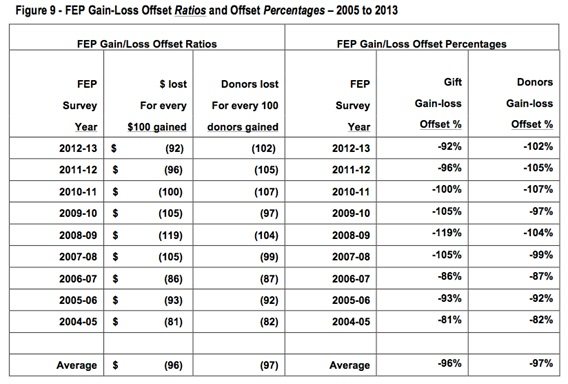
  • For every $100 gained, $92 was lost from lapsed donors and smaller gifts from current donors. (This net $8 is up from a net loss of $19 in 2009.)
  • For every 100 new and returning donors, 102 lapsed (an improvement from last year’s report of 105)
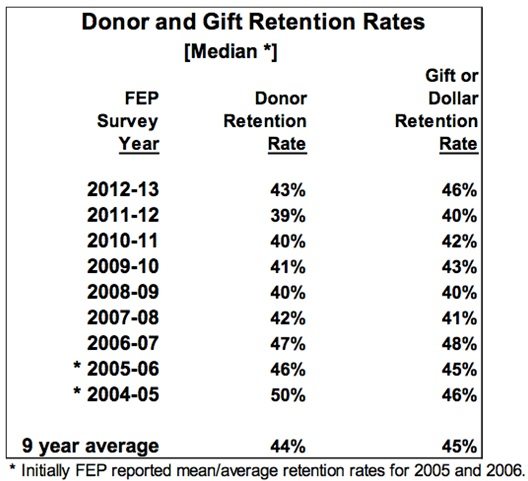
  • Forty-three percent of 2012 donors made gifts to participating nonprofits in 2013 (up from 39 percent in last year’s report)

This is the ninth year of the study, and as you can see from the chart below, these improvements are merely a recovery from a retention low experienced during the recession.
 

FEP

Sign up for our free newsletters

Subscribe to NPQ's newsletters to have our top stories delivered directly to your inbox.

By signing up, you agree to our privacy policy and terms of use, and to receive messages from NPQ and our partners.

Although the gift or dollar retention rate has fully rebounded and is producing a dollar net, the retention of donors is coming back much more slowly; in fact, nonprofits are currently losing more donors than they are gaining (see Figure 9).
Graph

NPQ has written repeatedly about the fact that for many small organizations, the recession meant cuts to infrastructure, including fundraising costs during a period where those expenditures were not paying off. Larger organizations, on the other hand, were able to maintain relationships with donors even if they were not currently giving.

Unsurprisingly, smaller charities have seen retention suffer during and in the aftermath of the recession. In 2012, organizations raising more than $500,000 saw an average gain of 16.6 percent in their net giving levels, while those raising $100,000 to $500,000 experienced net losses of 5.1 percent. Those raising less than $100,000 had even more significant net losses, at 13.5 percent.

Some of those differences have softened in the past year, but the implied story remains the same: Small organizations lost fundraising muscle while large organizations retained it.

Obviously, greater retention rates are worth your focus. Here is a summary of retention practices drawn from material produced by Professor Adrian Sargeant:

  • Connect often (especially in the 90 days after a first-time gift)
  • Share mission performance data often
  • Segment your database (by gift size/frequency)
  • Develop the donor relationship like a personal friendship
  • Find and use numerous human connectors
  • Always communicate what donations are used for
  • Be personal!

—Ruth McCambridge

 

Our Voices Are Our Power.

Journalism, nonprofits, and multiracial democracy are under attack. At NPQ, we fight back by sharing stories and essential insights from nonprofit leaders and workers—and we pay every contributor.

Can you help us protect nonprofit voices?

Your support keeps truth alive when it matters most.
Every single dollar makes a difference.

Donate now
logo logo logo logo logo
About the author
Ruth McCambridge

Ruth is Editor Emerita of the Nonprofit Quarterly. Her background includes forty-five years of experience in nonprofits, primarily in organizations that mix grassroots community work with policy change. Beginning in the mid-1980s, Ruth spent a decade at the Boston Foundation, developing and implementing capacity building programs and advocating for grantmaking attention to constituent involvement.

More about: Case StudiesDonor RelationsEquity-Centered ManagementNonprofit NewsPhilanthropyStakeholder Engagement
See comments

You might also like
GivingTuesday: Mobilizing Grassroots Donors
Isaiah Thompson
Four Ways Philanthropy Can Support the Movement for a Third Reconstruction
Richard Besser and Carmen Rojas
Black Women Claiming Philanthropic Space: A Conversation with LaTosha Brown
Rebekah Barber and LaTosha Brown
Foundations Look to New Models of International Development amid Retrenchment
Ted Siefer
The South’s Got Something to Say: Stories from Black Women in the South
Monica L. Coleman
How to Fund Like a Narrative Strategist
Chiara K. Cattaneo, Jody Myrum, Mandy Van Deven and Erin Lynn Williams

Upcoming Webinars

Group Created with Sketch.
December 9th, 2:00 pm ET

Nonprofit Safety & Security: Protecting Our People, Data, and Organizations in a Time of Unprecedented Threat

Register
Group Created with Sketch.
January 29th, 2:00 pm ET

Future is Collective

Register

    
You might also like
A red heart, formed by a group of people with painted hand palms, symbolizing solidarity in giving among the many.
GivingTuesday: Mobilizing Grassroots Donors
Isaiah Thompson
A neon-sign that says “repair” symbolizing the need to confront and self-correct the harms the sector has committed.
Four Ways Philanthropy Can Support the Movement for a Third...
Richard Besser and Carmen Rojas
An illustration of a nude Black woman squatting and leaning on her back hand while outstretching her other hand towards a glowing, golden sun.
Black Women Claiming Philanthropic Space: A Conversation...
Rebekah Barber and LaTosha Brown

Like what you see?

Subscribe to the NPQ newsletter to have our top stories delivered directly to your inbox.

See our newsletters

By signing up, you agree to our privacy policy and terms of use, and to receive messages from NPQ and our partners.

  • About
  • Advertise
  • Careers
  • Contact
  • Copyright
  • Donate
  • Editorial Policy
  • Funders
  • Submissions

We are using cookies to give you the best experience on our website.


Nonprofit Quarterly | Civic News. Empowering Nonprofits. Advancing Justice.
Powered by  GDPR Cookie Compliance
Privacy Overview

This website uses cookies so that we can provide you with the best user experience possible. Cookie information is stored in your browser and performs functions such as recognising you when you return to our website and helping our team to understand which sections of the website you find most interesting and useful.

Strictly Necessary Cookies

Strictly Necessary Cookie should be enabled at all times so that we can save your preferences for cookie settings.