
This article is the second in NPQ’s series Toward a Third Reconstruction, co-produced with Dēmos. Authors in this series articulate why we need bold, courageous action to bring a Third Reconstruction within reach—and offer strategies for systemic change that can help us get there.
As organizer Marshall Ganz explains, movement power is fundamentally about two things: organized people and organized money. This simple truth cuts through much of the noise of our current political moment to reveal what’s at stake.
We are living through a profound struggle over power in the United States, one that will determine whether we can achieve what several have called the “Third Reconstruction” or a further erosion of the democratic practices that remain under the weight of concentrated wealth and racial authoritarian consolidation.
In this struggle, labor’s role in organizing people is key. But this opportunity will not actualize itself. It requires investment, leadership, strategic campaigns, and an expansive vision of solidarity that reaches well beyond the union hall.
Unequal by Design
We are living through a profound struggle over power in the United States….In this struggle, labor’s role in organizing people is key.
Although often presented as values neutral, today’s economy isn’t just unequal by accident. It has been designed for extraction.
As W. E. B. Du Bois recognized almost a century ago in Black Reconstruction in America,1860–1880, concentrated wealth is concentrated power, and concentrated power is fundamentally incompatible with multiracial democracy.
What we call Trumpism and the MAGA movement represents the acceleration, not the origin, of racial authoritarian tendencies that have been building for decades. The current regime doesn’t merely tolerate inequality; it depends on it. Trumpism did not create this order, but its policies actively and explicitly accelerate it, while stripping away the polite fictions that once disguised it. Left unchecked, the current regime of concentrated wealth and unchecked power depends on, and thus systematically generates, four reinforcing dynamics:
- The capture and dismantling of government
- Government weaponization
- The relentless dismantling of public goods and investments in people
- The politics of division and identity-based scapegoating
Democratic practice withers when power is highly skewed. It is through gross inequities that race and identity are exploited and weaponized. Reviving—and reconstructing—the nation requires a new strategy, therefore, rooted in the movement lessons that led to what scholars call the First and Second Reconstructions.
This “reconstructionist strategy,” as our colleague K. Sabeel Rahman argues, requires a robust, multiracial, gender-inclusive labor movement as a necessary precondition for transformative change.
The Role of Identity and Status: Divide, Distract, and Coerce
Understanding how power maintains itself requires grappling with one of the most sophisticated tools in the authoritarian playbook: the weaponization of identity group stratification to divide, distract, and coerce the working class.
Elites, regardless of whether the system is nominally democratic or explicitly authoritarian, do not merely acquire power; they manufacture consent for people to accept its abuse. Their favorite tool is the promise of relative status—that is, separating White people from people of color, even when they share a similar class position. The logic is simple: if working-class White voters can be convinced that fellow working-class immigrants, Black voters, trans youth, or any ascribed group defined as the “other” are the real threat to their “way of life,” they will then defend the elites who actually hold material power. The result, in the US context, is a racialized caste system that drives a wedge between White and Black workers, offering what Du Bois called “a sort of public and psychological wage” or better access to privileges based on race, while impoverishing all.
That is, even as their economic interests are undermined by the very system that grants them this status, White workers perceive relative status through “public and psychological” wages. These status hierarchies are neither natural nor inevitable. They are reinforced and codified by patterns of ownership of capital in the economy, by state policy, by laws that define who can make claims on political and market institutions, including who gets protected and who gets excluded.
Strikes and mass disruption are essential tools of democratic resistance because they reveal and interrupt the flows of profit that sustain unequal power.
Another key factor concerns labor laws. These determine who has power in one of the nation’s core authoritarian institutions: the workplace.
Appeals to relative status are the calling card of authoritarianism—they fracture the solidarity necessary to challenge elite power. They turn the working class against itself, ensuring that organized money faces only fragmented resistance from organized people. The antidote is solidarity—real, practiced, institutionally expressed solidarity—instead of sentiment alone.
Labor’s Countervailing Power
Throughout US history, when ordinary people have bent the arc toward justice, they have done so not only, nor even primarily, through “moral suasion.” Typically, ordinary people achieve gains by disrupting business as usual, creating a crisis to be resolved, and compelling elites to negotiate. It is in this context when more just and egalitarian settlements emerge. This isn’t romantic nostalgia—it is strategic analysis based on the unique position of workers in the political economy and the special power of the strike weapon to interrupt profit flows.
Strikes and mass disruption are essential tools of democratic resistance because they reveal and interrupt the flows of profit that sustain unequal power relations. Du Bois understood this when he analyzed what he called the “general strike” by enslaved people during the Civil War—the mass work slowdowns, stoppages, and ultimately mass fleeing to freedom that helped bring down the Confederate economy and slaveholding regime.
Economic tactics were critical in the modern civil rights movement of the 1950s and 1960s, too. The Montgomery bus boycott demonstrated the power of economic noncooperation that made the costs of segregation visible and unsustainable. When Dr. Martin Luther King was assassinated, he was in Memphis supporting sanitation workers whose strike was fundamentally about dignity, human rights, and economic justice.
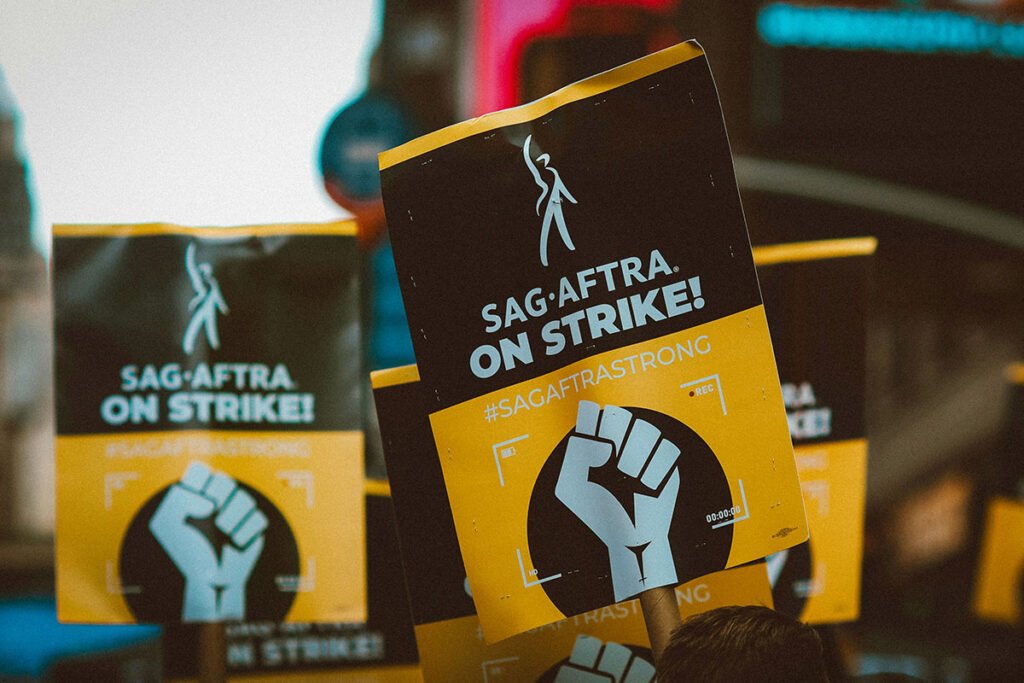
Today’s labor wave—from Hollywood writers and actors to healthcare workers and teachers to baristas and childcare workers—represents a continuation of this long tradition. Workers are once again discovering that their collective power to withhold labor is their greatest source of leverage in a political economy designed to extract value from their work, while denying them voice in how that work is organized.
Looking ahead, on May 1st, 2028 will bring an unprecedented convergence of expiring contracts across industries. This creates an organizing opportunity for the kind of mass coordination that can shift power relations rather than just winning marginal improvements. As one labor leader recently told us, “This is our moment to coordinate at a scale we haven’t seen since the 1930s.”
If those workers coordinate their demands and, if necessary, disruptions, we could witness the largest demonstration of people power since the Flint sit-down strike nearly 90 years ago. That is not a hyperbole; it is arithmetic.
Redefining Solidarity Beyond Labor: From Transaction to Transformation
At the same time, we must also reckon honestly with the historical failures of the labor movement. When the American Federation of Labor excluded Black workers in the early 20th century, when construction trades unions in the 1960s maintained apprenticeship programs that functioned as White ethnic job inheritance systems, even today when progressive industrial unions have failed to challenge workplace hierarchies beyond the factory floor—these weren’t just moral failures, they were strategic blunders that undermined labor’s capacity to build the broad and sustainable coalitions necessary for countervailing power and systemic change.
Sign up for our free newsletters
Subscribe to NPQ's newsletters to have our top stories delivered directly to your inbox.
By signing up, you agree to our privacy policy and terms of use, and to receive messages from NPQ and our partners.
Neoliberalism has taught us to understand solidarity as a convergence of shared interests in the pursuit of our individual self-interests, usually centered on the needs and perspectives of dominant groups within coalitions. This version of solidarity is brittle because it evaporates the moment people’s self-interests diverge or are co-opted by a competing power, or when sacrifice is required from those with relative privilege.
Solidarity is not a transaction. It is a durable, moral commitment to collective liberation.
The late political philosopher Charles Mills, author of The Racial Contract, and others have pushed us toward a different understanding: solidarity as a moral commitment rather than a transactional arrangement. Real solidarity means linking arms across lines of difference to fight shared systems of oppression, even when our immediate interests don’t perfectly align. It means recognizing that my liberation is bound up with yours (ubuntu), that the mechanisms of exploitation and opportunity hoarding constrain your life chances as well as mine, even if they operate differently across lines of race, gender, sexuality, nativity, and other forms of difference.
For the labor movement, this means leading with a transformative vision that centers inclusivity and identity rather than treating them as add-ons to an essentially economic agenda. It means understanding that fighting for $15 and a union is also fighting against the criminalization of Black youth and youth of color, against attacks on reproductive freedom, against the family separation policies that terrorize immigrant communities. These aren’t separate struggles—they’re different fronts in the same fight against concentrated power and for collective liberation.
Solidarity is not a transaction. It is a durable, moral commitment to collective liberation that recognizes our fates as interconnected and our struggles as ultimately indivisible.
Learning from History
Each previous attempt to democratize the US political economy offers lessons for our current moment. The First Reconstruction was fundamentally a democratic project that made enormous strides in expanding political rights through the 13th, 14th, and 15th Amendments. It was also a project of economic transformation—a fundamental redistribution of power from Southern slaveholding oligarchs to Black Southerners that created vital public goods like education systems financed by fairer taxation (which, however, receded as Jim Crow systems began to be implemented).
The Second Reconstruction—the Civil Rights era—made massive gains in dismantling formal segregation and securing political rights, but it never fully secured the economic rights that labor leaders like A. Philip Randolph understood as inseparable from civil rights.
Randolph’s March on Washington Movement in the 1940s explicitly linked civil rights and labor rights, demanding both fair employment practices and union recognition, as did the 1963 March on Washington for Jobs and Freedom. When King doubled down on economic justice in his final years, founding the Poor People’s Campaign and supporting striking sanitation workers, he was following this logic to its conclusion.
Each time in US history, when labor and democracy expanded together, they were also attacked together. The end of Reconstruction saw both the disenfranchisement of Black voters and the violent suppression of labor organizing. The neoliberal “counterrevolution” that began in the 1970s targeted both civil rights gains and union power, understanding correctly that these represented linked threats to concentrated wealth.
As Dr. King once famously said when addressing the AFL-CIO, “The labor-hater and labor-baiter is virtually always a twin-headed creature spewing anti-Negro epithets from one mouth and anti-labor propaganda from the other mouth.”
Toward a Political Economy of Freedom
What would a movement toward a Third Reconstruction look like? We contend that it must center inclusive economic rights.
This means not just restoring the right to organize and strike but expanding movement understanding of economic rights to include a right to housing, healthcare, education, childcare, and environmental safety as public goods, not private commodities. It means recognizing that reproductive freedom and immigration justice are labor issues because they determine who gets to participate in economic life on what terms.
Our economy is not neutral. Every aspect of how it operates—from labor law to trade policy, from tax structure to regulatory frameworks—reflects political choices. The current configuration isn’t the result of market forces or natural laws; it is the outcome of decades of policy choices that have systematically shifted power from working people to wealthy elites.
The government’s role should be to empower and invest in people and the environments in which we live, rather than subsidizing corporate profits, while leaving working families to fend for themselves.
This requires a paradigm shift from an extractive political economy to one of liberation that affirmatively provides care-based public goods, breaks up concentrated wealth and power, and invests in ordinary people, workers, and their communities.
Labor’s Essential Role
Labor movements are essential to organizing the power necessary to win rights because workers remain the most organized force in US society to center people power, providing the structural leverage to disrupt the power of capital.
We must move beyond technocratic tweaks to business as usual and toward the moral and structural transformation that our moment demands. The economy should center the people and the environments that we live in—ensuring that all people have the resources they need to thrive. That, ultimately, is what collective bargaining at scale can accomplish.
These days, the choice before society is clear: racial authoritarian control and domination or democratic renewal and authentic economic agency for all, with a focus on empowering the most marginalized.
There is no shortcut to achieving this transformation, only the long work of organizing and relationship building. This is not just a labor or economic issue. It is a democracy issue, a humanity issue, and a moral issue. The path out of racial authoritarianism runs directly through a multiracial labor movement.
To achieve a Third Reconstruction and build the multiracial democracy that the United States has never yet achieved, the labor movement must be active on the front lines of democratic defense and transformation.
This means labor leaders understand their role as democracy fighters, progressive donors treat labor organizing as democracy infrastructure, and all of us recognize that our individual fates are tied to the collective fate of working people everywhere.
Economic visioning, worker organizing, strikes, mass coordination, strategic noncooperation, and authentic solidarity are not ancillary to democratic renewal; they are the tools that make democracy possible. They disrupt authoritarian power, rebalance economic leverage, and forge the multiracial demos that the US Constitution only faintly promised. Our democracy, our economy, and our planet hang in the balance.