Welcome back to Ask a Nonprofit Expert, NPQ’s advice column for nonprofit readers, by civic leaders who have built thriving, equitable organizations.
This series offers Leading Edge members a new benefit: the opportunity to submit tough challenges anonymously and get personalized advice. In this column, we’ll publish answers to common questions to strengthen our entire community’s capacity.
In today’s issue, organizational leadership consultant Nick Takamine answers a reader’s question about capacity planning and leadership readiness.
Stuck on a problem? Submit your question here.
Dear Ask a Nonprofit Expert,
In the nonprofit strategic planning process, how critical is capability and capacity planning to assess how ready an organization is to bridge strategy and execution?
Sincerely,
Pragmatic Planner
Dear Pragmatic Planner,
I can imagine where you might be coming from with this question. Like so many of us, you may have seen strategy processes consumed by envisioning what could be, heavy on big-picture vision but light on what it might take to get there. The resulting strategies can struggle to offer practical guidance.
On the flip side, I have also seen strategy processes cling too tightly to what we’re comfortable committing to, inadvertently reinforcing organizational inertia. This approach can produce strategies that are more like glorified budget narratives, coordinating incremental change without confronting an organization’s deeper strategic questions.
Sign up for our free newsletters
Subscribe to NPQ's newsletters to have our top stories delivered directly to your inbox.
By signing up, you agree to our privacy policy and terms of use, and to receive messages from NPQ and our partners.
The greatest incoherence seems to occur when the juxtaposition of the terms strategic and planning is taken too far. This happens when strategy dreams up a big, hairy, audacious goal, then proceeds to take the form of a concrete plan. The SMART goals and methodical, multiyear timelines that result can often have little bearing on reality. These are the processes that get mocked as “strategy theater.”
I have also seen strategy processes cling too tightly to what we’re comfortable committing to, inadvertently reinforcing organizational inertia.
Is it even possible to reconcile our dreams of what could be with the present realities of what we’re comfortable committing to in strategy? I think so. These orientations can make sense together if we think of them as living in separate but entangled planes of organizational life.’
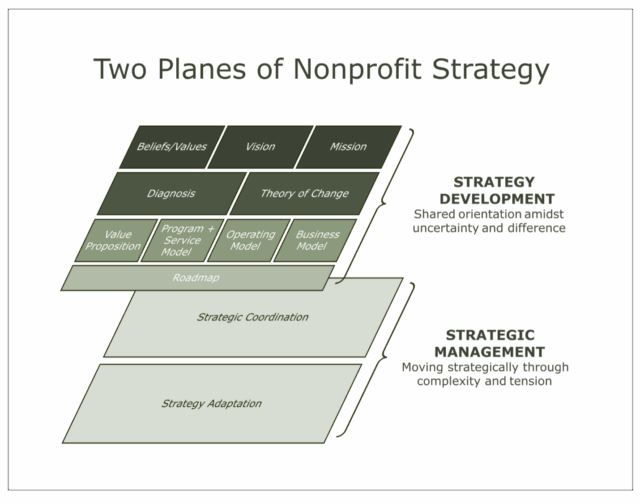
The Two Planes of Strategy
One plane contains the “future-back” work of aligning on strategic intent amid uncertainty and difference. Let’s call this strategy development. The other contains the “present-forward” work of moving strategically toward that intent through complexity and tension. Let’s call this strategic management. Both, together, constitute strategy.
Is it even possible to reconcile our dreams of what could bewith the present realities of what we’re comfortable committing to in strategy?
In the strategy development plane, we define our aspiration for the kind of organization we want to become. Here, we lean into bold, visionary, creative energy. We imagine the world we want. We consider what outcomes would have to become true for that world to exist. We ask “how might we” to consider our unique contribution to that change. We untether from mental models and organizational forms that no longer serve us. This is not, in my view, the realm of planning.
Instead, I see planning as a tool of strategic management. In the strategic management plane, we stay in constant relationship with present conditions as reality unfolds, taking the actual next steps available to us at a given time to iteratively open pathways to our strategic aspiration. Here, we lean into action-oriented, collaborative, learning-focused energy. We co-create the moves we can realistically make in service of our strategic becoming. We develop plans and budgets as tools to help us explore constraints, make trade-off decisions, and coordinate activity. The more complex and uncertain our environment, the more we consider those plans and budgets to be subject to revision.
Capability and capacity planning…shines when treated not as a definitive, singular answer but rather as an iterative dialogue between our aspirations and our present organizational realities.
Living in Both Planes
So, to answer your question directly: Yes, I believe capability and capacity planning is important in strategy. To me, it lives most comfortably in the strategic management plane, where it shines when treated not as a definitive, singular answer but rather as an iterative dialogue between our aspirations and our present organizational realities.
That dialogue is key. If I could offer one piece of advice, it is to avoid conflating or choosing between the strategy development and strategic management planes, and to instead operate fluidly across both. Make it a habit of strengthening shared orientation through regular exploration of the fundamental nonprofit strategic questions. Ensure day-to-day work is designed to open pathways to your organization’s strategic aspiration. And continuously learn from your encounters with reality, adjusting both aspirations and plans accordingly. This makes it possible to hold both what could be and what we’re comfortable committing to in productive tension at once.
In purpose,
Nick