In the environmental nonprofit sector, “centering frontline voices” has become a familiar slogan, often detached from how decisions are made or resources allocated. It appears in grant proposals, conference agendas, and organizational values statements. And yet, too often, those voices are still positioned as illustrative rather than authoritative—invited to animate strategies already decided, asked to translate lived experience into language legible to funders, or flattened into narratives that travel more easily than the truths they carry.
In mainstream climate and environmental work especially, frontline stories are frequently treated as communications tools rather than as sources of analysis, strategy, and accountability.
The Story Salon “Reframing Resistance,” presented during New York City Climate Week in September 2025, emerged from an intentional partnership between Counterstream Media and Frontline Resources Institute (FRI)—an initiative of the Environmental Defense Fund, grounded in a shared commitment to narrative as a site of strategy.
From the onset, our collaboration during Climate Week was shaped by a mutual understanding that story-based spaces only work when partners are willing to examine how power moves through the stories they support, and to practice deep listening as a form of accountability. At Climate Week in particular, as a space defined by polished talking points, corporate pledges, and institutional jargon, we wanted to interrupt that dynamic.
This pattern at climate conferences is rarely the result of ill intent. It is a function of how power moves through institutions: who controls space, who sets context, and who decides what counts as expertise. In mainstream climate and environmental work especially, frontline stories are frequently treated as communications tools rather than as sources of analysis, strategy, and accountability. Narrative becomes something added at the end, not infrastructure built from the ground up.
“Reframing Resistance” tested a simple but radical premise: what happens when frontline media makers are not asked to explain, persuade, or perform, but are instead recognized as the primary authorities on the realities they document? What shifts when funders, advocates, and policymakers are invited into a space designed not for interpretation, but for listening?
Why Counterstream Story Salons Exist
Story Salons are not panels or networking events. They are intentionally designed, closed-door spaces used as a strategy for narrative shift and power building. Namely, who defines the story, whose analysis circulates, and how that analysis informs decision-making.
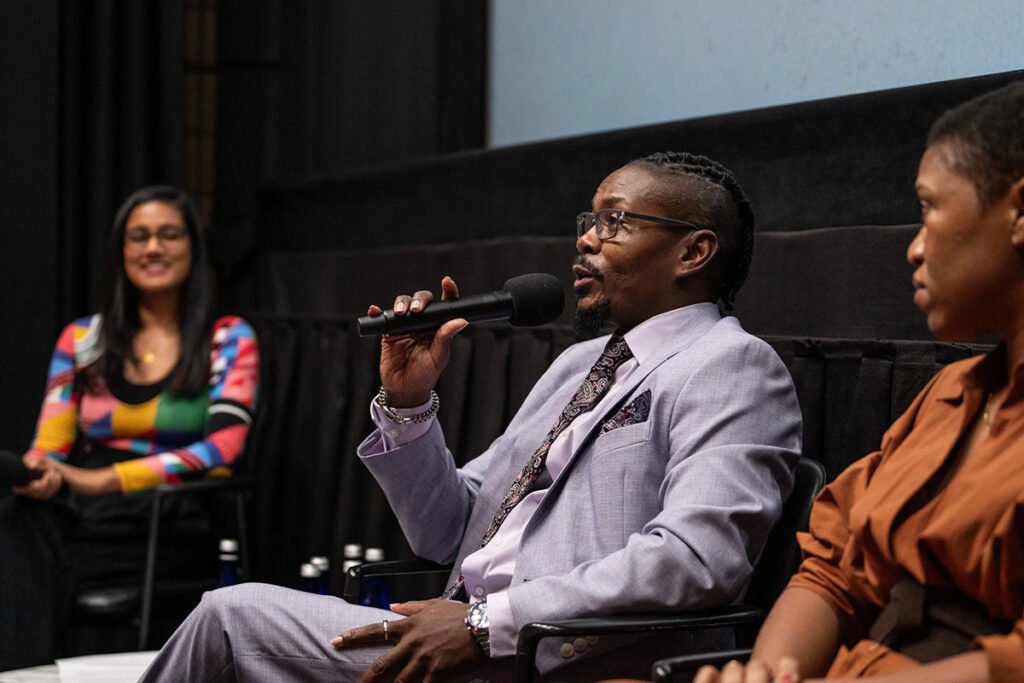
In our seventh Story Salon since Counterstream’s inception in 2021, “Reframing Resistance” centered the work of three frontline media makers and FRI grantees: Chantel Comardelle, Alexandra Norris, and B. Preston Lyles. Their films explore Indigenous climate migration, toxic prisons, and petrochemical harm through the lens of communities that are most impacted by unjust systems.
Frontline communities already hold deep analysis of the systems harming them and the pathways needed to respond. What is most often missing is not voice, but recognition of that authority.
These works are not simply illustrative climate stories. They are narrative interventions—developed through long-term engagement (often at personal cost) and a refusal to flatten complexity.
The structure of the Story Salons matters as much as the content. There is no traditional Q&A and no expectation that the filmmakers would translate their work into policy language or palatable takeaways. Audience members, including funders, policy experts, and nonprofit leaders were asked to listen and be present, without redirecting, reframing, or extracting.
Too often, nonprofit and philanthropic spaces position themselves as neutral conveners, when in reality they shape how stories are received, circulated, and ultimately acted upon. By reducing the pressure to interpret or justify, these live storytelling events help surface something the sector too often overlooks: Frontline communities already hold deep analysis of the systems harming them and the pathways needed to respond.
What is most often missing is not voice, but recognition of that authority.
Choosing Partners Is Part of the Practice
Our partnership with FRI was not incidental. Story-based spaces like this only work when institutional partners are aligned not just on values, but also on practice.
Counterstream approaches partnership selectively. We do not collaborate simply to expand capacity, reach, or visibility. We look for partners willing to interrogate their own power, share curatorial control, and commit to listening as an active responsibility. That alignment matters because narrative spaces are shaped as much by who convenes them as by who speaks within them.
Sign up for our free newsletters
Subscribe to NPQ's newsletters to have our top stories delivered directly to your inbox.
By signing up, you agree to our privacy policy and terms of use, and to receive messages from NPQ and our partners.
FRI’s work sits at the intersection of frontline organizing and institutional philanthropy. That positioning made it possible to co-create a space where frontline media makers were not asked to adapt their stories to institutional comfort, and where institutional actors were invited to sit with hard truths without rushing toward resolution.
Margot Brown is vice president of Justice and Equity at Environmental Defense Fund and acting director at Frontline Resources Institute. She shared: “Listening is not a passive act for institutions—it’s a responsibility. Spaces that center narrative authority ask large environmental NGO’s to examine not only what stories they amplify, but how they respond to them in practice.”
We look for partners willing to interrogate their own power, share curatorial control, and commit to listening as an active responsibility.
Narrative Infrastructure Is More Than Messaging
Narrative is not simply about messaging or visibility. It is infrastructure that determines whose knowledge circulates, whose analysis shapes decisions, and whose realities are considered actionable.
When narrative infrastructure is extractive, frontline voices, largely from Black, Indigenous, and communities of color, are consumed and discarded—valued for their emotional resonance but detached from decision-making power. When it is intentional, those same stories can reshape power by redefining who holds authority. Story-based spaces, when designed with care, can slow the churn of performative inclusion and create conditions for deeper accountability.
Narrative infrastructure also depends on how stories travel. If frontline narratives are confined to private rooms or reduced to highlights, their authority erodes. For Counterstream, this is why multimedia storytelling is not an add-on but a continuation of the same practice. Live convenings, digital publications, and audio are treated as connected forms in service of movement media—each extending the life of a story without diluting its integrity.
“Reframing Resistance” was produced with this in mind. The Story Salon was recorded and aired as the season finale of A People’s Climate, a podcast I host for The Nation—an independent publication founded by abolitionists in 1865, with a deep history of political and social analysis. That partnership reflects a shared commitment to long-form, justice-centered journalism that reaches beyond traditional environmental audiences and into broader public discourse.
For B. Preston Lyles, a media maker and lead organizer for the Toxic Prisons Campaign, narrative change is the line between recognition and erasure.
“If this work is going to happen, then the narrative has to change. People have to see people as just that. We cannot see people as other,” he said at the Reframing Resistance salon. “This is why abuses occur, because humans decide that other humans are objects. I have to be a reductionist in order to stand by and watch your life fall apart and do nothing while my life is going just fine.”
This does not mean every convening needs a live storytelling component, or that every organization needs a podcast. It does mean that nonprofits and funders must be honest about how their narrative spaces function. If narrative is truly infrastructure, then it requires sustained investment in the organizations and media makers building it—not one-off support for content, events, or visibility. Narrative infrastructure is revealed by its design and the resources that follow it.
The Counterpractice: What the Sector Must Unlearn
If environmental nonprofit and philanthropic institutions are serious about centering frontline expertise, some habits must be unlearned:
- The urge to translate rather than build trust
- The belief that scale requires institutional bureaucracy
- The assumption that discomfort signals failure rather than learning
- The treatment of narrative as an add-on, rather than core infrastructure
Unlearning these habits does not require perfection. It requires a willingness to change how power is held, including who sets the terms of storytelling, who controls narrative space, and who is resourced to steward it. It requires supporting spaces that redistribute narrative authority and building partnerships grounded in mutual accountability rather than institutional convenience.
The lesson is not that stories are powerful—that is already widely acknowledged. The lesson is that how stories are held determines whether they reinforce existing power or help transform it.
When frontline narratives are treated as authority, they do more than move audiences. They shape decisions, expose accountability, and expand what becomes possible for long-term systemic change.