
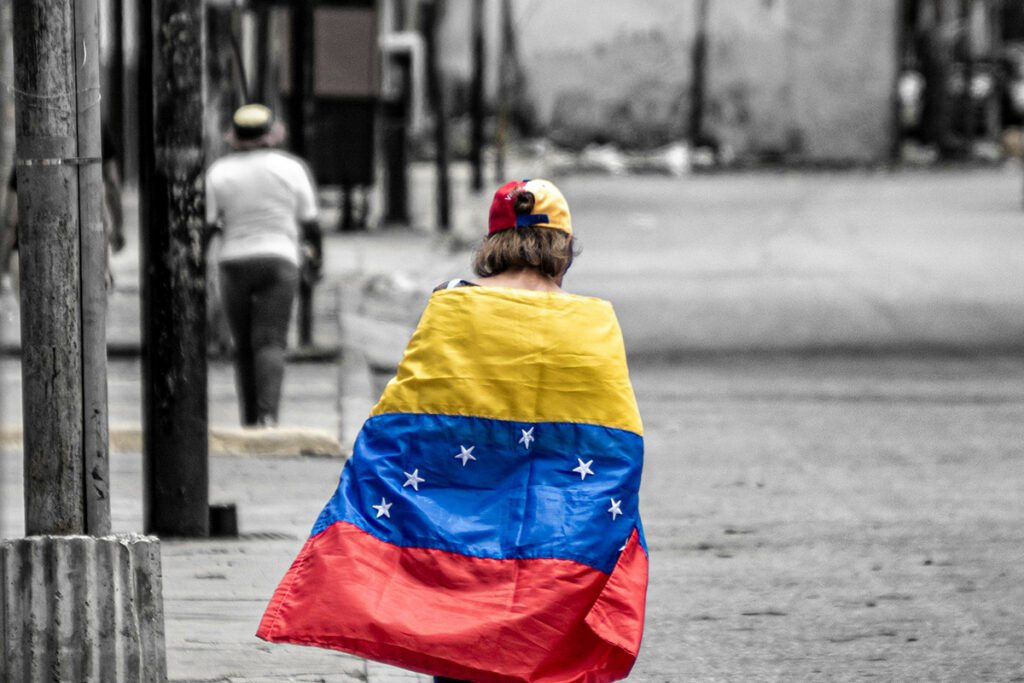
After months of hiding in anonymous locations, Jesus Armas, a political activist and educator, went to a coffee shop in Caracas. But the minute he stepped outside the business, he was captured by masked intelligence team members working for Nicolás Maduro, who was the 53rd president of Venezuela until his capture by US forces in January 2026.
Armas was taken to a house where a plastic bag was placed on his face to restrict his breathing and he was asked questions about the whereabouts of Maria Corina Machado, an outspoken dissenter of the Maduro administration. He didn’t know the answers, but his imprisonment last for nearly a year.
In an interview with NPQ, Armas shared, “I was cut off from the outside world. I spent almost a year without being able to have visits or phone calls, without any information about my family. You were kept 15 or 20 days without seeing the sun because we were in cells without windows.” Sairam Rivas, his significant other, sued repeatedly to be allowed to visit him. She took food, books, and toiletries to him. Meanwhile, Armas continued to learn more about activism from fellow peers such as Perkin Rocha, Machado’s defense attorney, who is still detained.
Armas was released in February 2026 after being housed in el Helicode, a prison in the city, for more than a year. He was one of an estimated 2,500 civilians, journalists, and politicians arrested for protesting against the power grab of Maduro in 2024. He had been the organizing campaign coordinator for Edmundo González, who won the presidential election, but the administration refuted the results. He and others had proof of the winning votes.
As Marysabel Rodríguez, coordinator at the nonprofit Espacio Público, explained to NPQ, “The issue of electoral fraud led to massive post-election repression, which resulted in the arbitrary detention. There was a kind of mechanism of mass arrests regardless of whether people were committing crimes or not.”
At the time of Armas’ arrest, he and Rivas had been living together and were participating in demonstrations asking for fair election results. They were concerned that she would be next. She said, “After my partner was arrested I took on an increasingly active role. They showed him photos of me and places where I lived. The more I participated in the protests and activities, the more they persecuted me.” Rivas was able to obtain political asylum and lived abroad to avoid detention. She returned to Venezuela in the spring, reuniting with newly freed Armas in their native homeland to continue their activism work. Armas has attended therapy and continues to tell his story. He accepts that being arrested again is a risk he takes.
Protestors in Venezuela have been persecuted for political dissent for more than a decade. They have faced questioning, arbitrary detention, and various forms of punishment. A recent United Nations report shows that under acting president Delcy Rodriguez’s rule more than 300 people are in custody, media censure continues, and repressive laws remain. Espacio Público, PROVEA, the Comité por la Libertad de los Presos Políticos (CLIPPVEA), and others are defending freedom of expression in the country. They work to advocate for their release, to inform the public about their rights, and to keep pushing for law reform that criminalizes the right to dissent. “They claimed we were part of a network of organizations that were financing terrorism. Under this charge, the organization was allegedly creating a state of national unrest,” explained Oscar Murillo, the executive director of PROVEA.
The majority of political prisoners have been released, but many are still behind bars. At Espacio Público, staff lawyers and volunteers provide free legal advice and representation in court if needed. The organization publishes annual reports with data about inmates, including their professions and genders, and descriptions about rights violations. Rodriguez has said that there has been a decrease in arbitrary arrests.
In September, the government announced it would unblock news websites. There is more access to news than before, but updates show that dozens of domains and several publications are restricted. Espacio Público is still trying to help free a journalist arrested in 2019. “Media outlets are still blocked and while some legal reforms are emerging, they are quite limited. Censorship is still present in some form. The order to broadcast certain content to the media remains,” said Rodriguez.
There are laws that were designed to persecute and punish dissent. The Constitutional Law Against Hatred, for Peaceful Coexistence and Tolerance allows political activists to be charged with the crime of discrimination, who can then be jailed. The Law for the Control, Regularization, Operations and Financing of Non-Governmental and Related Organizations, also known as the anti-NGO law, mandates that nonprofits register with the government and forbids them from engaging in actions that promote intolerance. Groups risk dissolution and fines if they break the law.
Sign up for our free newsletters
Subscribe to NPQ's newsletters to have our top stories delivered directly to your inbox.
By signing up, you agree to our privacy policy and terms of use, and to receive messages from NPQ and our partners.
And although Maduro was ousted from office in January, his former staff members and security agencies that enabled rights violations have maintained positions of power and haven’t been held accountable. As Rodriguez emphasized, “The repressive structure remains and the risk of a repeat of the most disruptive patterns of previous years is still present. The officials who operate and manage the apparatus are there.”
Rivas co-founded the group CLIPPVEA In 2022 when arrests in the country increased. Her efforts began in college when supporters of Chavez threatened opponents at the Central University of Venezuela. She and other classmates were arrested for protesting against the militarization of public spaces. That was her first time in el Helicode, and she remembers the death of a peer that influenced her decades-long commitment to her work. “It’s very important not to see the victims just as recipients of the program,” she said. “We want to train them to transition from victims to human rights defenders so they can be involved in strengthening democracy. They can then become leaders.”
CLIPPVEA aims to create a safe space to support detainees and their loved ones, to provide room for healing and remembrance, and to encourage families to continue fighting for reparations and justice. It has recently organized marches and public demonstrations in front of prisons. It helps relatives obtain legal assistance and trains them to learn about their civil liberties. The nonprofit also records lists of prisoners, their cases, the conditions of detention centers—and keeps track of those who died in custody.
PROVEA has accompanied the politically persecuted at marches and public demonstrations. Like Espacio Público and CLIPPVEA, it has advocated for them on social media. It became a target of criticism for the administration two years ago and was threatened with closure. Their lawyers were detained for months, leaders were questioned, and the organization received direct attacks by authorities of the regime.
This year’s report by PROVEA, “The Eclipse of Democracy,” is focused on monitoring freedom of expression. The organization has a larger mission that campaigns for access to healthcare, the environment, education, and housing. Its annual reports highlight pressing issues and provide data about each topic. The nonprofit plans to continue monitoring and advocating for the improvement of human rights in the country.
Murrillo said, “The current social demand is for these imprisonment processes to be brought to a close once and for all. There is currently no policy of remediation or reparation for the damage caused to all these people who were unjustly imprisoned in the country.”
Venezuelans are more comfortable than before participating in political demonstrations. Vigils are held by the families of prisoners—activities that would have been dispersed by authorities in the past. The government is showing greater tolerance towards members of political oppositions and civil society groups. Whether that will continue is to be seen. Organizers envision a democratic country with a new administration to carry out law reform that would eliminate press censorship, and guarantee citizens the right to freedom of expression.
As Murrilo described the situation, “After January 3, there has been a reduction in these cases of repression. What’s needed for progress is the reform to be implemented and made concrete.”