April 8, 2019; NBC News
Did you know there are about 7,000 spoken languages in the world? In the Americas alone, over 1,000 languages are spoken by indigenous groups. For the staff at Radio Indígena, the variety of languages is both a reason for being and a cause to advocate.
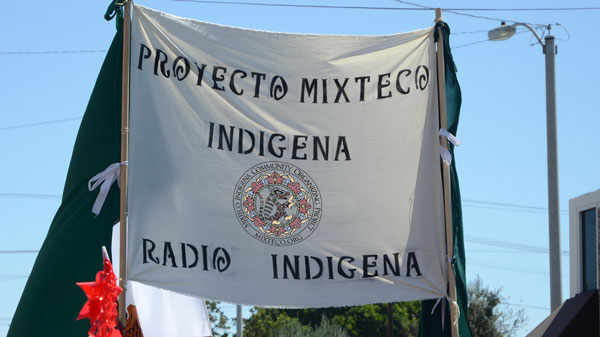
Radio Indígena (“indigenous radio” in, ironically, Spanish) broadcasts 40 hours of weekly original programming in languages such as Zapoteco, Triqui, and Nahuatl. It is hosted and run by the Mixteco Indígena Community Organizing Project (MICOP), a nonprofit in northern California formed to “aid, organize, and empower the indigenous immigrant community in Ventura county.”
The speaking of native languages is a critical part of cultural identity and well-being for indigenous communities, and it’s critical to the well-being of immigrant workers and their families who arrive in the US without speaking either English or Spanish. Josefino Alvarado, a California farm worker, said that many in his community were not kept abreast of current events before Radio Indígena because no news source was available that they could understand. Only a handful of indigenous radio stations exist in the US.
Broadcasting in indigenous languages isn’t just about making people informed, healthy, and welcome; it’s also about preserving a heritage that’s endangered. Of the world’s roughly 7,000 languages (there’s no way to get an exact count), about 40 percent are vulnerable or endangered, according to UNESCO. NPQ reported earlier this year that Alaska’s governor had declared a “native languages emergency.” Delfina Santiago, who co-hosts a show about indigenous history on Radio Indígena, said, “We’ve already lost three languages in Oaxaca…they’re gone.”
Many immigrants come to the US from Oaxaca—so many that a school district in California had to ban the term “Oaxaquita,” or “little Oaxacan,” as offensive. (According to census data from 2010, about 685,000 Latinx people in the US identify as indigenous.) People from Oaxaca frequently speak Mixteca, which has linguistic roots dating back 10,000 years and has over 50 dialects.
Sign up for our free newsletters
Subscribe to NPQ's newsletters to have our top stories delivered directly to your inbox.
By signing up, you agree to our privacy policy and terms of use, and to receive messages from NPQ and our partners.
Immigration contributes significantly to the loss of indigenous languages—or rather, the cultural isolation and discrimination that immigrants often face does so. Parents who emigrate to the US don’t always land in a place where others speak their language, and children are encouraged to learn English or Spanish to facilitate communication. Without a community of people who speak it, preserving a language is next to impossible; written resources on the Internet are scarce or unavailable for the vast majority. Wikipedia, for example, has active pages in less than 300 languages. There are English and Spanish pages about Mixteca, but no page written in the language, even though Mixtecs are the third-largest group of native Mexicans.
In part because of this paucity of resources, MICOP and Radio Indígena do more than just provide radio in various languages. MICOP provides medical and mental health services, education and literacy programming for kids, direct assistance to indigent community members, and cultural competency training for others wishing to engage the indigenous community—in addition to what it refers to as “community empowerment,” which includes Radio Indígena. They do all this with a budget of less than $2 million and only one full-time executive staff member. Eighty percent of MICOP’s staff is indigenous, as is forty percent of their board.
Organizations like MICOP, Radio Indígena, Indigenous Rights Radio, and other Latinx indigenous resources may be increasingly necessary as the demographics of immigrant populations shift. (North American indigenous communities, of course, have their own language preservation efforts and media organizations.) The New York Times noted that immigrants speaking only indigenous languages face increasingly long waits at the border because, though immigration officials provide interpreters in 350 languages, they’re missing or sparse in languages like Mam, K’iche’ and Q’anjob’al (all indigenous to Guatemala) and people arrive unable to communicate with immigration officials, advocates, or lawyers.
Jennifer Medina at the New York Times quoted Blake Gentry, a researcher who estimates that as many as a third of the migrants crossing the border through Arizona do not speak Spanish. “We have an entire infrastructure set up where the default language is Spanish, but there are thousands of people coming to the southern border who can’t communicate that way—and they basically become invisible.”
Maybe not invisible so much as unseen, and Radio Indígena and others are working to combat that trend. The United Nations declared 2019 the “International Year of Indigenous Languages” to preserve, honor, and educate about these traditions.—Erin Rubin