Farming 250, A Series with Civil Eats focuses on the question is being asked: What does America look like right now? In this new series, Farming 250, Civil Eats seeks to answer that question from the soil up. The newsroom is partnering with NPQ for the #WeTheCivic America 250 campaign.
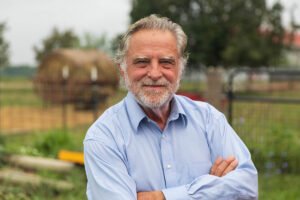
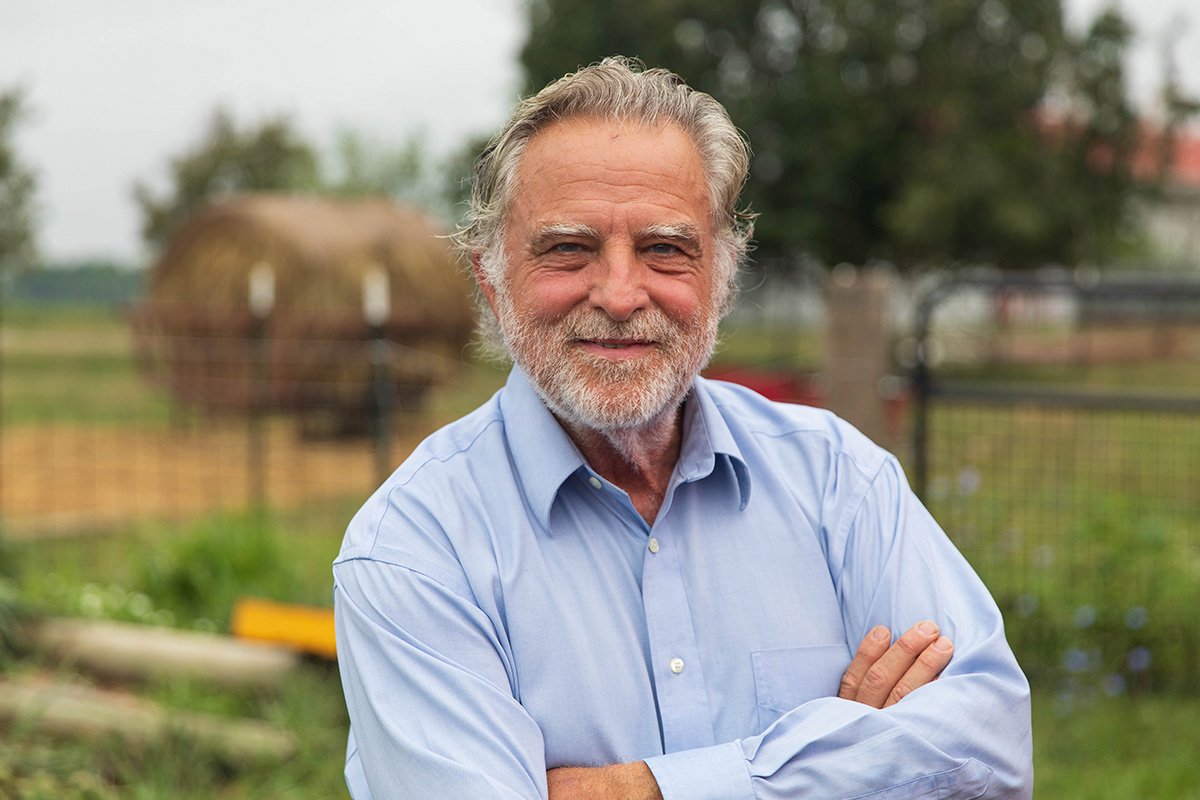
Johnny O’Mara is a first-generation shepherd in Mendocino County, in Northern California, and spent much of his childhood on his family’s property in the oak woodlands near Ukiah. From his uncle, he learned to hunt deer and wild pig there, beginning at the age of five. He now lives in a cabin on that same land.
After graduating from college with a philosophy degree, O’Mara felt the pull of the land. He trained for about two years at the Chadwick Garden in Santa Cruz under Orin Martin, and then worked on diversified farms in Sonoma County. Briefly, he ran his own small farm.
I think stewardship is ultimately about creating conditions for more life. If the grasslands are healthy, the animals are healthy. If the animals are healthy, people are healthy.
In his late twenties, looking for a way to work more directly with animals, he joined a friend’s contract grazing operation for wildfire fuel reduction across Northern California. That became his entry point into shepherding.
After five years in the system, working 12 to 14 hour days moving flocks through Marin, Sonoma, Napa, and Petaluma, O’Mara stepped back from large-scale grazing full time. Today O’Mara lives on his family property with a flock of 40 goats that he tends for his own sustenance. He also works as a freelance ranch hand for the neighboring community.
His main passion, though, is leading workshops dedicated to the “lost arts” of animal husbandry: animal processing, hide tanning, and felting. He relishes teaching skills often missing from modern food systems and guiding others to view shepherding as a relationship with the land.
Civil Eats sat down with O’Mara for a conversation on what it means to live and work closely with animals and connect people to the sources of their sustenance.
One of the most rewarding parts of this work is watching the land respond. I’m seeing a lot of wildflowers returning—Brodiaea, Calochortus (especially fairy lanterns)—and native sedges taking over.
How did your relationship to land, animals, and stewardship develop? What shaped the way you see the landscape you live in today?
The land that I’m living on was a hop farm during the Prohibition era. My great uncle bought it in the 1930s and it has been in my family for four generations. I’m the only one left to take care of this land. I’ve been hunting here since I was five, and now I’m running animals on it, which is really wild.
Here in the woodland, I’m reintroducing ruminants into the landscape in hopes of helping evolve these grasslands. I’m using grazing to increase biodiversity, improve the health of the grasslands, and reduce fire fuel and risk with my flock of mostly Alpine, Oberhasli, and Saanen mixes. I’m trying to create better conditions for the deer, the wild pigs, and everything that’s around.
I think stewardship is ultimately about creating conditions for more life. If the grasslands are healthy, the animals are healthy. If the animals are healthy, people are healthy.
One of the most rewarding parts of this work is watching the land respond. I’m seeing a lot of wildflowers returning—Brodiaea, Calochortus (especially fairy lanterns)—and native sedges taking over. The holy grail is to get the seedheads of non-desired species before they can disperse.
It’s a super privileged thing that I get to have goats, and I get to have land.
You stepped away from contract grazing and now work as a freelance ranch hand. Why?
The grazing business is very arduous. It’s mostly dominated by large operations with thousands of sheep, lots of infrastructure, a lot of capital. You need trucks, trailers, living setups, fencing, workforce.
I had 130, 150 animals at one point and I kind of drove myself crazy. I was all over the place. Wherever there’s work, you haul your animals there and set up camp, and it wasn’t really working for me anymore.
I think about kin as family. Family are the people we’re indebted to.
You’re constantly trying to meet landowners’ expectations, and sometimes what they want is not actually what’s good for the animals or the land. The sheep are not a mower. They replicate mowing, but it’s not the same thing. There’s a term in grazing called moonscaping, where you make the Earth look like the moon. A lot of people want every bit of vegetation removed because they think that’s what fire safety looks like.
But having grass on the ground doesn’t mean it’s going to burn I think there’s an ecological illiteracy problem in how people understand these systems. In ecologically managed grazing, trampled vegetation is left on the ground as mulch. The soil gets manure, urine, and hoof disturbance, but it’s still covered. That keeps soil cooler, feeds soil biology, and supports healthier grasslands.
Now I really like being able to show up for people who need competent help and know they can rely on me. It’s hard to find trained people to work as ranch hands. It’s a unique skill to be able to move animals, load trailers, herd cows in the hills, build fences. These are becoming lost arts that you can’t really go to school to study.
You often speak about reciprocity and kinship when it comes to stewarding land and animals. What do they mean to you?
Sign up for our free newsletters
Subscribe to NPQ's newsletters to have our top stories delivered directly to your inbox.
By signing up, you agree to our privacy policy and terms of use, and to receive messages from NPQ and our partners.
I think about kin as family. Family are the people we’re indebted to.
Over years of living with my animals, we’ve built a relationship. The reciprocity shows up in caring for them and creating systems that make it easier to care for them.I milk them every day. I let them out on the range, where they roam with their guardian dogs. I walk them up drainages where I want them to browse during certain parts of the year or on certain days, and I’ll go gather them up.
There are no fences on my property. The goats know where the springs are, where they’re safe, where the predators are, and where the best forage is throughout the seasons.
They depend on me, and I depend on them.
They provide me with meat and milk and cheese. And I use the leather: I have a pair of boots that I wore for three years, like pretty much daily, that were from my old billy goat. They are some of the strongest material I’ve ever had.
At the core of my desire to be working in agriculture is to have my own relationship with food. It’s a very lucky thing. With goats and the land, I get to be part of this more-than-human community.
You’ve been leading a growing number of animal harvesting and land-based skills workshops this year. What’s drawing people to these experiences, and what happens when someone harvests and processes an animal for the first time?
I heard a call for it in the greater community. It started off as a friend calling me, saying, “Hey, a deer jumped into my garden and broke its neck. Can you come and deal with it?” And people would see a deer get hit by a car and want to use the venison and tan the hide.
The animal processing classes mark a threshold for people. It becomes a rite of passage and a birthright to reclaim this ability to process ruminants for consumption.
In my classes, we hold the animals as they transition. The “how” is everything. We bring an animistic worldview, seeing animals not as objects, but as subjects. We are demystifying this amnesia that meat just shows up at the store wrapped in plastic.
There was a woman in the class who was really keen on getting into hunting, and I let her hold the knife and kill one of the goats. She did it better than I’ve ever done it. It was amazing to watch her first time—fluid, easy.
She wants to hunt, and that skill is going to serve her. And she’s going to teach other people how, and they’re going to teach people.
Once you learn the skills, they become part of the way you see the world.
In your workshops, you’ve described these skills as bringing “an ancient agreement” into focus. What is that agreement, and how do you understand it through your work with animals?
The ancient agreement is one of the guiding principles in my life. It was first framed to me in college studying the French phenomenologist Maurice Merleau-Ponty. The Phenomenology of Perception is the first literary work where a white man talks about how we are just a network of our relationships—which is, of course, an Indigenous perspective.
In my workshops we say, “I’m killing this animal because this is the agreement that I want to make. In order to feed myself, I want to be in relationship with these sheep and goats that are tending the grasses in this way that I believe in.”
In the dominant culture, we don’t even have the time to think about these agreements that we make with life. We say we want to be causing less harm. But how much harm is caused every time you fill up your gas tank? We’re not actually getting to see what dies with our carbon footprint.
What is the direction you want to move toward, and what do you hope your legacy will be for future generations?
Right now, I want to do more teaching. As for legacy, I hope that I’m inspiring a generation of people who want to live a more intimate life with Mother Earth and feel competent about that connection.
I always return to a beautiful interview with the poet Gary Snyder. He said that if we’re going to save this planet, we’re going do it because we love it, not because we feel guilty.
This interview has been edited for length and clarity.