Farming 250, A Series with Civil Eats focuses on the question is being asked: What does America look like right now? In this new series, Farming 250, Civil Eats seeks to answer that question from the soil up. The newsroom is partnering with NPQ for the #WeTheCivic America 250 campaign.
This piece was originally published on Civil Eats and can be read here.
A predominant political narrative in both the Beltway and mainstream media posits that all American farmers voted for Trump and are now suffering due to tariffs and the Iran war. According to this narrative, the big question is whether these salt-of-the-earth, Midwestern drivers of oversized tractors will stick with the president.
Michael Shepherd, an assistant professor at the University of Michigan who studies the politics of rural communities, is currently working on a farmer-focused survey that seeks to answer that exact question. But he’s also interested in how it fits into the bigger, long-term picture that gets less attention: Like most Americans, farmers have always been a diverse, complicated group with evolving political priorities.
“I very much see farmers as part of this broader story of rural politics,” Shepherd told Civil Eats recently. Those politics have shifted right over the last 50 years as economic realities changed and political parties began homing in on culture war issues.
As a political scientist who also teaches health policy, Shepherd has looked at a wide range of factors—from racism to healthcare access—that shape how rural people vote. His book, Rural Pain, Republican Gain, will be published this August.
What his research has shown, he said, is that many Plains farmers, who harvest thousands of acres of commodity corn each year, are primarily conservative and likely vote Republican based on their economic interests. But as soon as you move beyond that group, things get more complex.
“I think agriculture is deeply tied to how rural people perceive themselves and how they think about themselves and their communities, even if the share of people actually working in that industry is a little bit smaller than the stereotype.”
Broadly speaking, farmers operating small, diversified, and organic farms tend to lean left, or libertarian. But at the level of individual farmers, the picture is even more complicated.
Rancher Will Harris, for example, recently told Civil Eats that he’s “apolitical,” but he went to the White House last year because administration officials were talking about soil health and curbing the influence of agribusiness corporations.
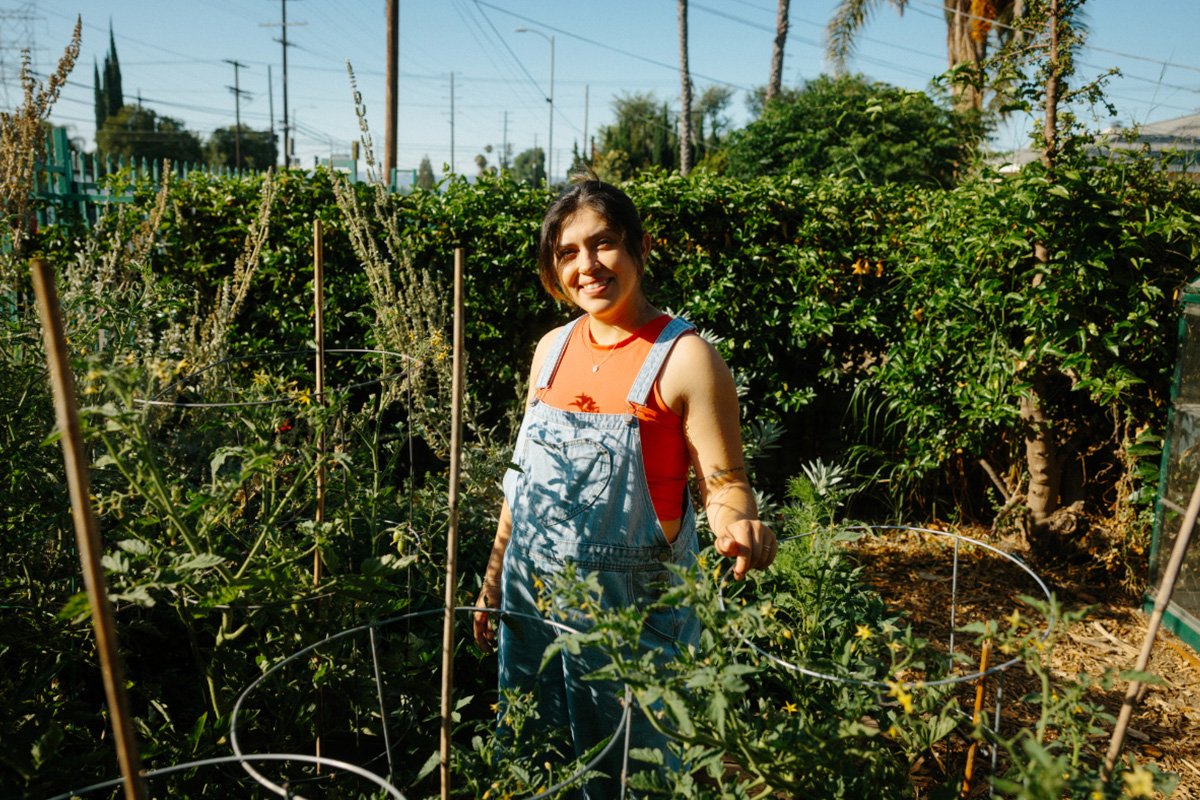
The farmers at Rock Steady Farm and Soul Fire Farm , meanwhile, base their commitment to growing vegetables on liberation and food sovereignty for queer and BIPOC communities.
At Farm Aid 2025, hundreds of politically and racially diverse farmers from all over the country attended the farmer forum and concert, where a strain of left-wing populism ran through speeches, Neil Young played “Big Crime” as a criticism of the Trump administration, and a lineup of elected Democrats took the stage to introduce musicians.
Civil Eats recently spoke with Shepherd about his observations, how things have changed over time, whether farmers should be considered a voting block, and how their’ political identities are connected to the communities where they live and grow.
“So, in our current era, when tariff policies are harming farmers across the board, there are subsidies going out to try to correct for some of that, but a lot of those benefits are going to the large, more corporate farms, and the small family farmer is really being left behind.”
Lisa Held: How do you think about the relationship between farmers, rural communities, and political affiliation?
Michael Shepherd: Even though we know that the vast majority of agriculture is occurring in rural places, most rural people don’t work in agriculture. It’s a very small share of the overall rural economy.
So they’re not synonymous, but I think agriculture is deeply tied to how rural people perceive themselves and how they think about themselves and their communities, even if the share of people actually working in that industry is a little bit smaller than the stereotype.
In terms of differences in politics, farmers’ personal economic livelihoods are quite a bit different than a lot of other folks that work in rural areas. Agriculture can be countercyclical, so when some folks are struggling—if they’re working in the manufacturing industry, for example—farmers might be doing quite well, so that can lead to some interesting complexities.
The other thing is, there’s a tendency, at least from the outside, to not understand how many farmers are not working on the large-scale, highly profitable farms, and how many people, at least numerically, are working on smaller family farms that really struggle to turn a profit. So, in our current era, when tariff policies are harming farmers across the board, there are subsidies going out to try to correct for some of that, but a lot of those benefits are going to the large, more corporate farms, and the small family farmer is really being left behind.
But in terms of their politics, I think farmers are traditionally very conservative people and are more likely to identify with the Republican Party.
LH: Is that because they’re voting on farm policy or other issues?
MS: Yes, there’s a tendency to say, ‘Farmers should be voting based on agriculture policy and outcomes.’ I think that misunderstands not only the way farmers are, but the way everybody is.
Sign up for our free newsletters
Subscribe to NPQ's newsletters to have our top stories delivered directly to your inbox.
By signing up, you agree to our privacy policy and terms of use, and to receive messages from NPQ and our partners.
I think most of the data show that they are quite cognizant of the fact that some of these [Republican] policies have been harmful, but there are other priorities that they have, other concerns are simply more important to them. Those could be social issues, identity-based politics, cultural considerations, racial politics, immigration. There are lots of things that could just simply be factoring more into how people vote than agricultural policy.
I always like to use the example, “I’m a professor. I don’t vote solely based on education policy.” I think it’s tempting when you’re talking about someone that’s not yourself to look at them and say, “Well, you’re voting against your interests,” when in reality they just have other priorities.
“Most of the places that you go, the farmers vote the way the other people in their communities vote, and that to me suggests that it really is this identity-based, social-based thing that’s tied to rural life rather than, “Farmers are just Republicans.”
When we look at rural voters in general, rural people socially see themselves as more similar to Republicans and the Republican Party, and they tend to view the Democratic Party as a distant other. When you look at the issues that the two parties have differing positions on, there are some that rural voters are actually much more in line with the Democratic Party than the Republican Party, but that identity-based difference is quite large.
LH: If you look at a map of U.S. counties that have the most direct-to-consumer farm sales, these are primarily liberal-leaning places, and many farmers there are more liberal. Does the identity factor explain that?
MS: Yes, if you go to a small organic dairy farm in Maine, you’re just as likely to be talking to a Democrat as you are a Republican. If you go to a large soybean farm or corn farm in rural Illinois, it’d be a different situation. There’s a big difference between agricultural-reliant communities voting one way versus individual farmers.
I think if we were to do a national survey of farmers, you would still see that the majority of farmers are identifying as Republicans or conservatives, but there are big regional differences there. There are big farm size differences there.
In the Plains region in the Midwest, where you have larger farms, those folks are overwhelmingly Republican. If we go to some of the smaller farms that you’re alluding to, some organic farms, you find some libertarian folks, you find some liberal folks, and sometimes you find people that just have heterodox politics that don’t necessarily map very neatly onto either of the parties’ agendas. And they may not vote, or they may vote in ways that are somewhat inconsistent over time. It’s certainly not a monolith.
Most of the places that you go, the farmers vote the way the other people in their communities vote, and that to me suggests that it really is this identity-based, social-based thing that’s tied to rural life rather than, “Farmers are just Republicans.” I don’t think that’s necessarily the case. Farmers are Republicans where most of their neighbors are Republicans, and that leads to some cross-country differences.
LH: This country also has a history of farmer-labor movements. For example, the left-leaning populist origins of Minnesota’s Democratic Farmer Labor Party. How does that factor in?
MS: In the ’30s and ’40s, it was the New Deal era, and it was very common to see farmers associated with the Democratic Party, more leftist. If we go back even in the 1800s and early 1900s to your William-Jennings-Bryan populists, agricultural laborers had left-wing populist views.
There’s been somewhat of a populist streak there forever, but whether it’s left wing or right wing has somewhat changed. What we observe is starting in the 1980s, a couple of things happened that started to shift the composition of the people that are farmers, but also the politics of these areas.
There was technological innovation in agriculture. The capital-intensive nature of agriculture, especially in the Plains region, really changed. What that led to was a lot of people exiting agriculture as a job, and the people left behind were left managing very large farms.
So, a lot of those folks became big business people. Agribusiness became more of a thing at that point, and those folks tended to be more conservative for tax reasons, as opposed to the old-school left-wing populace. Another thing that happened was the farming crisis of the 1980s, when folks started to lose family farms.
What we’ve seen since is a general splitting of rural and urban voters along partisan lines, and more recently, somewhat of a return in some places of smaller farms from the sort of organic circles, the folks that are a little left-wing and a little bit libertarian. So, in California, Oregon, Washington, Maine, Vermont, New Hampshire, you see groups of folks who are a mixture of people who’ve been farming their whole lives and then people who have somewhat more recently started doing that, and those folks have more heterodox politics than some of your Plains-region farmers.
The other thing is that politics in general really started to change over that period as the two parties started to focus more on cultural issues. Those issues and how people felt about them started to become more central to people’s politics, even for farmers. The people who were Christian identifiers or believed strongly in traditional gender roles, those folks, if they were farmers, gravitated to the Republican Party, again not necessarily for agriculture-based reasons.
LH: Farmers are now only about 2 percent of the U.S. population. Why are they still so prominent, then, in the national political conversation?
MS: There are a couple of reasons. One is because the federal government spends so much on farm subsidies and supports. That naturally elevates farmers to being of political importance and political relevance. The federal government supports agriculture, on a per-person basis, probably more than any other industry.
I think the other reason we pay a lot of attention to how farmers vote and the story of farmers is because it’s an interesting story. It’s fascinating to think about groups of people that the federal government provides a lot of support for that are maybe somewhat hostile to the federal government in general.
And I think farmers are in some ways used as a stand-in for a stereotype of the rural manual laborer. More rural people work in healthcare than work in agriculture, but you don’t really hear a lot of stories about rural nurses or rural doctors. The farmer is almost an American myth in some ways; they represent a storied figure in our history.
But one thing happening here is a lot of times we focus a lot of our resources and discussion on the large-scale farmer, when in reality, most farmers are just barely getting by, and they’re working on really small farms, family farms. They deserve a lot of policymaking help, and they could use a lot of assistance, but a lot of our discussions are on other aspects of the agriculture sector.
This interview has been edited for length and clarity.