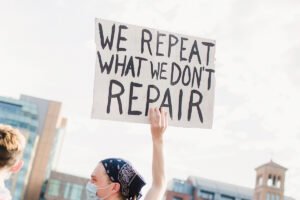


“I’m not above you. I am not below you. I am right here with you.”
This is a mantra I learned from a colleague at Advance Peace, in Richmond, CA, where I mentored youth and young adults caught in the grip of cyclical gun violence. We worked in an environment where firearms had become normalized as a way of settling disputes, and where many young people had inherited conditions that taught them the world was organized around kill or be killed. In that work, solidarity with the youth could not be theoretical. Young people had to know we were willing to despair with them, not observe it from a safe distance.
When I entered philanthropy, I assumed this kind of solidarity would remain a guiding virtue. Not in the same form as dodging bullets or pleading with a young man in a triggered state to put his gun down, but as a commitment to share in the risks and exposure that the communities we support must face every day. I believed the work would still require proximity, shared risk, deep understanding, and deep empathy.
But since starting this career, first as a program manager and now as an implementation strategist, I have wrestled with how easily distance becomes normalized in philanthropy. In these roles, I have been responsible for assessing, recommending, and making decisions about how substantial resources are allocated and, just as importantly, how they are not.
Its power lay in the fact that this campaign did not treat community wisdom as a model to be captured, replicated, or relocated into institutional management; it treated that wisdom as a movement to be resourced, amplified, and protected.
Philanthropy often holds deep analyses of the conditions that produce poor health, shortened lives, and preventable suffering. Yet privilege can still allow the field to move around those realities or step safely to the side. When this distance goes unchecked, cerebral expertise often obscures and silences the wisdom of lived experience, practice, care, and survival. In doing so, philanthropy risks coopting care rather than nurturing more just and equitable forms of it.
Witnessing the consequences of this distance has taught me that solidarity is more than a virtue; it is a necessity. Without it, care can become detached from accountability, and support can become another form of extraction. This is why author and political philosopher Joy James’s framing of the “captive maternal” has become essential to me.
The Captive Maternal as a Replication of Harm
The captive maternal is a term that names a mode of care in which the labor of survival, protection, healing, and sacrifice is demanded from those closest to suffering, while the structures producing that suffering remain intact. Communities and affinity groups, forced to absorb violence, abandonment, and institutional failure, often respond with brilliance. They build deep bonds of care, create practices of protection, and develop ways to heal, support, and keep one another alive when institutions and the state have failed to do so.
Alongside this, philanthropy is often guilty of facilitating the transfer of power from community-rooted care into institutional and state frameworks that benefit from that care without surrendering power back to the communities that created it. That tension has pushed me to think more carefully about what philanthropy invests in and who it trusts and how, at its best, it can help seed movements and animate visions of community.
Sign up for our free newsletters
Subscribe to NPQ's newsletters to have our top stories delivered directly to your inbox.
By signing up, you agree to our privacy policy and terms of use, and to receive messages from NPQ and our partners.
Before entering into the realm of philanthropy, I witnessed this possibility through The California Endowment (TCE) Schools Not Prisons campaign. As a community organizer and funded partner on the campaign, I saw philanthropy step down from the ivory tower and enter the fray alongside young people, organizers, artists, and directly impacted communities by supporting their vision for repair and restoration. I witnessed firsthand how an institution could take real risk: physical, political, and material risk alongside those confronting the status quo.
The captive maternal is a term that names a mode of care in which the labor of survival, protection, healing, and sacrifice is demanded from those closest to suffering, while the structures producing that suffering remain intact.
Schools Not Prisons showed what philanthropy can do when it refuses the captive maternal function. A prominent example was the campaign’s tour itself. Through the campaign, TCE substantially resourced a statewide effort and stood with communities challenging powerful interests invested in punitive systems. Even as those interests questioned the campaign’s credibility and pressured the organization and its staff, TCE continued to resource youth-serving organizations, directly impacted leaders, artists, and local organizers confronting a state that too often relied on punishment instead of investing in people’s growth, healing, and development. Its power lay in the fact that this campaign did not treat community wisdom as a model to be captured, replicated, or relocated into institutional management; it treated that wisdom as a movement to be resourced, amplified, and protected. Rather than merely funding communities to manage harm, it helped resource their power to name, challenge, and transform the systems producing it.
Revolutionary Love
If the captive maternal names how care is captured and displaced, then Professor James’s invitation toward revolutionary love offers philanthropy another path: to return care to the work of liberation rather than allow it to become another instrument of management.
Philanthropy is inherently contradictory. It often seeks to repair harms created by the systems that produced its wealth. This does not make philanthropy useless, but it does make it dangerous when left uninterrogated. Philanthropy can redistribute power, seed movements, protect imagination, and stand in material solidarity with communities fighting for liberation. But at its worst, it can soothe the conscience of wealth, manage symptoms, and preserve the order it claims to transform.
Philanthropy is inherently contradictory. It often seeks to repair harms created by the systems that produced its wealth. This does not make philanthropy useless, but it does make it dangerous when left uninterrogated.
Revolutionary love refuses to let care become a substitute for justice. It calls philanthropy to stop cooperating with the captive maternal by joining care to confrontation, healing to power, and solidarity to risk. For philanthropy, this means approaching community-rooted practices with awe, humility, resources, and support, not as models to be studied, bottled up, and replicated. To the institution, such work may look like a program. To the community, it is often a living practice of care, memory, survival, relationship, and love. Revolutionary love requires philanthropy to protect that sacredness, resource its power, and help dismantle the conditions that made such care necessary.
This brings me back to the mantra I learned in the field: “I’m not above you. I am not below you. I am right here with you.” For philanthropy, that cannot simply be a sentiment. It must become a practice, especially in a political climate where racial equity, DEI, and community power-building are being targeted, chilled, and recast as threats.
To be “right here with you” means refusing the safety of distance when the work becomes contested; it means sharing risk, moving resources, defending the work publicly, and standing with communities not only as they survive harm, but as they build the power to end it.