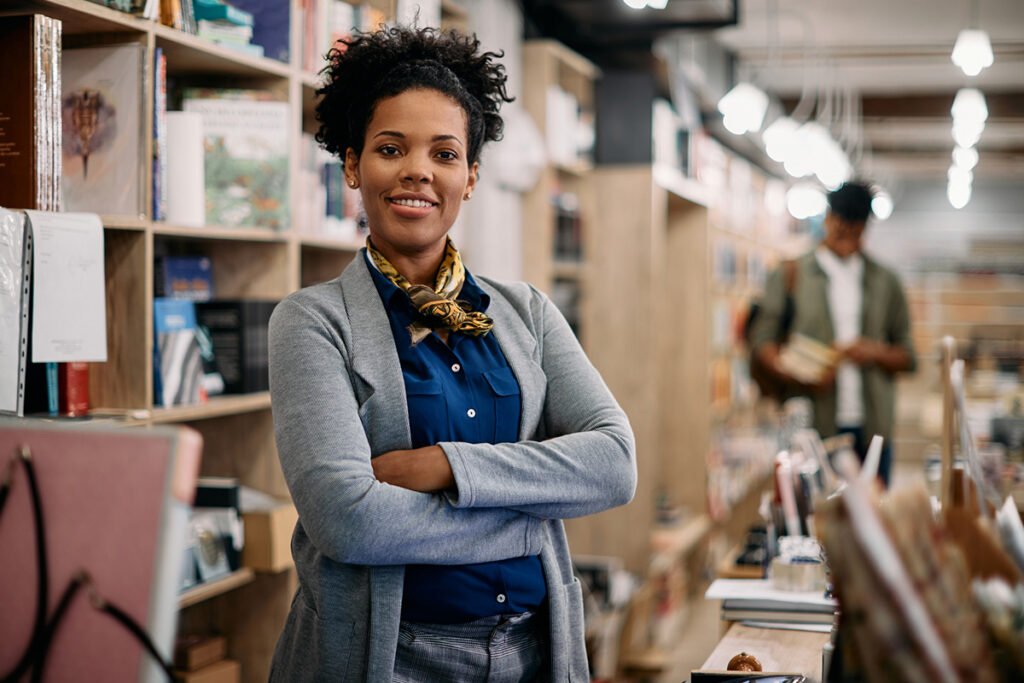
Maati Jone Primm did not envision herself as a bookstore owner, even though Marshall’s Music and Bookstore, the oldest operating Black-owned bookstore in the United States, has been in her family for decades. The bookstore, originally founded in 1938, was purchased by Primm’s grandmother, a college-educated woman who was the first in her family to be born outside of slavery.
Located in Jackson, MS, often referred to as the “Blackest City in America,” Marshall’s is situated within the historic Farish Street district. This downtown neighborhood was once a hub for Black businesses and offered refuge to Black Mississippians during the Jim Crow period until the 1970s, when businesses in the district began to decline. Elsewhere in the city, Black people would have to hold their heads down or get off the sidewalk if a White person approached them, but that was not the case on Farish Street.
“Everybody convened on Farish Street. It provided a life,” Primm told NPQ. “You could have fun. You could visit a doctor. You could come to the bookstore and be educated. It was difficult to have books. You couldn’t go to a White library and take out books, or even touch them, or even sit there.”
The Importance of Black Bookstores
Though many of the businesses are no longer in existence, Marshall’s remains, and Primm attributes its longevity largely to the longtime support of customers. She says that there are customers who came to the bookstore as children with their grandparents, who now bring their own grandchildren to the store.
Primm grew up in Minneapolis but would visit her grandparents and the bookstore during the summer. It was then that she was able to witness how people and businesses thrived within the district “in spite of all the racism and terrorism that goes on in Mississippi, even to this day.”
Still, even after she bought the bookstore from her family, she never intended to stay. She thought she would be in Mississippi for at most four years, but the calling was too great. As an extension of the bookstore, she began to engage in advocacy work, such as successfully fighting for people who had been wrongfully convicted. To Primm, this advocacy work is part of what her family has instilled in her.
[Black bookstores] do far more than sell books—they have a long history of educating people and helping to shape minds.
“The idea of my family is that you’re not truly successful unless you’re helping to lift others up,” she said.
That is one reason why Primm believes the work of Marshall’s should extend beyond its four walls. Inspired by the work of people like Booker T. Washington and George Washington Carver, Marshall’s holds what Primm calls Saturday schools where they are “going out amongst the people, going into projects, renting spaces, going into churches—wherever we need to go to teach the people.”
Primm also works to ensure that as soon as people come inside the bookstore, they receive an education that extends beyond what is being taught in schools. For instance, the building features a wall of remembrance that allows people to learn about the ancient University of Timbuktu in Mali, General Hannibal, and other historical facts. The wall extends up into the present day.
“We’re not stuck in the Civil Rights Era,” Primm said. “We concentrate on the whole, so when you walk in, you get an education just by reading the wall.”
As Primm notes, this type of education is more important than ever since the state has implemented laws that discourage the teaching of Black history, sparking concerns from lawmakers and advocates that children are not being taught comprehensive history in schools. Primm says that the education students received has long been inadequate—and she’s working to change that.
“Even before those laws were in place, what you would get in public institutions in terms of Black history was the history of loss—how we lost this, how we lost that, how we were dependent on other people to address our plight, which is garbage. We were taught garbage in order to…keep us compliant,” she said.
The number of Black-owned bookstores has significantly increased across the United States in recent years.
Sign up for our free newsletters
Subscribe to NPQ's newsletters to have our top stories delivered directly to your inbox.
By signing up, you agree to our privacy policy and terms of use, and to receive messages from NPQ and our partners.
Speaking to Primm, one can sense her passion and understand why Black bookstores are important. They do far more than sell books—they have a long history of educating people and helping to shape minds. In recent years, books like Katie Mitchell’s Prose to the People: A Celebration of Black Bookstores and Char Adams’s Black-Owned: The Revolutionary Life of the Black Bookstore have helped shine light on this history.
The State of the Black Bookstore
Continuing the work of lifting up the importance of Black-owned bookstores is the National Association of Black Bookstores (NABB), which was founded on Juneteenth, 2025. The group has identified five goals:
- Serving as the national clearinghouse and advocate for Black bookstores
- Providing professional resources and community for booksellers
- Leveraging collective buying power of Black booksellers
- Growing and sustaining Black participation and accessing the bookselling industry
- Preserving and educating the history and legacy of Black bookstores
In early 2026, NABB released its inaugural The State of the Black Bookstore report, which amplifies the fact that the number of Black-owned bookstores has significantly increased across the United States in recent years. The report also acknowledges the challenges they face, often related to funding but not limited to it.
The report notes that there are 306 Black-owned bookstores across the country. This is down from the peak of 325 in 1999, but up significantly from the 120 recorded bookstores in 2020. For many, there is a connection between the racial justice protests of 2020 and the growth in Black-owned bookstores since. It is a sign that, particularly amid attacks against the teaching of Black history in public schools, people are searching for third places where they can receive unaltered knowledge. In many ways, Black-owned bookstores are helping to fill this need.
Among the challenges…for Black-owned bookstores are…frequent exclusion from major author tours; and neighborhood shifts, like gentrification.
The 306 Black-owned bookstores across the country represent 8 percent of independent bookstores in the United States. Of these, 36 percent are currently operating without a permanent brick-and-mortar location. Only 4 percent of people working in the publishing industry identify as Black.
While New York is home to the most Black-owned bookstores in the country, a disproportionate number of Black-owned bookstores are located in the South. Sixty-six bookstores are located in Florida, Georgia, and Texas alone. This is notable as these are some of the states most impacted by laws limiting public school curricula—not to mention that Florida and Texas have the highest number of banned books as of mid-2025.
The report also notes that there are 14 states with no Black-owned bookstore at all.
Among the challenges the report identifies for Black-owned bookstores are capital and start-up costs, along with high rent and systemic barriers to financing options; revenue sales and the fact that these bookstores often lack financial support; marketing and visibility, and frequent exclusion from major author tours; and neighborhood shifts, like gentrification.
As the owner of a bookstore that has been able to survive for nearly a century, Primm reflects on the challenges that bookstores across the country are facing. She suggested that some “may need to address [how] they go about doing business” and perhaps adopt an approach that is in more direct communication with community members and “go outside the four walls of their stores and let people know who they are.”
She also contends that racism is likely impacting Black-owned bookstores, citing her own bookstore as an example. For years, Primm has been working to obtain a larger space because the current location is quite small and restricts her from doing some of the activities she would like to do. The City approved her proposal to buy a building, but it has been four years and Primm has seen no progress made, largely because state officials are refusing to move the proposal forward.
“I’ve never heard of people taking four years to purchase a building,” Primm said. “It’s just straight-up racism that’s preventing us from doing what we do.”