
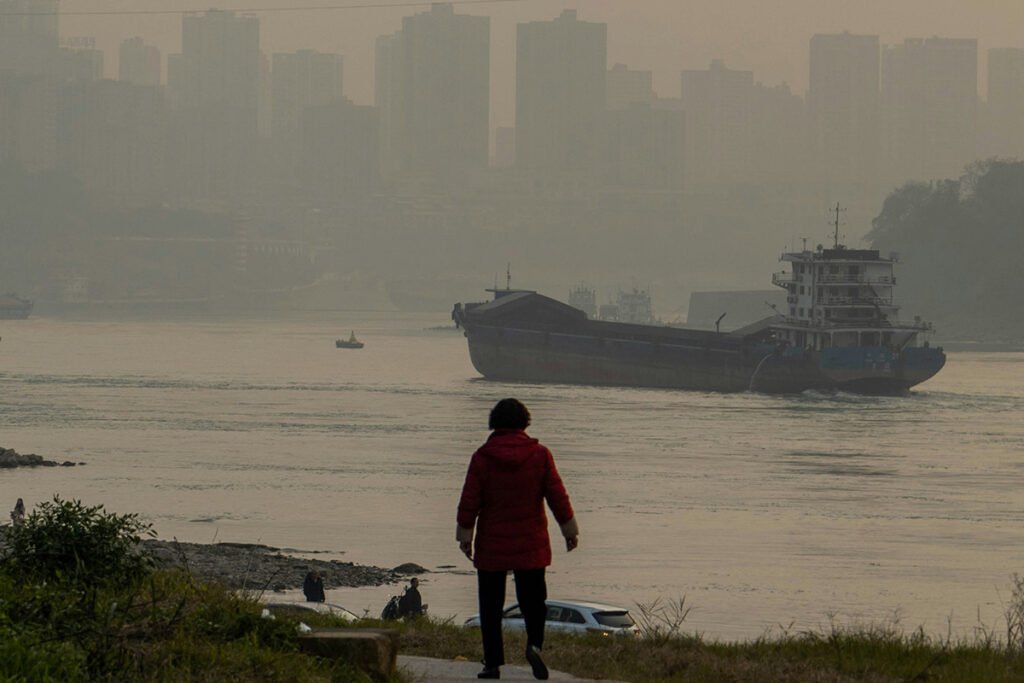
North America receives the largest share of philanthropic funding to tackle poor air quality, more than any other region, according to a new report by the Clean Air Fund (CAF) entitled Philanthropic Foundation Funding for Clean Air.
That’s despite most of the world’s most-polluted countries being in Africa and Asia. No US city ranks among the 50 most polluted in the world.
“If you were an alien looking at this problem, you’d be like, ‘Why in the world are these beings putting all their funding where the pollution is not as bad and there’s way less population?’” said Christa Hasenkopf, director of the Clean Air Program and founder of the EPIC Air Quality Fund at the Energy Policy Institute at the University of Chicago.
North America received 34 percent of all foundation funding for the issue in 2023, versus less than 1 percent going to Africa and 6 percent going to Asia, excluding India and China.
Of the almost eight million deaths attributable to pollution in 2023, the majority were in Asia. Prolonged exposure to toxic particulate matter 2.5 (PM2.5) that is generally emitted from vehicles, manufacturing, and farming can lead to lung diseases such as chronic obstructive pulmonary disease, cancers, and heart failure, as well as developmental delays in children and dementia.
“If you were an alien looking at this problem, you’d be like, ‘Why in the world are these beings putting all their funding where the pollution is not as bad and there’s way less population?’”
The Geographic-Funding Disconnect
That Africa and Asia receive so little philanthropic funding shows “the gross level of inequality of the Global North and Global South,” said Weenarin Lulitanonda, cofounder of the Thailand Clean Air Network, in an interview with NPQ.
Thailand’s cities often rank among the most polluted in the world. Lulitanonda explained that often the Global South experiences worse PM2.5 levels because the Global North has “exported” its own pollution by fueling high-emission petrochemical, agriculture, and manufacturing industries in places like Thailand.
“This problem is ultimately a global supply-chain issue,” she added.
According to Sean Maguire, CAF’s executive director of strategic partnerships, the disparity comes from the fact that foundations tend to be housed in higher-income countries, and they prefer to fund programs closer to home. “And that’s perfectly legitimate,” Maguire said in an interview with NPQ.
For example, funding from the United States to the North American region accounted for 57 percent, or $164 million, of total air quality funding, according to the CAF report. Several of the largest funders, including the Bezos Earth Fund and Bloomberg Philanthropies, are based in the United States, and their money went toward clean energy projects, green transport solutions, and climate-friendly agriculture transitions.
For funders located in or focused on lower-income countries, where there are many competing challenges, air pollution may not be prioritized, said Chris Hagerbaumer, executive director of OpenAQ, which aggregates global air quality data into a public database. According to Hagerbaumer, this is because funders are largely unaware that air pollution is the number one environmental contributor to premature death.
“It’s a perfect storm of philanthropic dollars largely being spent where the philanthropies are located, and international funders funding issues they already know about in countries where they face the fewest barriers to dispersing the funding,” she explained.
At the same time, even if a donor did want to prioritize the issue, local organizations in Africa or Asia that could do public advocacy for industry regulation reform or educate farmers on less harmful ways of clearing their fields are generally not on donors’ radar, according to Hagerbaumer.
Those organizations “are often in countries where there’s not a funding network or relationship within the country and I think that makes a difference,” she said.
An Underfunded Issue
The amount of overall philanthropic capital going to clean air is an issue as a whole. From 2019 to 2023, only 0.1 percent of all philanthropic money was spent on clean air.
Yet the issue is devastating and far-reaching. Pollution-related illness places a cost burden on the health systems of countries—an estimated $8.1 trillion per year according to the World Bank—and drives down economies by keeping people out of the workforce. An approximate 1.2 billion days of work are lost globally due to air pollution, according to the Organisation for Economic Co-operation and Development.
But this impact of toxic fumes that emanate from vehicles, industry, and wildfires doesn’t seem to resonate with donors.
“The disparity between the enormity of the problem and the amount of philanthropic and development aid that goes towards solving air pollution is completely baffling and nonsensical,” said Hagerbaumer.
That disparity even applies to donors who fund health. CAF’s report found that 74 percent of the foundations that do invest in tackling poor air quality are mainly focused on climate, energy, and the environment rather than health. In fact, from 2019 to 2023, health-focused foundations actually decreased their investment in air quality.
“It is one of the top global health issues, but there’s not a proportionate amount of global health funding that’s devoted to the issue,” said Hasenkopf.
If between $4 million and $8 million was invested annually in capturing air quality data alone, pollution levels would be reduced for 838 million people.
Sign up for our free newsletters
Subscribe to NPQ's newsletters to have our top stories delivered directly to your inbox.
By signing up, you agree to our privacy policy and terms of use, and to receive messages from NPQ and our partners.
The problem, noted Maguire, is that many fail to see “the throughline” from investing in a low-emission zone or improving fuel standards to better health outcomes. Vaccines, for example, are an easier sell when it comes to health funding.
This applies to public spending too. For every $1,000 spent by a development agency, only $11 is directed to projects to improve air pollution.
That figure is now likely to be even less following the widespread cuts that governments, including the United States and the United Kingdom, have made to their overseas development budgets since 2023. The US State Department has also shuttered its air quality monitoring program that provided data on PM2.5 levels in over 80 countries through sensors at US embassies and consulates as part of President Trump’s efforts to reduce government spending.
Financing Data Capture Is the First Step to Change
While the funding landscape for tackling air quality looks bleak, the silver lining is that it doesn’t require huge amounts of money for investors to see impact.
According to data from EPIC (Energy Policy Institute at the University of Chicago), if between $4 million and $8 million were invested annually in capturing air quality data alone, pollution levels would be reduced for 838 million people.
OpenAQ’s most recent report found that 36 percent of countries, representing one billion people, are not monitoring the quality of their air. The majority of these countries are in the Global South.
Yet data allow cities and countries to understand exactly where pollution is coming from so they can tackle it more effectively, said Maguire. Lulitanonda’s team at Thailand’s Clean Air Network, for example, has been able to use data to propose a clean air bill.
“If more countries were to monitor and or fully share the data they produce, public knowledge and the will to take action would increase. In other words, where there is no data, it is easier to say there is no problem,” said Hagerbaumer.
“Not just more money is needed, but more philanthropic actors, too.”
Likewise, a small investment in installing air quality monitors could produce major gains in health, the economy, and climate protection, said Hagerbaumer. Such investment has more value in contexts where air quality is taking years off people’s lives, she added, such as Papua New Guinea, Niger, and Somalia, where citizens lose an average of three years of life expectancy due to toxic smog.
In 2024, EPIC launched an Air Quality Fund to provide typically underfunded countries with the financing to capture air quality data that would help push for national clean air policy implementation. There has already been progress in that short time: The Gambia’s government is currently working on new clean air policies; in Malawi, the government is sharing regular air quality bulletins; and Ghana has put together new air quality management legislation.
“It’s impressive what they’ve done, but it also shows how scarcely resourced they are that this relatively small infusion of funding can have that kind of impact,” said Hasenkopf. If she were a donor, she said, these are the kinds of returns she’d be looking for. She urged new foundations and philanthropists to consider investing in the clean air space.
“Not just more money is needed, but more philanthropic actors, too. This is a subtle but important point. Having more and diverse funders in the space means there is more space for different approaches and different risk-taking profiles to solve the issue,” she said. “All of that is healthier and ultimately more productive for the space as a whole.”
But rather than relying on new funding that may never come, especially given how cash-strapped the development sector is overall, Ruaraidh Dobson, founder and principal scientist at the air quality consultancy South London Scientific, suggested those working in the space consider what programming can make the most difference per dollar spent with funding that is already available.
“The thing that comes next has to be more focused on building sustainable capacity in low- and middle-income countries in particular,” he told NPQ, calling on the sector to innovate. “We need to try slightly different models because, candidly, the model that we are trying—and I don’t exclude myself from this—isn’t really getting us where we want to go.”
On an issue that requires an overhaul of industry regulations and societal behavior change, trying new models in the face of minimal funding is no simple task. But something has to change, Dobson said, and it’s unlikely to be the dollar amount.
For More on This Topic:
The Polluters Down the Street—EPA Changes Put Lives at Risk
A Satellite Assist in the Fight Against Air Pollution
Pollution Has a Class Problem in Thailand and Beyond