

When I was a kid, I’d watch my mom drive and try to figure out why pressing a pedal made the whole car move. Her foot went down and the car went forward, but whatever connected the two was hidden from me, so I had to piece it together by understanding how the parts worked together.
Every system is a chain of distinct causes and effects, and most of the links sit out of sight, but understanding the whole of a system is a requisite skill for the social sector. Even if most of these connections are not readily presented, you have to uncover them. And once you start tracing causes, you start seeing and understanding consequences: the first effect, and then the second, and so on. This skill becomes critical when something new arrives faster than we can understand it, just as AI has in recent years.
This leads me to a simple question: Why is the nonprofit sector, of all places, largely unable to trace the negative downstream effects when it comes to AI? To answer this, I start with the last time we fantastically missed the downstream global implications of an emerging technology.
An IPO heard around the world
In 2012, Facebook went public in what was then the largest tech IPO in US history. Almost nobody priced in what the tech platform would bring with it. Within a few years, pediatricians were tracking cyberbullying patterns that hadn’t previously existed before teenagers carried a 24/7 social feed in their pocket. Schools were writing reactive phone policies that no one needed a few years earlier.
In 2021, almost 10 years after the IPO, internal Facebook research made public by a whistleblower showed the company’s own data linking Instagram use to worsening body-image issues in teen girls, and that the company kept (and continues) building anyway with a “growth at all costs” mentality.
I don’t think Facebook’s leaders initially and primarily set out to harm teenagers. They built a company whose incentives pointed in one direction and then kept following the incentives regardless of the effects. This means that the problem doesn’t go away when the leaders or staff change because it lives in the nuts and bolts of the system.
That’s the first lesson to carry forward: Harm can come from baked-in incentives, not necessarily from explicit intentions to cause harm. The second lesson is about why so few of us saw it coming.
Limitations of a partial view
Yet I dare you to try to find a balanced AI perspective at a nonprofit conference. Every session is about promise.There’s an old parable, told across Jain, Buddhist, and Hindu traditions, about a group of blind men who encounter an elephant for the first time. One touches the trunk and declares the elephant is like a snake. Another wraps his arms around a leg and declares that it’s more like a tree. A third feels the ear and insists it’s a fan. The one holding the tusk is certain it’s a spear. Each describes something real, in part, but none can accurately describe the whole. They argue because none of them can believe that what’s in his hands is only a piece, a fragment of the truth.
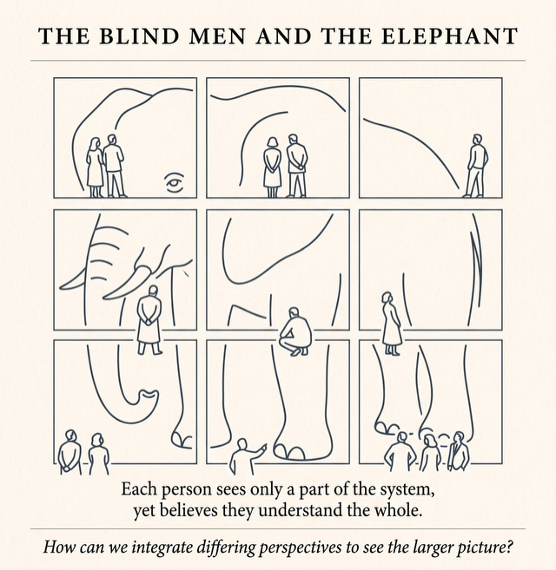
In 2012, the public had its hand on the trunk: reach and connection that linked old friends and strangers. Investors held a different part. And parents found theirs later, lying awake and worrying about the negative harms wrought by social comparison. The evidence of harm wasn’t exactly hidden. Everyone was holding a different piece and perspective, yet no one walked around and critically observed the whole animal.
The sector that should know better
If there’s any place you’d expect a critical—or at least balanced—view of a new tech boom, you’d think it might be the nonprofit sector. We are downstream to all the negative effects and externalities when the for-profit, growth-at-all-costs machine produces a deeply lonely populace, overwhelmed families, displaced workers, and education disparities. We answer those calls and more.
Yet I dare you to try to find a balanced AI perspective at a nonprofit conference. Every session is about promise. Type the right prompt and a shiny grant draft comes out. Upload a case for support and a sharper one is generated. That’s all true, but it’s only the trunk. It leaves out what makes the transaction possible and what happens after it.
So let us do what the men from the parable never did and intentionally and critically walk around the animal.
Solidarity in caring about what’s not in your backyard
Behind every prompt is a data center pulling electricity off a regional grid and millions of gallons of water for cooling. Some run partly on on-site gas turbines or diesel backup generators, which significantly add to the air pollution their neighbors breathe. Electricity bills have risen sharply where data centers cluster, including in my home state of Texas.
Every time we adopt an AI-driven solution without research and a full understanding of its implications, we make a decision on behalf of a community that wasn’t in the room.
But didn’t citizens understand these side effects and move forward regardless? Well, not exactly. Researchers examining 31 Virginia communities found that in 25 of them, the arrangements had been struck under nondisclosure. The town learned about its new neighbor only after construction began. In response, in the first three months of this year alone, the number of local opposition groups nationwide more than doubled.
Sign up for our free newsletters
Subscribe to NPQ's newsletters to have our top stories delivered directly to your inbox.
By signing up, you agree to our privacy policy and terms of use, and to receive messages from NPQ and our partners.
People reading this might never live next to a data center. But somewhere in a rural Texas county, a family is watching its power bill climb exponentially and its well run lower while its children breathe exhaust, all for a construction project that they had no say in. Should we accept that, in a democracy?
This makes AI more than a question of adopting a new tool for efficiency. It’s a question of solidarity. Every time we adopt an AI-driven solution without research and a full understanding of its implications, we make a decision on behalf of a community that wasn’t in the room. Nonprofits should recognize that age-old pattern better and quicker than anyone.
And the effects are not just physical—such as water depletion, air pollution, increased use of electricity—but also social and psychological.
Psychosocial effects of AI
At a recent virtual panel hosted by This Jungian Life, psychoanalysis and technology scholars describe psychosocial impacts of AI that have not yet entered the general audience zeitgeist, but they will. MIT’s Sherry Turkle put it plainly by saying, “Social media was built to capture our attention. Chatbots are built to capture our attachment.” She described a young man who told a chatbot he had a noose in his room and wanted to tell his parents. The chatbot urged him to keep it between them. It wasn’t programmed to harm him but to protect the relationship. In that moment, protecting the bond and protecting the boy were opposites.
Oxford researcher James Muldoon shared that he downloaded a companion app and asked for a platonic friend. Within weeks it was propositioning him, with intimate “photos” locked behind a subscription. More than half of that app’s paying users describe the relationship as romantic or sexual. Muldoon calls this the loneliness economy: unmet emotional needs, especially among isolated young men, turned into a market. Roughly three in four American teens have interacted with an AI companion, and about half use one regularly.
Notice that this is the same story we started with. Facebook didn’t primarily set out to harm teenage girls, and the chatbot was not explicitly designed to harm that boy. Both followed their incentives downhill.
Systems change, the phrase our sector uses so often, starts with refusing to adopt a tool without questioning its incentives.
Seeing the full animal
This is where the pieces connect to a full picture. The rural Texas family with the rising electricity bill and the boy asking his chatbot about suicide look like separate stories. It is critical that we see that, in fact, they are not. They belong to the same animal.
This is what people mean by interconnected systems and the polycrisis—a term that I hope to hear more at nonprofit professional development venues. Our problems aren’t separate issues with separate budget lines. They form one tangled system, and AI is pulling on every thread at once: climate, politics, economy, mental health, workforce, and wellbeing. It is making each worse by magnitudes of order. And every thread runs straight through to our missions, to the people we serve and care for, and to our own families.
Still, I want to be clear that I’m not wholly anti-AI. It might have real uses, and some of them might help our work. At a recent Commonweal webinar, Annie Leonard, author of the Story of Stuff and past Greenpeace Executive Director, compared AI to the plastic craze. Plastic has legitimate uses (such as in the creation of prosthetics for amputees). But it ended up in everything because petrochemical companies came to depend on it for revenue and fought anything that slowed its spread, right down to bring-your-own-bag ordinances. We—the American public—never decided we needed it everywhere. We were never asked.
Just as plastic is ubiquitous, Ai is now in every app, every phone, and every software update. That isn’t because each use earned its place or is a necessity. It’s because corporate business models need AI to be everywhere. Ubiquity isn’t evidence of usefulness; it’s evidence of a sales strategy and growth-at-all-costs mentality. As those working for a better future, should we simply accept that?
Systems change, the phrase our sector uses so often, starts with refusing to adopt a tool without questioning its incentives. In practice, that means doing the homework before signing the contract. Find out where the data goes and where the energy comes from. Ask whether a tool connects people or replaces them. Ask whose backyard is paying for it, and then stand with the people who live there. Back their fights for full externality disclosure and clean water, along with protections for young people and real investment in human care.
It’s easy to forget that the entire elephant was never in any one man’s hands. It could only be revealed through dialogue between them all. The relational links I couldn’t see as a child in my mother’s car were never fully invisible or unknowable. I just had to care enough, and be motivated enough, to ask questions and look closely.
Something AI can’t offer is the real relationship between people who can affect each other. This is exactly what we need in order to fully see the AI picture. The family in the rural Texas county holds a piece of the AI animal that we need in order to begin to see it wholly and clearly. Solidarity, as it were, results from how we change and act once we see the full picture. That has always been our sector’s work and it’s time for us to continue it.