
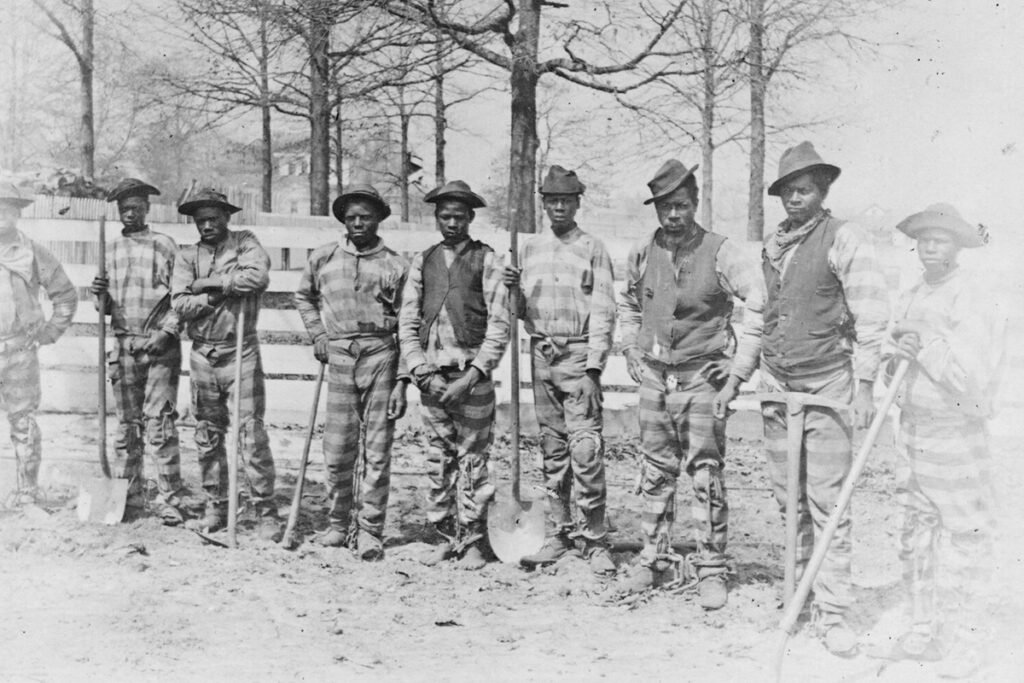
The arc of Georgia prison labor bends not toward justice or rehabilitation, but towards profit for the elite. Such has been the case for well over 100 years—and continues today. To better understand this trajectory, we must look to the past of how this industry came to be.
In the late 19th century, Georgia’s legislators faced a problem. The Civil War had ended, but the economy built on slavery still needed laborers—cheap, coerced, disposable bodies to rebuild the state.
The solution was elegant in its brutality: the Black Codes and later Jim Crow laws. It was a legal architecture so deliberately broad that any person could be arrested for vagrancy, loitering, or any alleged crime. And it applied overwhelmingly to Black men, though Whites and women were not excluded, and the courts processed and sentenced them in hours. Within days, those persons were slaves on chain gangs. After proving themselves docile on county road crews, they were rented to private landowners, industries, and railroad companies under the convict leasing system.
On the county work crews, the men were driven like beasts as they swung axes through swamp trees and pushed shovels through mosquito-laden heat to create roads that would never bear their names. They did not get paid but could buy a pardon or be released early for good behavior. Those who refused to conform were often sent to rock quarries where many were simply worked to death, their unclaimed bodies buried locally in potters’ graves at the far edge of the nearest cemeteries, unrecorded.
The chain gang was not a short-term aberration of the New South. Well into the 1960s, it was part of Georgia’s public works labor policy.
Georgia’s prisons grew—fed throughout the Great Depression by Jim Crow arrest pipelines—until World War II created a need for the dispossessed men in service. The leased labor lost by farmers and businesses was replaced with POWs until the end of the war.
Post war, as veterans’ benefit stipends ran out, many who had thought that the military allowed them to avoid prison found it waiting. In the mid-20th century, prisons again became overcrowded as citizens—many the descendants of freed convict laborers—returned to road crews cleaning ditches, clearing brush, and cutting the grass along the sides of roads built by their grandfathers.
The path from birth to prison remained well worn by Georgia’s poorest citizens.
The details still required chains on ankles, but twelve hours outside in the Georgia heat was preferable to the suffocation of their overcrowded living units. Fresh air and a sack lunch were the only wage Georgia offered.
In the 1950s, the physical chains were removed from road crews. After the swamps were cleared and the bridges and roads were built, the need for manual laborers continued with the construction of public buildings. Courthouses, schools, and stronger work camp housing all came from labor that fit the description of slavery.
Then greed evolved and sinister new plans emerged.
In the Business of Systematized Cruelty
Relatives of State and local politicians, beginning in the 1960s, started small businesses near prisons and won government contracts that took the convicts’ detail and turned it into a parolees’ job. Those companies employed the disadvantaged at minimum wages that maintained plausible deniability about coercion while ensuring a captive, grateful, dare-not-complain labor pool doing jobs that once required a state officer standing over the crew.
The whip became the threat of parole revocation. Road work became landscaping crews. The money changed from “saved” by the county to “profit” for the LLCs. But the path from birth to prison remained well worn by Georgia’s poorest citizens.
Beginning in the mid 1960s, a few thousand people inside Georgia’s prisons began work in what can only be described as sweatshops. Georgia Correctional Industries (GCI) produces goods for state profit, and still pays zero dollars per hour. The Thirteenth Amendment’s exception clause—“neither slavery nor involuntary servitude, except as a punishment for crime”—remains federal law, and Georgia exploits it without apology.
From then until today, the living units those workers return to at the end of their shifts are occupied at double and triple design capacity. The reason those cells are overfilled is an ever-decreasing approval of paroles, coupled with increased mandatory minimum sentences and the over-policing of poor communities as revenue strategies.
Understanding how this architecture of a captive market functions requires understanding who benefits from a full prison.
The Thirteenth Amendment’s exception clause—“neither slavery nor involuntary servitude, except as a punishment for crime”—remains federal law, and Georgia exploits it without apology.
Georgia’s governor appoints the five-member State Board of Pardons and Paroles, who are the sole body authorized to release state prisoners. Governor Brian Kemp has filled those seats with career law enforcement figures, the professional class least predisposed to decarceration.
The result has been arithmetically predictable: parole grants between 2020 and 2025 were cut in half. At the same time, intake numbers climbed. Overcrowding has reached historic levels in a state whose incarceration rate (968 people per 100,000, including prisons, jails, ICE, and juvenile facilities) already exceeds that of any democratic nation on Earth.
More prisoners means more need for beds. More need for beds is the premise on which construction contracts are awarded. In 2023, Balfour Beatty received a contract that has grown to $451 million now allocated for the 1,500 cell facility in Washington County. In 2025, Governor Kemp’s mid-year budget proposed an additional $40 million simply for the design of yet another new prison, location unspecified. The 2022 election cycle saw Kemp receive $1,724,956 in campaign contributions from Georgia’s construction industry, enabled by a legal loophole allowing sitting governors to accept unlimited contributions, even from donors with state contracts in hand.
Sign up for our free newsletters
Subscribe to NPQ's newsletters to have our top stories delivered directly to your inbox.
By signing up, you agree to our privacy policy and terms of use, and to receive messages from NPQ and our partners.
For a governor whose beginnings are based in the construction industry, this is not a coincidence; this is a business model.
The Architecture of Corruption
The Federal Department of Justice concluded a six-year investigation in 2025 and published a 94-page report finding that conditions in Georgia’s state prisons constitute cruel and unusual punishment, in violation of the Eighth Amendment. The report documented homicides, suicides, torture, mold, malfunctioning door locks, and staff levels at some facilities running below 30 percent capacity.
All in all, 85 percent of the state’s economy is built on the same foundation as the chain gang roads: the bodies of poor people, disproportionately Black, whom the law has always found reasons to cage.
Between 2018 and 2023, 142 people were killed inside Georgia’s prisons. In 2024, total deaths hit an annual record high of 330 souls. GDC Commissioner Tyrone Oliver’s response: “One is bad. But it’s not as bad when you look at the population we’re dealing with.”
That contempt is not mismanagement. It is policy. Violent, chaotic prisons justify the public fear that justifies the construction budgets that flow back to the contractors who fund the campaigns that keep the same officials in office to appoint the same parole board that keeps the prisons full.
The Georgia Judicial Industry—including prisons, courts, lawyers, community supervision, and privately owned detention centers—generates approximately $5.98 billion annually. All in all, 0.85 percent of the state’s economy is built on the same foundation as the chain gang roads: the bodies of poor people, disproportionately Black, whom the law has always found reasons to cage.
Reform was recommended by Guidehouse Inc., a consulting firm hired by Governor Kemp as a response to the shooting death of a member of the contracted kitchen staff by a prisoner in Smith State Prison. Georgia’s Legislative investigation that followed—and was to consider the findings reports of both the DOJ and Guidehouse—chose not population reduction, rehabilitation programming, or sentence reform: It chose instead to build more prisons as suggested by the Commissioner of Corrections.
What the pitch for new prisons never acknowledged was the historical data pointedly demonstrating that longer sentences and more prisons have never reduced crime.
Guidehouse’s finding of emergency-level staffing crises—despite years of GDC failing in its attempts to lure and retain employees—were used not to decarcerate toward manageable numbers of slaves, but to justify an additional $600 million in prison investment, the bulk of it in construction.
The proposed new facilities are marketed as humane, single-occupancy cells to reduce cellmate-on-cellmate violence, a genuine problem given what the DOJ documented. But the math is deliberately concealed from the public.
What the pitch for new prisons never acknowledged was the historical data pointedly demonstrating that longer sentences and more prisons have never reduced crime.
There are currently 1,434 triple-high bunks in spaces originally designed for single occupancy. Building two new 1,500-cell prisons eliminates only those triple bunks and does not address the double-celling throughout the system nor anticipated growth.
GDC’s own 60-month population projection anticipates at least 1,300 new individuals serving life without parole entering the system, bringing the total LWOP population to approximately 3,500. The new single-occupancy cells will be double-bunked immediately, under the same “temporary” designations that have persisted for decades.
This is the unbroken metaphorical chain. The economic logic is structurally identical to what it was in 1870: Arrest the poor, force free labor, warehouse them, create public contracts, support the party that writes the laws ensuring the next generation of prisoners who exist now only as the waste product of a judicial industry that enriches the elite from the misery of the poor.
The legal loophole allowing sitting Georgia governors to receive unlimited campaign contributions from state contractors is an ethics emergency.
What Can You Do? Apply Pressure to Yield Change
Nonprofit workers, human rights advocates, movement organizers, and philanthropic funders, are positioned to apply pressure at the precise joints in this system where public attention has been largely absent. These include:
- Parole board accountability: The most direct lever for reducing Georgia’s prison population is a parole board that actually grants parole. Advocacy organizations should be tracking and publicizing every appointment to that board, and building coalitions to challenge the governor’s unchecked appointment authority.
- Transparency in prison contracting: The legal loophole allowing sitting Georgia governors to receive unlimited campaign contributions from state contractors is an ethics emergency. Investigative journalism nonprofits and good-government groups have an obvious target.
- Challenge the “new prison” narrative: When construction contracts are announced, the civil society response cannot be silence. The public argument that new prisons mean safer prisons ignores a 150-year record proving otherwise. Organizations need a ready counter-narrative that connects construction announcements to the campaign finance records behind them.
- Invest in what actually reduces incarceration: The literature on decarceration is extensive and consistent. Affordable housing, accessible mental health care, substance use treatment, and restorative justice programs reduce recidivism and incarceration rates.
Georgia spends $1.62 billion annually on a corrections department dedicated to warehousing human beings. Redirecting even a fraction toward these alternatives would produce measurable change. The case must be made loudly, repeatedly, and with data.
The DOJ has documented the constitutional violations, newspapers have verified those findings, advocacy organizations have filed the lawsuits. What remains is to sustain public pressure and philanthropic investment in the organizations doing the work that Georgia’s government refuses to do.