
Editor’s Note: This is the second in the author’s three-part series on dynamic governance, a new way to run either for-profit companies or nonprofit organizations. In case you missed it, you can read the first part here.
Mealtimes at Living Well Care Home and the Ethan Allen Residence include farm-to-table foods made from scratch, with a chalkboard list of which farms provided the ingredients. A naturopathic physician is the medical director, and yoga and Tai Chi classes are available to residents. The rooms have warm and inviting colors inspired by feng shui. Essential oils are used as cleaning products, all of which are nontoxic. Though they might sound like high-end spas, these are two innovative senior care facilities in Bristol and Burlington, Vermont.
When Dee DeLuca and a small group of like-minded folks acquired Living Well (a 15-bed residence) 10 years ago and Ethan Allen (a 34-bed home) last year, she had a vision of transforming these facilities into loving and supportive environments where elders could thrive with few or no medications, natural foods, and holistic treatments. This vision, along with a dynamic framework to govern the organization, was instrumental in the shift from business as usual, in an industry where high employee turnover, isolated residents, and processed food are common.
“With dynamic governance, we are working with creativity,” explains DeLuca, executive director and co-founder of Living Well. “The typical bureaucratic structure [with top-down decision-making] leaves a lot of unmet needs on the table. With dynamic governance, the needs in the organization get met in a much more efficient way—and we have more fun!”
Employees who have a say in how they work are engaged employees, with a high level of commitment to the decisions they make. Many studies have shown a strong relationship between employees’ workplace engagement and a company’s overall performance. A 2013 Gallup poll estimates that only 13 percent of workers worldwide are engaged, resulting in $300 billion in lost productivity annually in the U.S. alone, as well as higher rates of absenteeism, safety incidents and turnover. To put it simply: Disengaged employees erode the bottom line.
Dynamic governance, also called sociocracy, is a system for decision-making, organizational and corporate governance, and project management that creates more inclusive and effective organizations. Employees at all levels make policy decisions that govern their work; the levels are linked for flow of policies, information, and feedback, bottom-up as well as top-down.
DeLuca believes dynamic governance has helped create a fundamental shift, impacting staff and residents alike. “When people know they have control over how decisions are made in the place where they work and live, they behave differently,” says DeLuca:
“There’s a kindness, gentleness and compassion that has become the personality of [Living Well]. We have had some irritable people here over the years, on the staff, resident and family side. Over time, they relax. When there is compassion and love all around, it is difficult to be mean and upset.”
Living Well went from operating in the red before the acquisition to being in the black. The failing senior care facility was transformed into an award-winning home that embraces holistic health, a transition that DeLuca believes was made smoother through the use of dynamic governance. Importantly, this initiative has helped save the organization money while boosting quality of life. The facilities buy food in bulk directly from local farms, preserving the food for off-season. DeLuca says that their average meal costs are lower than the industry average, while offering higher quality food. She credits the serving of whole foods and offering holistic health options with lowering medication costs.
Sign up for our free newsletters
Subscribe to NPQ's newsletters to have our top stories delivered directly to your inbox.
By signing up, you agree to our privacy policy and terms of use, and to receive messages from NPQ and our partners.
In dynamic governance, authority for policy decisions is delegated to small groups of members (M) called circles with distinct aims and domains. Each circle is connected to the next higher circle by two people—an operational leader (L, in red), and a delegate (D, in green) elected by the lower circle—who are full members of both circles. The result is to link the circles for flow of policies, information, and feedback, bottom-up as well as top-down. Functional circles may have sub-circles; the number of circles and of levels depends on the size and complexity of the organization.
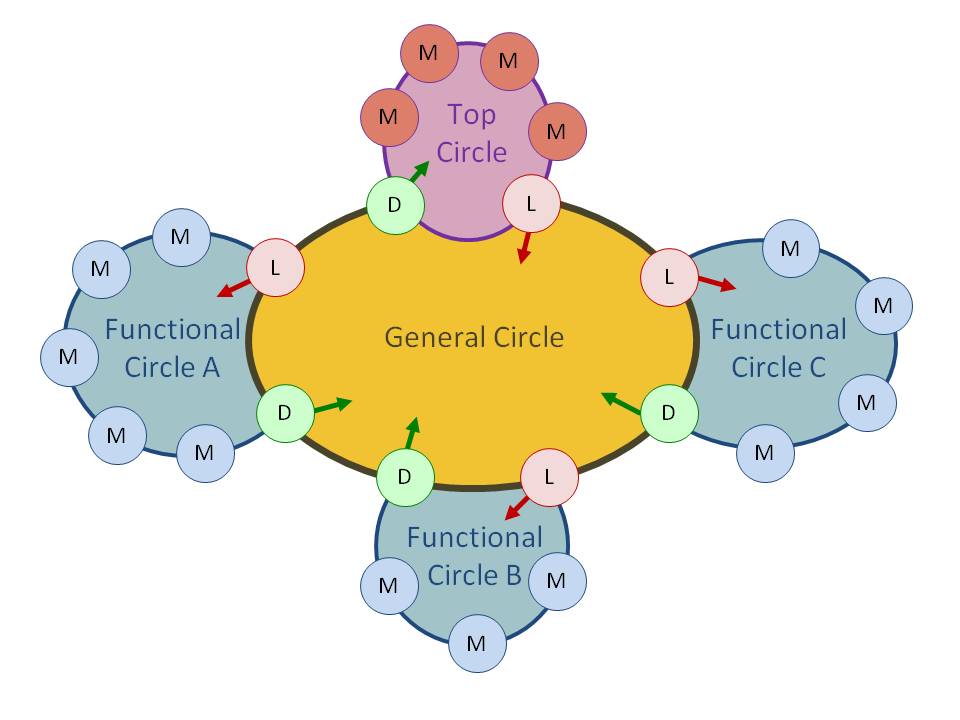
Image credit: Compliments of Sheella Mierson, from the Sociocracy Consulting Group
The staff, residents and family members at Living Well and Ethan Allen are all part of the governance and decision-making structure. Both facilities have formal and informal practices that allow elders to have a voice in making decisions. An elder council meets monthly to discuss their needs and concerns. A council member then sits at the head of the table at the monthly staff meeting to present a report. This perspective is invaluable for continuously improving the home.
DeLuca says “I spent several decades of my adult life owning, creating, buying and selling small businesses [before acquiring Living Well]. I was tired of having it all sit on my shoulders. I did it alone and I was done being a worker bee…. [With dynamic governance,] my job is to steer the creativity, which is exhilarating, instead of being a policewoman and disciplinarian most of the time.”
Living Well staff can be seen unfolding rugs that might be a tripping hazard or tidying common spaces, regardless of who is officially responsible. When staff takes responsibility for the betterment of the whole, it creates a safe and happy home, and she attributes this shift to using dynamic governance.
“If some of the employees that have to carry out a decision are not committed to it, they may drag their feet or even sabotage it,” says Sheella Mierson, a consultant for the Sociocracy Consulting Group. “If they are 100 percent committed to a decision, it’s a completely different ball game because everybody is giving it their best thinking and effort. When there are difficulties, everyone is going to put their mind to solving it and putting together whatever resources are needed.”
“Generally, once people understand that they have a voice and it has weight and they can use it anytime, folks don’t hesitate to speak right up because they can,” DeLuca says. “There is a safe container for that to happen always. The level of participation from residents, staff, families, and the community is really high.”
The original version of this article was published at TriplePundit.com on July 9, 2014.