Our food and farming systems are in crisis. As food insecurity rapidly escalates across the United States, small-scale farmers face a parallel exigency: the struggle to produce nourishing food while developing successful business models. But a new generation of New York state farmers, galvanized by a social justice mission to serve their communities and strengthen fresh food access are meeting the challenges with fresh approaches.
As newcomers enter the profession, “more regional food systems are definitely becoming more of a value system,” Iris Fen Gillingham told NPQ. In 2022, Gillingham founded the nonprofit Gael Roots Community Farm in Livingston Manor, NY, a small hamlet two hours north of New York City.
“I think that’s pivotal in a lot of the future of agriculture,” she added.
Agricultural Education and Food Access
Fresh out of college and heartbroken by the continued loss of agricultural farmland to development, Gillingham found funders to purchase the 150-acre property on which the community farm sits. The land is sentimental as her parents had leased part of the property during her childhood to farm as well. The land is currently protected with an environmental protection easement, which she now leases.
Gillingham spearheaded Gael Roots Community Farm’s food pantry founding last November, dismayed by the growing food insecurity in her hometown, despite the 2024 median income being a little over $72,000.
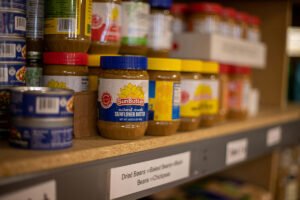
Gillingham grows vegetables and raises sheep, focusing on food access, agriculture education, and fiber arts through a pay-as-you-can farm stand and programming. She also founded Calliope & Gael Grocers, a no-charge, free-choice food pantry serving Livingston Manor families, in partnership with the local Calliope-on-Main Foundation. Raised on an off-the-grid farm down the road, Gillingham was involved in community, climate, and environmental justice work growing up. “When I started to see how much our society has disconnected people from where their food comes from, I felt like it was really valuable to teach more of what I had learned in my life,” she said.
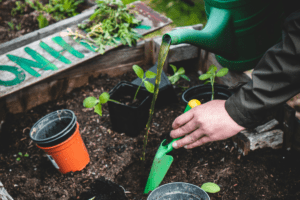
Gillingham collaborates with the local school district to offer agriculture and fiber arts programming to complement their curriculum. Students have planted garlic and harvested potatoes at the community farm and learned to identify plants in school. Community programs include understanding heritage sheep breeds and wool.
Gillingham spearheaded Gael Roots Community Farm’s food pantry founding last November, dismayed by the growing food insecurity in her hometown. Despite the 2024 median income being a little over $72,000 (2024 dollars), according to census.gov, Gael Roots supplies vegetables to nearby farms and provides additional produce and meat.
Sullivan County, where the farm is located, has the second-worst health outcomes in the state. Part of the community farm’s mission, by proxy, is making healthy food options more accessible to all. “Affordability is a major part of health,” she notes.
Food as a Means of Community Organizing
Another farm in Sullivan County, Finca Seremos, works with Gael Roots to support the community.
“When we talk about this [Finca Seremos] as a food justice project, it’s really a community organizing project at the core. It uses food as the vehicle for making those connections,” Chris Nickell, founder of Finca Seremos, told NPQ. Chris, along with their partner in life and work, Brenda Gonzalez, started the farm in 2023.
After a decade of personal and professional community organizing in their Upper-Manhattan Washington Heights neighborhood before and during the pandemic, burnout spurred the pair to seek restorative community endeavors, which meant accelerating their long-term farming plans.
Nickell and Gonzalez were raised in Appalachia and Puerto Rico cultures and communities, where people looked out for one another. “We can’t imagine doing a farm that wouldn’t fit these values,” Nickell said.
Finca Seremos offers free-choice, sliding-scale community-supported agriculture (CSA) in Liberty, Washington Heights, and Inwood. CSA connects local farmers directly to the community, which led the duo to farm in support of it, as Gonzalez explained to NPQ, “Because it is rooted in practices of mutual aid, interconnectedness, and community building.” The farm also sells wholesale to mission-aligned organizations, a channel that began unexpectedly when they had an abundance of produce in their first year. The farm will expand to three acres this season to grow more for wholesale.
Gonzalez and Nickell hope that Supplemental Nutrition Assistance Program (SNAP) recipients comprise 30 percent of their 150 CSA slots. They have fostered a vibrant member network, interacting with participants and building relationships as they select their produce.
Sign up for our free newsletters
Subscribe to NPQ's newsletters to have our top stories delivered directly to your inbox.
By signing up, you agree to our privacy policy and terms of use, and to receive messages from NPQ and our partners.
Beyond farming and providing accessible food, a mutual aid chat connects members to immigrant rights work and immigrant defense and health resources. During New York City’s recent nurses’ strike, members of the chat responded to requests for solidarity at the picket line.
[Community-supported agriculture] connects local farmers directly to the community, which led the duo to farm in support of it, as Gonzalez explained to NPQ, “Because it is rooted in practices of mutual aid, interconnectedness, and community building.”
Small Farms, Big Impacts
At Serra Vida Farm, Sea Matias demonstrates how a small farm’s food-access work at scale can be supported through a combination of land access and shared infrastructure. The 32-year-old is one of the first lessees of West Branch Commons, a community land trust that provides land and support to beginning growers from marginalized backgrounds. Community land trusts are emerging as a way for new farmers to obtain land at a low cost and help protect farmland.
Matias is also a partner of the 607 CSA, a Catskills Agrarian Alliance (CAA) program that connects small farms to markets by aggregating food for individuals, food pantries, and mutual aid organizations. In CAA, Matias discovered a natural intersection of goals, values, and support. The alliance also offers shared cold storage, logistics planning, and trucking, so farmers do not have to handle that themselves.
Apprenticing in community gardens in the Bronx, where they hail from, and fulfilling needs within the community, was “just beautiful,” Matias told NPQ. Wanting to grow food for mutual aid at scale and honor their grandmother’s love of plants and legacy of care for others, they founded Serra Vida Farm in the Catskills Delaware Valley in 2024.
Community land trusts are emerging as a way for new farmers to obtain land at a low cost and help protect farmland.
Last year, Matias donated 97 percent of the 14,000 pounds of food they grew to 18 mutual aid groups/food pantries in Delaware County and the Bronx. With an environmental education background, a Farm School NYC certification, and farm experiences under their belt, Matias deeply understands the pathways through which New York’s local food system can be utilized.
In Support of the Community
While these farmers have all crafted different approaches, their work is characterized by thoughtful intent and collaboration. They all practice agroecology, which Nickell defines as stewarding land in ways that actively oppose the country’s predominant extractive, oppressive food system. Including food sovereignty, agroecology “describes our growing practices, captures the way we think about our stewardship of land, the social life of our food, and that we co-create knowledge with our fellow farmers,” Nickell explained.
The farmers grow food that is culturally meaningful, from Asian eggplants to uvilla, a Peruvian husk cherry, asking recipients for their preferences. Matias has adapted seeds from their Puerto Rican relatives—the mountain-region climate is similar to the Catskills.
These models, nonprofit and for-profit, are replicable. Inspired by Rock Steady Farm, one of the few worker-led cooperative vegetable farms, Gonzalez and Nickell plan to transition from an LLC to a cooperative ownership model and are actively developing a tiered ownership structure. Rock Steady is also led by QTBIPOC and has created space in agriculture for people in those communities.
These farmers recognize that collective action is required, from partnering with organizations, sharing knowledge and equipment, to developing deep community roots. It’s especially true if farms are to adapt to challenges like climate change, noted Gillingham.
Grants, funding, and donations are critical to their work, growth, and survival. Until last year, Gillingham also worked at a restaurant. Matias holds a variety of agriculture-related jobs. Gonzalez and Nickell, in their mid-30s, have used up their savings to make their farm work. Despite it all, these young agrarians’ passion for their mission is evident.
“Beyond an act of resilience,” Matias said, “it is extremely important to show our communities that we have their best interests in mind; we have their backs. These farmers are showing the ways in which a local food system can be sustained to serve both farmers and communities.”