
Most days, I wake up thinking about what I want to get done. I have classes to attend, maybe an interview to do, messages to answer, and sometimes some writing to finish. But in Gaza, the day rarely goes as planned.
There is always something I need to find first. It could be water, electricity, an internet connection, or something my family needs that I am not even sure will be at the market. I can spend hours of my day trying to get something that, before the genocide, I didn’t have to think about.
This has become part of daily life across Gaza. Almost a year after the ceasefire, people still spend much of their day trying to meet their most basic needs.
The Struggle for Basic Needs
“They say there is a ceasefire and that things are getting better, but we are still struggling and exhausting ourselves just to get the most basic things.”
When I spoke with Yousef, a 26-year-old who has been displaced in the al-Mawasi camps near Khan Younis for nearly two years, he told me that part of his day begins with finding water.
“Water trucks do not reach the camp where I live,” Yousef said, adding that they stop at a nearby camp. He walks there and carries jerrycans of water for more than 200 meters back to his family. On some days, he has to make the trip twice.
Yousef says that he tried to find out why the trucks do not reach his camp. He was told by someone involved in the distribution that there is only enough water to serve the camp they already reach, and not enough to cover his as well.
Yousef’s experience is not unusual. According to a United Nations assessment, 74 percent of surveyed households receive water directly from trucks, while 63 percent get less than six liters of drinking water per person per day. The crisis comes amid the destruction caused by Israeli military operations to Gaza’s water infrastructure, while Israeli restrictions on the entry of materials and equipment continue to hinder repairs.
“They say there is a ceasefire and that things are getting better, but we are still struggling and exhausting ourselves just to get the most basic things,” Yousef said.
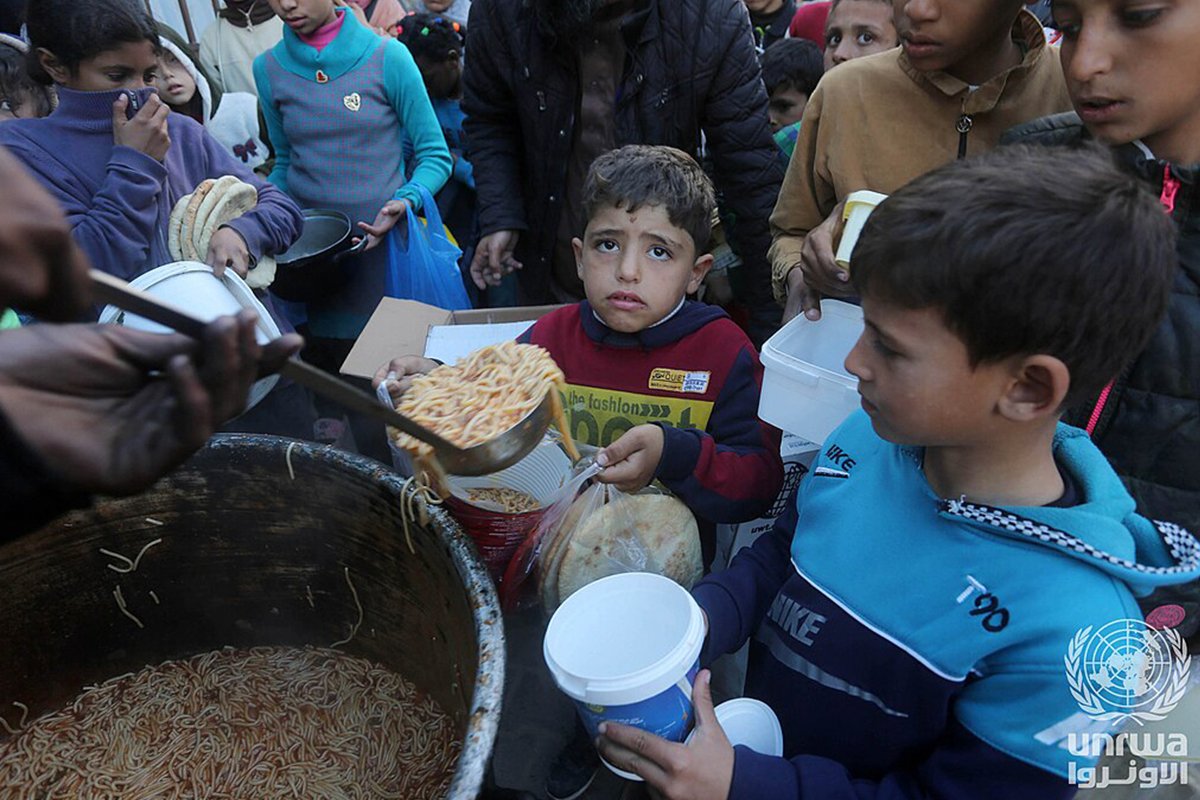
And it is not only about water. Yousef says that the camp where he lives relies largely on the displaced people themselves. There is no takiya, a community kitchen that provides free meals and operates regularly in the camp.
“Can you imagine? We have been in this camp for two years, and we still do not have a takiya,” he said.
Most families in the camp cannot afford food, according to Yousef. When residents reach out to humanitarian organizations for help, he says they are often told that the programs have already reached the number of people they can support, or that the available aid is barely enough for those already receiving assistance.
Although increased aid has improved food security, the situation remains fragile. More than 1.4 million people of Gaza’s population are projected to face crisis levels of food insecurity or worse between July and December 2026.
“We are still focused on survival needs,” Khitam said.
When I spoke with Khitam, who works in psychosocial support and humanitarian relief with several organizations in Gaza, what she described was similar to what Yousef told me. She says that Gaza has not yet moved into a real phase of recovery.
“Unfortunately, we are still focused on basic survival needs,” she said.
She observes this in the families she works with. A father may want to go to work, but first he has to think about when the water trucks arrive, who will fill the family’s jerrycans, when food will come, and who will take care of these needs while he is away.
For Khitam, the problem is not that humanitarian organizations are doing nothing. They provide food, clothing, hygiene supplies, psychosocial support, and other services. But the gap between what they can provide and what people need remains enormous. In her work, she meets families who need baby formula and diapers, older people who need assistance, and people who need individual psychological support. A lack of funding and essential supplies makes it difficult to meet all these needs.
The United Nations also noted that Israeli restrictions on the entry of essential materials and equipment into Gaza, along with funding shortages, continue to limit humanitarian organizations’ ability to provide and expand their services. For Khitam, these limitations can show up in things that may seem small.
Psychosocial support teams use simple materials such as clay to help children express what they are feeling, as well as balloons and other supplies for recreational activities. But Khitam says even these basic materials are often unavailable or difficult to find.
“Even a speaker that a facilitator might use for activities with dozens of children becomes a problem when it needs to be charged and there is no reliable electricity,” she said.
When we discussed how many people these programs can reach, one line from Khitam stayed with me: “We provide, but in reality, we barely provide enough.”
During an activity, for example, she may be able to provide meals for 20 people in a camp where more than 500 displaced people live. In some programs, organizations set limits on the number of cases each worker can take, even when many others need the same support.
This raises a different question about humanitarian aid. It is not only about how many aid trucks enter Gaza, but what humanitarian organizations can actually provide with the supplies and funding available to them.
Sign up for our free newsletters
Subscribe to NPQ's newsletters to have our top stories delivered directly to your inbox.
By signing up, you agree to our privacy policy and terms of use, and to receive messages from NPQ and our partners.
“We have become just a tool for survival.”
When Tents Are Still Homes
Ahmed Asfour expected things to be different when the ceasefire began.
Ahmed is from southern Gaza and lives with his family in al-Mawasi. He thought that, with time, they would be able to return home—or at least leave life in a tent behind. But ten months later, they are still there.
During the summer, Ahmed says that the tent becomes so hot during the day that his family cannot stay inside for long. It has become more of a place to sleep than a place where they can actually live.
Life in a tent brings other problems too. Insects and other pests find their way inside and underneath the tents, adding another burden to already difficult living conditions.
Humanitarian organizations also remain limited in their ability to provide adequate shelter. According to OCHA, shelter assistance during one week in July reached less than seven percent of what humanitarian partners could have provided if enough shelter materials had been available amid shortages and Israeli restrictions on their entry into Gaza.
But the tent is not Ahmed’s only concern.
What worries him most is his mother’s health. He says getting the treatment she needs is difficult. At times, the only medicines they can find temporarily ease her pain or symptoms, while her underlying condition remains without consistent treatment.
Reaching a medical checkpoint can also mean traveling a long distance because there are few health services near where his family is displaced. Ahmed’s experience comes at a time when only of Gaza’s health service points are functioning, amid shortages of medicines and medical supplies. For him, this is what it means to remain in an emergency: medicine that helps his mother today and a tent that shelters his family, but no lasting solution beyond that.
Khitam says people need more than food and water. They need safe spaces for children, psychological support, housing that gives them some privacy, and the chance to return to a life where they can think beyond their immediate needs. She speaks particularly about privacy. Before the genocide, people had homes where they could close the door behind them. Now, many live close together in tents and displacement camps, where there is little space for privacy.
For Khitam, returning home or having adequate shelters is not simply about having a roof. It is part of getting back a sense of normal life and dignity. Even those trying to help others are living through the same crisis. Khitam notes that psychosocial workers listen every day to stories of loss, fear, and displacement and try to help people cope, while many of them need support themselves.
“I can make things a little easier for them, but when they leave, they go back to the same conditions. They go back to thinking about water, the takiya, and food.”
“We need psychological support, too,” she said.
This is why Khitam does not believe Gaza has reached a “post trauma” stage. People are still living through the conditions that caused the trauma in the first place. When I asked her what it means when humanitarian work is limited to helping people survive, her answer was direct: “It is like an anesthetic.”
“Psychosocial support programs were not just about listening to people. We tried to empower women and adolescents, provide safe spaces, and sometimes connect people with opportunities that could help them regain some economic and social independence,” Khitam said. “Today, our ability to do that is extremely limited.”
A woman may come to Khitam and talk about experiencing violence or struggling with difficult living conditions. Khitam can listen and offer some relief, but she cannot necessarily provide a safe place, a job opportunity, or a solution that changes the conditions the woman will return to.
“I can make things a little easier for them, but when they leave, they go back to the same conditions,” she said. “They go back to thinking about water, the takiya, and food.”
Khitam sums up what humanitarian work has become for her in one sentence: “We have become just a tool for survival.”
Her words bring me back to Yousef, who still has to search for water, and Ahmed, who searches for treatment for his mother and lives with his family in a tent they can barely stay inside during the day.
Humanitarian organizations have acknowledged these limits themselves. OCHA has warned that aid can only go so far while access remains restricted, funding falls short, and the underlying causes of humanitarian need remain unaddressed.
How much aid enters Gaza matters. But there is another question: what would be enough to move people from simply surviving to something more stable? Food, water, medicine, and tents can help people get through another day, but they cannot on their own restore homes, livelihoods, privacy, or a sense of normal life.
Still, people continue to ask for more than survival. Yousef wants a day that does not begin with finding water. Ahmed wants lasting treatment for his mother and a home his family can actually live in. The people Khitam works with want safety, work, and the ability to think about their future more than their next meal.
Nearly a year after the so-called ceasefire, the distance between survival and recovery remains vast, but so does the demand for a life with dignity beyond survival.