
In 2024, we saw the tightest congressional race in California’s 13th district, with the House of Representatives race being decided by 187 votes. For context, that means that less than a tenth of one percent of the 210,000 voters made the difference.
Our organization, Asian Americans Rise, registered 702 voters in the district earlier that year; 454 of them turned out to vote.
A single, modestly funded registration effort added more than twice the number of voters that ultimately separated the winner from loser.
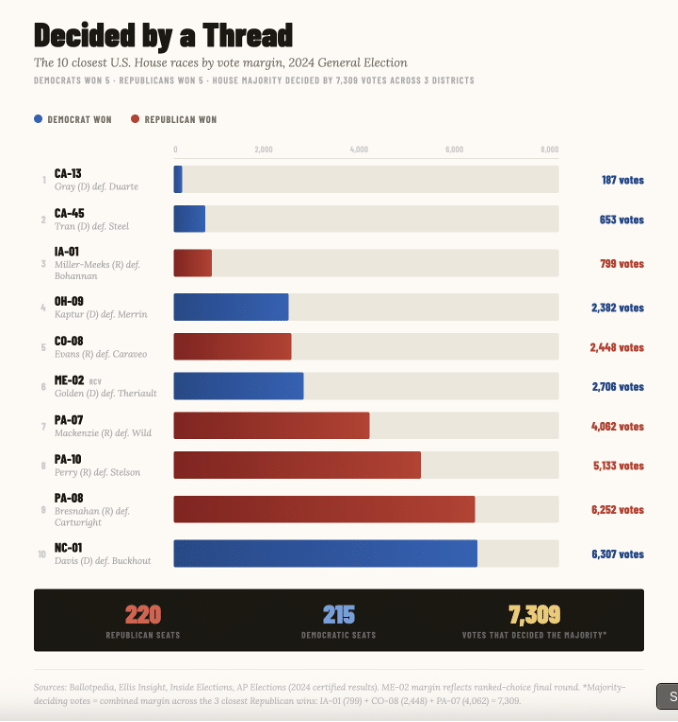
Now multiply that across the country. In 2024, 13 US House races were decided by fewer than 8,000 votes apiece. Zoom in and it gets starker: the entire majority turned on just 7,309 votes—the combined margin of the three seats that flipped control of Congress. At those margins, the election isn’t necessarily won by the best argument. It’s won by whoever did the unglamorous work of finding eligible people, registering them, and getting them to the polls.
We are told, election after election, that low turnout is a story about apathy—that people don’t vote because they don’t care. That explanation is comfortable but doesn’t tell the full story. In our experience, people who don’t vote are people the system never reached in time—they were never asked at the DMV, never contacted in a language they speak, never given a reason to believe their ballot would count in time to cast it.
Apathy Is a Convenient Lie
The uncomfortable truth is that this country never built voter registration to work at national scale. Historically, it was designed as a gate. What exists today is a fragmented ecosystem defined by:
- Local silos. Civic engagement is organized state-by-state and org-by-org, with little ability to redeploy resources quickly to where elections are actually competitive.
- Short time horizons. Most operations—including state party infrastructure—spin up months before Election Day and dissolve immediately after, taking institutional knowledge with them.
- Inconsistent data systems: Voter files, outreach tools, and field operations often don’t integrate, slowing execution.
- Volunteer-heavy models: Work that now requires logistics, data, and compliance is still treated as episodic grassroots labor.
- Episodic funding: Resources arrive late, unevenly, and often after strategic windows have closed.
- Candidates: they are incentivized to spend their money on their own name recognition instead of voter participation that benefits all races.
We would never tolerate this in disaster response. We don’t rebuild the emergency system from scratch every time a hurricane forms, then disband it once the storm passes. Yet that is exactly how we treat the machinery of democracy.
Sign up for our free newsletters
Subscribe to NPQ's newsletters to have our top stories delivered directly to your inbox.
By signing up, you agree to our privacy policy and terms of use, and to receive messages from NPQ and our partners.
A Tale of Two Districts
In 2024, we tried something different. Asian Americans Rise targeted 12 toss-up congressional districts with large, historically under-registered Asian American populations. Instead of a last-minute turnout push, we built a registration-first system months in advance.
We used voter-file analysis and demographic modeling to find people who were eligible but unregistered. We reached them with direct mail and follow-up texts tailored to each district’s rules and deadlines. And we treated registration and turnout not as two separate campaigns, but as one continuous system.
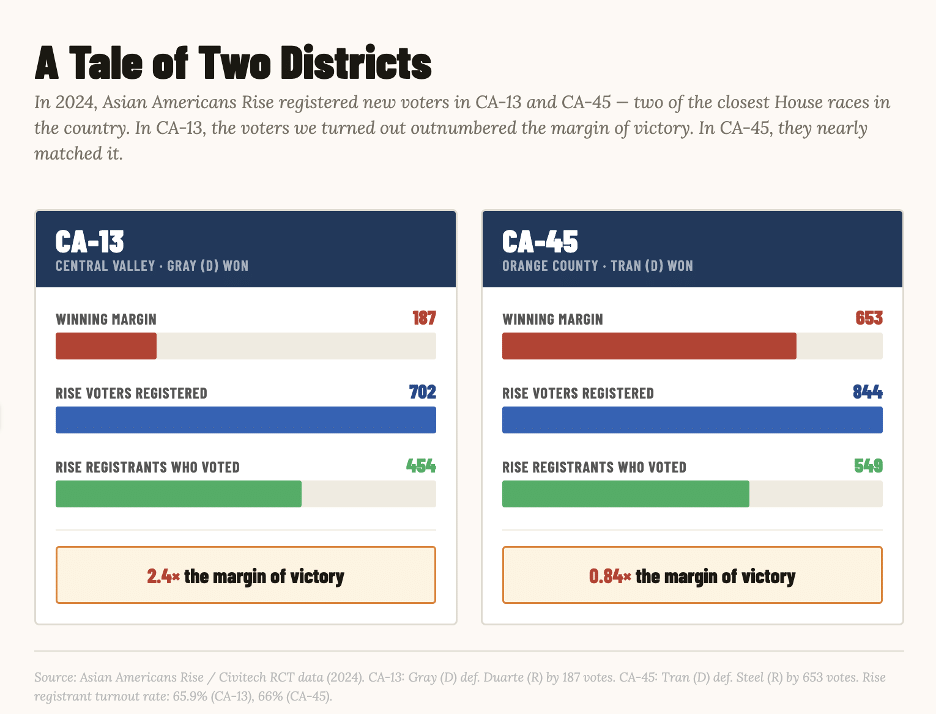
The lesson was simple and decisive: When outreach is early, consistent, and credible, voters show up.
Why This Doesn’t Happen Everywhere
Registration is largely left to state parties that face high staff turnover and rarely have the funding or technical know-how to run mass registration year-round. So a proven, repeatable method stays the exception—not because it doesn’t work, but because no one owns the job of making it standard.
This is not a messaging problem. Better ads won’t fix a system that never contacts the voter in the first place. It’s an infrastructure problem, and infrastructure problems have infrastructure solutions:
- Permanent, professional registration operations that run year-round, not just in the frantic months before an election.
- A national database of unregistered but eligible voters that any on-the-ground organizer can use to target outreach by canvass, phone, text, or mail.
- Dedicated, durable funding—including a standing commitment that a small share of candidate campaign dollars, say 5 percent, is set aside for registration and turnout that lifts every candidate up and down the ballot.
In short, treat voter engagement as infrastructure, not charity.