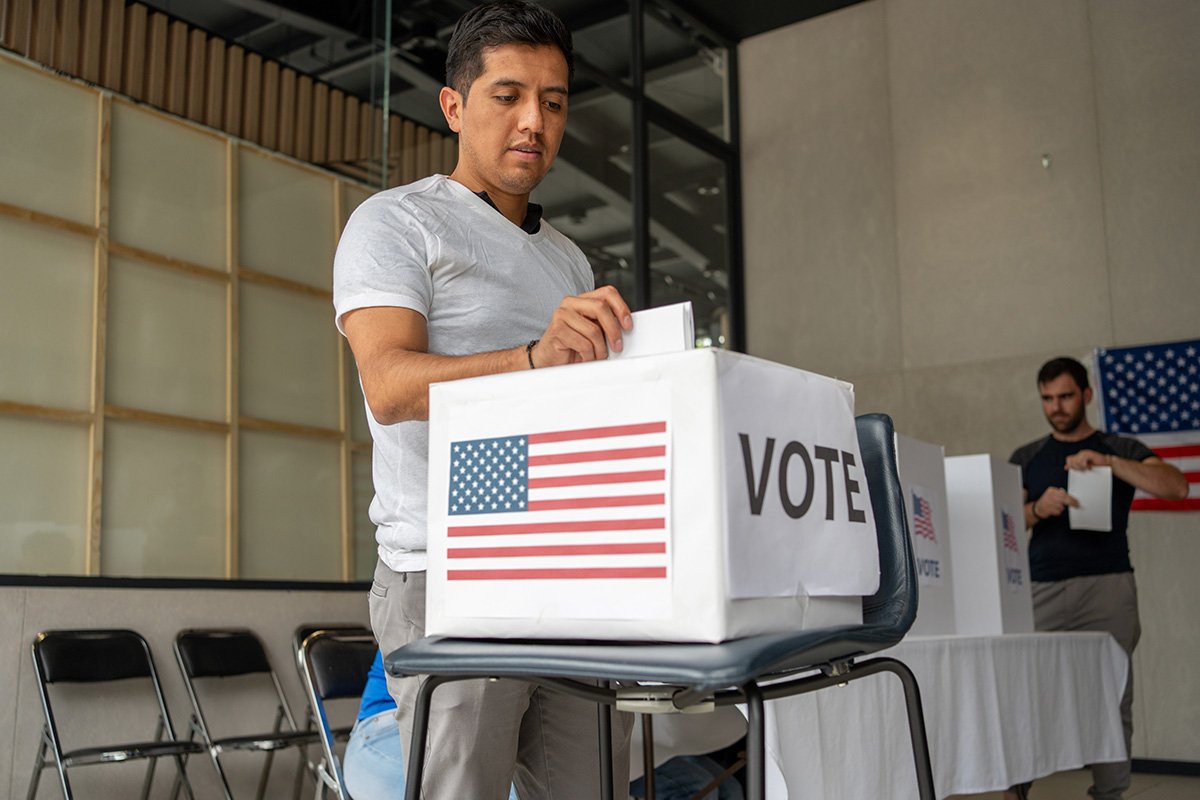
Historically, Latine communities have supported Democrats over Republicans. But come November, we might see a surge of voters fed up with the current administration’s anti-immigrant agenda and economic strains. Nonprofits led by Latine advocates are betting that anger will win over the Republicans’ fear tactics.
But First, Some Historical Voting Trends
Founded by the Federation for American Immigration Reform in 1985, the conservative think tank the Center for Immigration Studies (CIS) released a much-talked-about report in 2001 about the losing Republican hope of ever winning the Hispanic vote. Latine communities (except for Cubans in Florida) were staunch Democrats, and CIS analysts doubted “whether the GOP attempt to woo Hispanics is worth the enormous effort that it would take to make solid gains.”
Nevertheless, after eight years of Bill Clinton’s sexual scandals, free trade agreements, and support for neoliberal governments that caused economic havoc all over Latin America, George W. Bush would win the elections against Al Gore with 35 percent of the Hispanic vote. That number would rise a not-shy 5 percent in 2004, driven by concerns about national security and moral values, aided no less by two critical wedge issues: 9/11 and the same-sex marriage debate.
Republicans thought they were onto something—perhaps wooing Catholic swing voters was paying off? It wasn’t enough.
In 2008, when polls showed that an overwhelming 67 percent of Hispanics had voted for Barack Obama, Republicans were back at the table. States like Colorado, Florida, Nevada, and New Mexico went over to the Democrats, likely due to Republicans’ anti-immigrant rhetoric with “racial overtones,” specifically aimed at Muslims and Hispanics.
Ironically, the Bush administration tried and failed to provide a legalization path for the 12 million undocumented immigrants (the majority of which were Hispanics), after it met staunch resistance from the far right. And the now-infamous US Immigration and Customs Enforcement (ICE, created under the Homeland Security Act in March of 2003) was becoming increasingly active all over the country. A table by the CATO Institute clearly shows how deportations more than doubled under Bush.
Side by side, [Obama’s] stand on the issue of immigration reform does not look very different from the Republican candidate, John McCain—who, in fact, cosponsored the original version of the DREAM Act.
Obama ran on hopeful promises toward immigration reform, including a path to legalization, and support for the Development, Relief and Education for Alien Minors (DREAM) Act. But he also made it very clear that he was against open borders and amnesty. Side by side, his stand on the issue of immigration reform does not look very different from the Republican candidate, John McCain—who, in fact, cosponsored the original version of the DREAM Act.
The Obama administration showed early signs of immigration enforcement when Department of Homeland Security (DHS) Secretary Janet Napolitano announced in 2009 that their first priority was securing the border and the removal of undocumented immigrants. By 2011, advocates expressed “a deep sense of betrayal and disappointment” towards Obama’s administration and continued to mobilize. The newly established United We Dream Network was the most active, using the presidential election year to march, rally, and protest demanding a DACA solution and family reunifications. On June 15, 2012, Napolitano announced a new DACA policy, overstepping Congress, which analysts argue granted Obama 71 percent of the Hispanic vote that election year.
The amnesty didn’t last, however, as the deportation campaign at the end of the year continued. The language of ICE going after the “worst of the worst” was also actually first coined by Obama (he liked to say “gang bangers”) when, in reality, 69 percent of people deported under his administration were non-criminals or low offenders.
By 2014, advocates were begging for “more humane deportations”; by 2015, Know-Your-Rights pamphlets started circulating for people to know what to do if ICE came knocking on your door. But things kept getting worse, as documented by human rights organizations on deaths in ICE detention and the blatant lack of legal representation for people (including children) seeking asylum.
Deportations under Obama, in fact, increased and exceeded Bush’s efforts (by 1 million people), and he was eventually dubbed the “deporter-in-chief” by advocacy groups. By then, ICE had already become a bit of an unstoppable force, endorsing for the first time a presidential candidate in 2016—Donald J. Trump.
Not surprisingly, the Latine support for Hillary Clinton dropped to 67 percent, then dropped again for Joe Biden to 61 percent, and down again to 57 percent for Kamala Harris. A bit more than half of Latine voters in the 2016 election said they were really voting against Trump than for Harris and listed immigration reform fourth on their list of concerns.
Although Biden created humanitarian pathways toward more naturalizations, the surge of migrants fleeing the post-COVID pandemic economic global crisis drove the Biden administration to continue Title 42 expulsions (including immigrants requesting asylum), expelling more people at the border than any other president since 2016. The administration also expanded ICE border detentions and private prison capacity from 25,000 to 40,000 people, and increased deportation charter flights by 55 percent, according to the CATO Institute. Although ICE activity inside the country decreased overall, groups like the ACLU warned that leaving ICE policies in place—such as partnerships with local law enforcement and with companies that ran for-profit prisons—would embolden the deportation machine for the next president.
Regardless, it is a false narrative to claim that the Hispanic vote won Trump the 2024 election—rather it was the Democrats that lost the Hispanic vote. In the case of Trump, though, it was White men under 50 that shifted from Biden by 10 points, winning him the election.
Demobilizing the Non-White Vote
Of course, the Hispanic vote is not a monolith. Many Latine people see the economy and health care as more crucial issues than immigration reform, but the strength of 36 million Latine eligible voters has the power to move the needle. Some of these voters, no doubt, overlap with the 30 million Black eligible voters, who vote Democrat in greater numbers than any other group. White voters, meanwhile, make up 61 percent of all eligible voters in 2026, out of which around 40 percent tend to vote Democrat.
Sign up for our free newsletters
Subscribe to NPQ's newsletters to have our top stories delivered directly to your inbox.
By signing up, you agree to our privacy policy and terms of use, and to receive messages from NPQ and our partners.
[T]he Hispanic vote is not a monolith. Many Latine people see the economy and health care as more crucial issues than immigration reform, but the strength of 36 million Latine eligible voters has the power to move the needle.
These trends do make the right-wing nervous, so nervous that they rather attack and cheat than woo non-White voters. Gerrymandering is one tool on their belt, disrupting mail voting is another, but a finer tool is voter intimidation. Trump’s threats of sending the National Guard and ICE to polling locations are nothing less than direct threats to US citizens who have been racially profiled, mistakenly detained, and hurt in multiple states by unhinged armed immigration officers. Such blatant intimidation is illegal, but so have been so many other things…
Crying wolf, or in this case, crying voter fraud is another desperate measure. So desperate, in fact, that the Trump administration is resorting to potentially illegal tactics like the “Unlawful Voter Initiative,” where, according to a whistleblower, DHS officers use people’s personal voting information to verify on public websites whether they are eligible to vote or not. These sites, of course, often lack the most recent information, including people who have become naturalized citizens since the data was last updated.
Moreover, the Supreme Court conservative majority approved on September 25 DHS’ use of the Systematic Alien Verification for Entitlements, or SAVE, database to verify voters’ eligibility. The SAVE program was created in 1986 under the Immigration Reform and Control Act to check federal benefits eligibility, and some states like Arizona, Colorado, and Florida have used it past elections. But the system has been known to wrongly flag citizens—the US Court of Appeals for the Eleventh Circuit ruled in 2014 that Florida’s purge of voters using this system was illegal.
Mobilizing for the Midterms and the 2028 Election
Recent news headlines like “Republican jitters grow as unpopular Trump fuels midterm ‘bloodbath’ fears,” clearly show that things are not going well. Trump’s approval numbers just dropped to 29 percent, according to the American Research Group poll. That is why Latine nonprofits are betting on the Hispanic voting power this year and into the next presidential election.
Groups like the LatinoJustice PRLDEF are taking every legal measure possible to safeguard November’s and future elections. They are part of a civil rights coalition with nine nonprofits and six other legal counsel organizations that filed a federal lawsuit on September 18 to challenge voter interference through armed agents like ICE.
The National Immigration Law Center, which is also part of the above coalition, filed another lawsuit against the DHS on September 21, to stop the agency from compiling voter lists and conducting “in-person interviews at people’s homes.” As reported by CNN, DHS’ “voter fraud” investigation would focus specifically on recently naturalized citizens in states lie Washington, Wisconsin, Missouri, Georgia, California, Pennsylvania, Nevada, New York and Connecticut.
The Voto Latino Foundation has been tracking the growing Latine voting bloc for years and promises a direct impact on the ground, with a force of 28,475 volunteers on the ground, plus coalitions with other get-out-the-vote groups. Their El Brief news cultural hub is focused specifically on the million young Latine voters who become eligible to vote each year.
With offices in key states like Arizona, California, Colorado, Florida, Georgia, Nevada, North Carolina, and Texas, Mi Familia Vota 501c4/Mi Familia En Acción 501c3 expanded the Latine power by working all year on mobilizing people, instead of just during election years. By recognizing the intersection between issues that are important to their communities (reproductive rights, worker’s rights, gun control, environmental justice, immigration, affordable healthcare, among others) and voting, they have created “a 365-day, year-round engagement approach has positioned us to make a meaningful impact where it is most critical,” according to their 2024 annual report.
Trump’s approval numbers just dropped to 29 percent, according to the American Research Group poll. That is why Latine nonprofits are betting on the Hispanic voting power this year and into the next presidential election.
In states like Texas, organizations like La Unión del Pueblo Entero (LUPE) in Rio Grande Valley have been organizing people’s assemblies, based on the urgency to mobilize around immigration reform. Know-your-rights campaigns like “Valle Fuerte, Valle Libre” have become exemplary in the state, driving people to register folks to vote in droves and become involved in other issues such as the economy, LGBTQ rights, and education rights.
Candidates know Latine citizens can flip elections; as UnidosUS makes it clear in a press release, “Any elected leader or candidate who ignores the surging sentiment of the Latino electorate, the nation’s second-largest voting-age population, does so at their own peril.” In May they conducted a bipartisan poll of 3,000 Latine voters that showed that 76 percent plan to vote in November, while 68 percent said that the country is headed in the wrong direction. Those surveyed also said immigration is a priority for Latine people, who said their communities have been harassed by ICE and that raids and detentions have a direct impact on the local economy.
Republicans started sounding the alarm back in 2024, after governorship defeats in New Jersey and Virginia, of a quick erosion of the pro-Republican Hispanic vote. Right-wing groups like the Latino Action Alliance warned that the Trump administration “just went too far on immigration enforcement,” as reported by The Hill.
Progressive candidates taking over school boards in Florida to fight book bans could also be a sign, driven largely by students who have been able to turn the debate from attacks against critical race theory to censorship in schools and defending the First Amendment. The Sarasota Next Gen Dems grew from the battle, led by young voters, driving voting registration and training leaders for the midterm elections and beyond.
Desperate, Republicans are resorting once again to an anti-communist message that is running dry, even in Florida. When Democratic socialist Angie Nixon won the primary for a Senate seat against a retired army intelligence officer, it came as a surprise to both parties. Yet, according to a survey conducted in March by the Latino Public Opinion Forum (LPOF), 67 percent said they felt “the country is on the wrong track,” and cited the economy and ICE tactics as their two main concerns.
And although of those surveyed by LPOF, Cubans living in Florida showed the highest support for Trump, the younger Cuban American generation is just not buying it. Andres Plasencia put it very plainly in an opinion article for the Miami Herald, “When communism has taken everything from you, you vote to make sure it never follows you here. Many Cuban Americans like me didn’t grow up fleeing anything. As time passes, we’ve become more Americanized and less Cuban in ideology. In school, the talk among young Cubans isn’t about Cuba policy but about college tuition, the job market, what this country will look like when it’s ours to run.”
Come November, we’ll see if eligible Hispanic voters can turn the tables, even in states like Florida.