The dramatic increase in minimum wages in cities and states across the country over the last decade is often heralded as a policy milestone. But it is also a story about what can happen when large, long-term investments are made before there is any guarantee of success.
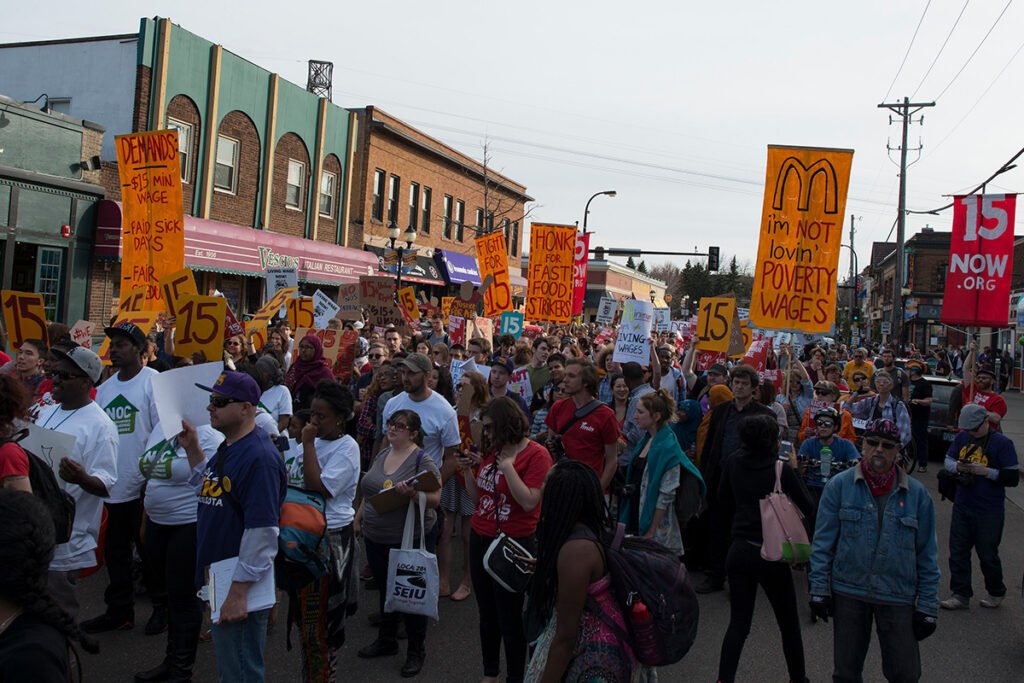
When 200 fast-food cooks and cashiers walked off the job in New York City in November of 2012 demanding $15 an hour and a union, nobody gave them a shot to win. Inside the labor movement and out, Democrats and Republicans, journalists and pundits all scoffed at the workers’ demand to more than double the federal minimum wage.
At the time, all the talk on the economy was about debt and deficits; raising pay was not on the agenda. There were two lone wolves in Congress, Senator Tom Harkin and Representative George Miller, who introduced a bill for a $10.10 minimum wage but couldn’t get any traction. The workers from McDonald’s, Burger King, KFC and other fast-food giants, knew what they needed to pay their rent, put food on their families’ tables and shoes on their kids’ feet.
Change doesn’t spring from politicians; it comes when regular people take dramatic action and push the politicians beyond where they would ever go on their own.
Fast-food cooks like Alvin Major, a father of three, who was paid just $7.25 at KFC, refused to moderate their demands. With each strike, their bold call caught on, spreading from coast to coast and across the service economy—to workers in home care, airports, retail and higher education. Politicians like New York Governor Andrew Cuomo and California Governor Jerry Brown, initially skeptics, raced to make their state the first to adopt $15.
Today, nearly half of the country is on its way to $15 per hour. Fifteen states have passed $15-an-hour minimums and hundreds of companies, including giants like Amazon, Target, Disney and Sam’s Club have adopted $15 per hour floors. Unionized workers across the service economy, from home care and nursing homes to school bus drivers, now go into negotiations with $15 as the floor.
Yet as monumental as the victories were, much work remains. The US Bureau of Labor Statistics just reported the share of economic output going to labor versus capital is now at a record low. Headline after headline highlights how unaffordable life has become. It’s why I’ve found myself thinking of Alvin and his colleagues a lot lately and asking myself what we can learn from their struggle.
An Investment in Change
One of the big lessons of the movement is that change doesn’t spring from politicians; it comes when regular people take dramatic action and push the politicians beyond where they would ever go on their own. By 2020, every Democratic candidate for president ran on $15—support for $15 was a key piece of the party’s platform. One Bloomberg headline screamed that Fight for $15 and a Union picket lines were “required stops” on the campaign trail.
The workers “entirely changed the politics of the country” according to MSNBC’s Chris Hayes. They turned $15 from “laughable to viable,” according to Steven Greenhouse in The New York Times, and transformed it from “absurdly ambitious to mainstream,” wrote Lydia DePillis in The Washington Post.
Yes, the Fight for $15 and a Union movement succeeded because workers led it with a bold demand and direct action. But one of the overlooked lessons of the movement is that organizing is expensive. Without the extraordinary financial commitment and risks taken by the union I once led, amid considerable resistance, one of the most successful social movements of the last 50 years would not have gotten off the ground.
At the Service Employees International Union (SEIU), we made a massive investment in the Fight for $15 and a Union even though there was no clear path to winning new members. At the movement’s peak from 2015 to 2019, the union spent more than $50 million a year to maintain and grow it in cities across the country. There were loud internal voices that questioned that spending. In one early debate, some leaders wondered whether the increasingly large investment should be made to back fast-food workers, when homecare workers—representing a significant portion of the union’s membership—were also stuck at near minimum wage and were excluded from city and state minimum wage increases.
But union leaders believed challenging corporate power in the fast-food industry would reshape a broader economy that was leaving workers behind. And the bet paid off far beyond fast-food workers. As the Fight for $15 and a Union movement gained momentum, it changed the politics of wages across the country, strengthening bargaining power for union members, and driving wages up in other workplaces.
Local unions experienced the positive impact of the movement in their contracts, and even the most skeptical union elected leaders and staff members agreed that the SEIU’s investment was smart, even if it remained risky on whether it would ultimately lead to more union members.
Sign up for our free newsletters
Subscribe to NPQ's newsletters to have our top stories delivered directly to your inbox.
By signing up, you agree to our privacy policy and terms of use, and to receive messages from NPQ and our partners.
And when on the same day in 2015, Cuomo and Brown signed $15 minimum wages into law, it became clear the returns on that substantial investment would exceed leaders’ wildest imaginations. By 2021, the National Employment Law Project reported 26 million workers had won $150 billion in raises as a result of the Fight for $15 and a Union movement.
I write this now not to pat ourselves on the back for winning a big bet we made 13 years ago, but to underscore what is needed to confront the vast inequality that is eroding our democracy.
One of the overlooked lessons of the movement is that organizing is expensive. Without the extraordinary financial commitment and risks taken by the union I once led, one of the most successful social movements of the last 50 years would not have gotten off the ground.
All Tides Rise
The Wall Street Journal recently reported that there is a “record divide between corporate profits and worker pay.” As prices rise for everything from groceries to rent, the $15 per hour minimum wage that workers fought so hard to achieve is no longer close to enough for a single adult working 40 hours a week every week to cover their basic needs in any state, according to a Nexstar analysis of data from the MIT Living Wage Calculator. It’s also not sufficient for a family of four, with both adults working, to get by in any state without public assistance, the MIT data show. Across the country, workers have started demanding—and winning—more.
The cooks and cashiers leading the Fight for $15 and a Union movement knew this. It’s one of the reasons their core demand was for $15 and a union. The second part of that demand was key because they knew only with a union contract would they have the ability to continue to negotiate for higher pay and other benefits as costs skyrocketed. On this front, the workers exposed the structural limits in the existing labor law and regulatory system—limits that help explain why widespread wage gains did not translate into widespread collective bargaining rights.
The magnitude of investment that helped win higher wages for 26 million workers should force all of us to ask whether current giving matches the scale of the change we seek.
Large segments of the workforce remain excluded from meaningful protections, including domestic workers and care workers. And franchise models (common in the fast-food industry where many of the workers worked) subcontracting, and agricultural and gig work arrangements continue to diffuse responsibility and weaken workers’ ability to bargain collectively. Even where formal protections exist, their interpretation and enforcement fluctuate with changing political conditions. Weak enforcement allows employers to violate workers’ organizing rights with impunity.
Clearly, there is much work to be done. Yet despite the overwhelming need, too much funding for social change remains fragmented and cautious. Fight for $15 and a Union succeeded because workers and organizers were backed by sustained, large-scale resources over many years, long before victory seemed plausible.
That is the challenge philanthropy must grapple with today. If donors and foundations want transformative change, they must be willing to finance transformative movements in their early stages. That means funding a campaign before it has obvious momentum and a public mandate. These early investments ensure that organizations can build leaders, test strategies, and seize opportunities when the landscape shifts.
The magnitude of investment that helped win higher wages for 26 million workers should force all of us to ask whether current giving matches the scale of the change we seek.
Alvin Major grew into a leader, more than doubled his salary, and changed his life because leaders of a union invested in an idea that many dismissed as impossible. Millions of people are still waiting for that kind of investment today.