logo logo
giving banner
Donate
    • Membership
    • Donate
  • Social Justice
    • Racial Justice
    • Climate Justice
    • Disability Justice
    • Economic Justice
    • Food Justice
    • Health Justice
    • Immigration
    • LGBTQ+
  • Civic News
  • Nonprofit Leadership
    • Board Governance
    • Equity-Centered Management
    • Finances
    • Fundraising
    • Human Resources
    • Organizational Culture
    • Philanthropy
    • Power Dynamics
    • Strategic Planning
    • Technology
  • Columns
    • Ask Rhea!
    • Ask a Nonprofit Expert
    • Economy Remix
    • Gathering in Support of Democracy
    • Humans of Nonprofits
    • The Impact Algorithm
    • Living the Question
    • Nonprofit Hiring Trends & Tactics
    • Notes from the Frontlines
    • Parables of Earth
    • Re-imagining Philanthropy
    • State of the Movements
    • We Stood Up
    • The Unexpected Value of Volunteers
  • CONTENT TYPES
  • Leading Edge Membership
  • Newsletters
  • Webinars

Seven Months after Maria, Thousands of Puerto Ricans March against Austerity

Steve Dubb
May 3, 2018
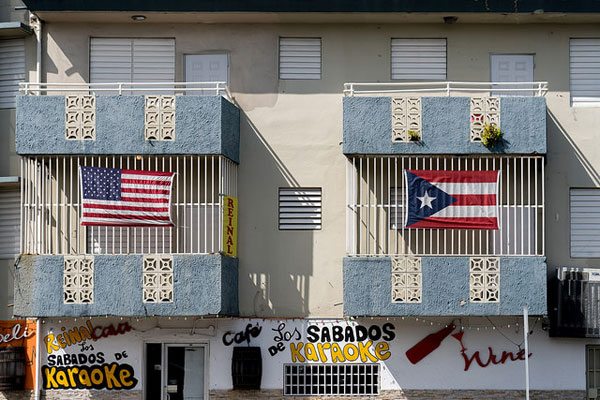
“US and Puerto Rican flag on a building in Puerto Rico,” by Lorie Schaull

May 1, 2018; Washington Post, NBC News, and New York Times

“Thousands of Puerto Ricans marched Tuesday to protest pension cuts, school closures, and slow hurricane recovery efforts as anger grows across the US territory over looming austerity measures,” writes Associated Press reporter Danica Coto in the Washington Post. The march, held on International Labor Day (a holiday that, although not widely celebrated in the US, originated here) “attracted teachers, retirees and unionized workers from both the private and public sectors, as well as the mayor of the capital of San Juan, Carmen Yulín Cruz,” notes Coto.

Considerable press attention has focused on the clashes that occurred during the march between protestors and police. According to Puerto Rican government officials, 13 people were arrested and 15 police officers were injured, either by projectiles thrown by protestors or their own tear gas. NBC News reports that, “According to the ACLU chapter in Puerto Rico, police officers disproportionately used violence against demonstrators, reporters, and legal observers, followed by warrantless arrests of protesters in their homes and university dorms.”

Of course, the main goal of the marchers was to call attention to the pain caused by both economic austerity and a slow recovery from Hurricane Maria. In Puerto Rico today, 30,000 residents still remain without power. Speaking before the march, Mayor Cruz called attention to her compatriots’ plight: “There are retirees here who are going to lose their pensions, there are students, there are employees who are going to see money for their medical plans taken away.”

Sign up for our free newsletters

Subscribe to NPQ's newsletters to have our top stories delivered directly to your inbox.

By signing up, you agree to our privacy policy and terms of use, and to receive messages from NPQ and our partners.

Perhaps the biggest impact of austerity has been on Puerto Rico’s public schools, 179 of which have already closed, with another 280 of the remaining 1,100 schools slated to shut their doors. Public pensions also face a 10-percent cut, public university fees have doubled, and reduced paid and sick days are also part of the benefit reduction package. Aid has been slow to arrive, too. For example, a New York Times article reports that total post-disaster assistance to Puerto Rico’s universities totals a paltry $8.9 million.

All of this has been overseen by a highly unpopular congressionally appointed fiscal oversight board, widely viewed as favoring corporate and bondholder interests over Puerto Rico’s own. Last month, Puerto Rico’s Senate voted 25–0 (with five abstaining or absent) to cease funding the board’s operations. Puerto Rico Senate President Thomas Rivera Schatz denounced the board’s executive director Natalie Jaresco, who receives a $650,000 salary, for living “at the expense of the people of Puerto Rico while trying to eliminate the Christmas bonus to workers of private companies and the government and is also trying to reduce your working hours or eliminate your vacation. And who is attacking the medical services, education, and housing of the Puerto Rican people.”

Speaking about the budget cuts with NBC News, Edwin Meléndez, who directs Hunter College’s Center for Puerto Rican Studies in New York City, said that it is true that, “in many instances, the austerity is disproportionately affecting the most vulnerable populations—it could be a more equitable reform that would be more balanced in terms of cutting services.”

As we have covered in NPQ, in the post-Hurricane Maria context, issues of sovereignty and equity are paramount. More NPQ articles about recovery efforts in Puerto Rico can be found here.—Steve Dubb


Our Voices Are Our Power.

Journalism, nonprofits, and multiracial democracy are under attack. At NPQ, we fight back by sharing stories and essential insights from nonprofit leaders and workers—and we pay every contributor.

Can you help us protect nonprofit voices?

Your support keeps truth alive when it matters most.
Every single dollar makes a difference.

Donate now
logo logo logo logo logo
About the author
Steve Dubb

Steve Dubb is senior editor of economic justice at NPQ, where he writes articles (including NPQ’s Economy Remix column), moderates Remaking the Economy webinars, and works to cultivate voices from the field and help them reach a broader audience. In particular, he is always looking for stories that illustrate ways to build a more just economy—whether from the labor movement or from cooperatives and other forms of solidarity economy organizing—as well as articles that offer thoughtful and incisive critiques of capitalism. Prior to coming to NPQ in 2017, Steve worked with cooperatives and nonprofits for over two decades, including twelve years at The Democracy Collaborative and three years as executive director of NASCO (North American Students of Cooperation). In his work, Steve has authored, co-authored, and edited numerous reports; participated in and facilitated learning cohorts; designed community building strategies; and helped build the field of community wealth building. Most recently, Steve coedited (with Raymond Foxworth) Invisible No More: Voices from Native America (Island Press, 2023). Steve is also the lead author of Building Wealth: The Asset-Based Approach to Solving Social and Economic Problems (Aspen 2005) and coauthor (with Rita Hodges) of The Road Half Traveled: University Engagement at a Crossroads, published by MSU Press in 2012. In 2016, Steve curated and authored Conversations on Community Wealth Building, a collection of interviews of community builders that Steve had conducted over the previous decade.

More about: Nonprofit NewsPolicyPuerto Rico
See comments

You might also like
Social Enterprise: Lessons from Down Under
Vicki Pozzebon
If Farm School NYC Closes, What Will the City Lose?
Farm School NYC and Iris M. Crawford
How to Develop a Community Housing Vision for Puerto Rico
Alison Chopel, Orlando Velázquez Pérez, Belinés Ramos Negrón and Eduardo J. Rodríguez León
The New COVID Vaccine Rules Leave Parents with More Questions Than Answers
Barbara Rodriquez
The Protective Visas That May Never Come
Mel Leonor Barclay
Moving Beyond a Buzzword: Making “Resilience” Real
Laurie Mazur

Upcoming Webinars

Group Created with Sketch.
January 29th, 2:00 pm ET

Participatory Decision-making

When & How to Apply Inclusive Decision-making Methods

Register
Group Created with Sketch.
February 26th, 2:00 pm ET

Understanding Reduction in Force (RIF) Law

Clear Guidance for Values-centered Nonprofits

Register

    
You might also like
A protest sign reading, “No Business on a dead planet”, emphasizing how the wellbeing of our planet is more important than profit.
Social Enterprise: Lessons from Down Under
Vicki Pozzebon
Participants growing garlic at the Farm School NYC. 2025.
If Farm School NYC Closes, What Will the City Lose?
Farm School NYC and Iris M. Crawford
Aerial view of colorful houses in Yauco, Puerto Rico.
How to Develop a Community Housing Vision for Puerto Rico
Alison Chopel, Orlando Velázquez Pérez, Belinés Ramos Negrón and Eduardo J. Rodríguez León

Like what you see?

Subscribe to the NPQ newsletter to have our top stories delivered directly to your inbox.

See our newsletters

By signing up, you agree to our privacy policy and terms of use, and to receive messages from NPQ and our partners.

  • About
  • Advertise
  • Careers
  • Contact
  • Copyright
  • Donate
  • Editorial Policy
  • Funders
  • Submissions

We are using cookies to give you the best experience on our website.


Nonprofit Quarterly | Civic News. Empowering Nonprofits. Advancing Justice.
Powered by  GDPR Cookie Compliance
Privacy Overview

This website uses cookies so that we can provide you with the best user experience possible. Cookie information is stored in your browser and performs functions such as recognising you when you return to our website and helping our team to understand which sections of the website you find most interesting and useful.

Strictly Necessary Cookies

Strictly Necessary Cookie should be enabled at all times so that we can save your preferences for cookie settings.