
Welcome back to Ask a Nonprofit Expert, NPQ’s advice column for nonprofit readers, by civic leaders who have built thriving, equitable organizations.
This series offers Leading Edge members a new benefit: the opportunity to submit tough challenges anonymously and get personalized advice. In this column, we’ll publish answers to common questions to strengthen our entire community’s capacity.
Sign up for our free newsletters
Subscribe to NPQ's newsletters to have our top stories delivered directly to your inbox.
By signing up, you agree to our privacy policy and terms of use, and to receive messages from NPQ and our partners.
In today’s issue, Jeanne Bell answers a reader’s question about remaining committed to the mission during times of turbulence (much as we’re seeing today).
Stuck on a problem? Submit your question here.
Dear Ask a Nonprofit Expert,
We’ve had to pivot in a myriad of ways given the current political climate. Can you share tips and suggestions on how we can remain committed to discussions and practices related to social justice and advocacy?
Sincerely,
Justice-Committed Reader
Dear Justice-Committed Reader,
Your question resonates deeply, and I know it is on the minds of many nonprofit leaders today. Leaders are walking a tightrope of staying true to their values and protecting their organizations from being publicly attacked or defunded.
In “How Justice-Rooted Organizations Can Respond to the Racial Justice and Equity Backlash,” Kelly Francis Bates and Fiona Kanagasingam argued: “Justice-rooted organizations, especially those led by BIPOC, immigrant, LGBTQ+, and other historically marginalized communities, face the greatest risk. With limited resources and thinner margins of safety, some are already experiencing burnout, targeting, and even dissolution.”
Leaders are walking a tightrope of staying true to their values and protecting their organizations from being publicly attacked or defunded.
In their article, they outlined a spectrum of responses across the sector (see image below), which leads me to the first of five suggestions on how you can remain committed to discussions and practices related to social justice and advocacy.
Suggestion 1: Have regular dialogue inside your organization about where your current organizational response falls along this spectrum and why.
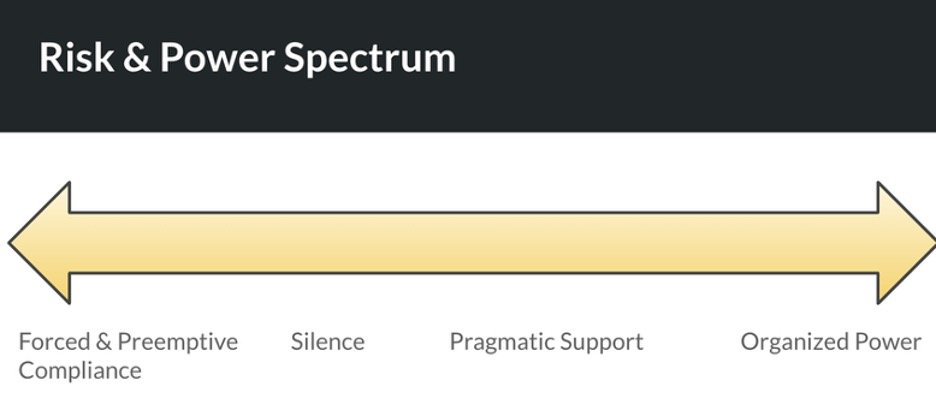
Being open and honest with each other internally about where the organization is positioned is a form of empowerment. Grappling with the complexity of your organizational response is itself an antidote to the harmful, simplistic narrative about nonprofits coming out of the federal administration.
Suggestion 2: Double down on your internal learning about how race, class, gender, and other forms of identity interact with your organizational mission and programming.
Even if your organization has chosen to be somewhere on the left side of the Risk and Power Spectrum publicly, this does not preempt your internal work to deepen staff and board understanding of the issues your organization addresses and how they manifest in the lives of your constituents. You can attend to staff and board learning through topical sections of larger board and staff meeting agendas, retreats with guest speakers, internal book groups or “lunch and learns,” and so on.
Suggestion 3: Do not retreat from the diversity, equity, and inclusion (DEI) practices that are baked into your organization’s policies and practices.
This is not the time to preemptively undo progress your organization has made in hiring, developing, and promoting staff equitably.As Bates and Kanagasingam reminded us: “The work of racial justice and DEI is under attack in an evolving legal landscape, but it is not illegal. Federal laws that provide equal opportunity and protect civil rights remain, and ignoring them remains illegal.” This is not the time to preemptively undo progress your organization has made in hiring, developing, and promoting staff equitably. In “Why Legal Fear Shouldn’t Drive DEI Decisions,” Jennifer Johnson warned: “Abandoning DEI puts organizations at risk of falling behind in talent, innovation, and global relevance. The threat may feel urgent, but the bigger risk is retreating from what works.”
Suggestion 4: Lean into organizational networks and coalitions.
There is safety, camaraderie, and potential power in numbers. This is the time to be with your allies: show up to network meetings, attend conferences, and work in solidarity rather than isolation. As Jonathan Miller of Public Rights Project recently advised nonprofit leaders, “Join coordinated advocacy efforts. Work in coalition with peer organizations to demonstrate collective strength. Share information and legal guidance. Pool resources. Combine legal, communications, and operational capacity to respond efficiently to threats that no single organization could manage alone.”
Suggestion 5: Remind staff and board that the organization may not be their primary or sole political home.
Even for organizations positioned to the right on the Risk and Power Spectrum, their response may be unsatisfying to some staff and board members. This is a particular challenge for justice-centered organizations, where leaders may feel they cannot take public stances on all the issues that their employees care passionately about. As adrienne maree brown said in an interview with NPQ’s Steve Dubb: “Not every workplace is going to be a political home. Your job is where you work. It may or may not qualify as your political home.” Rather than being defensive about this reality, leaders can make space for staff and board to discuss the variety of ways they manifest their values and political commitments at work and beyond.
I hope these suggestions prove useful to you and your colleagues. And a final word of inspiration: Over 3,000 nonprofits cosigned an open letter in response to Trump’s September 25 memo characterizing progressive advocacy and protest as “domestic terrorism and organized political violence.” Their message was clear: “This Administration is trying to bully people into silence but speaking out is, and has always been, our collective mission. We stand with those wrongly targeted and with each other. No exceptions.”