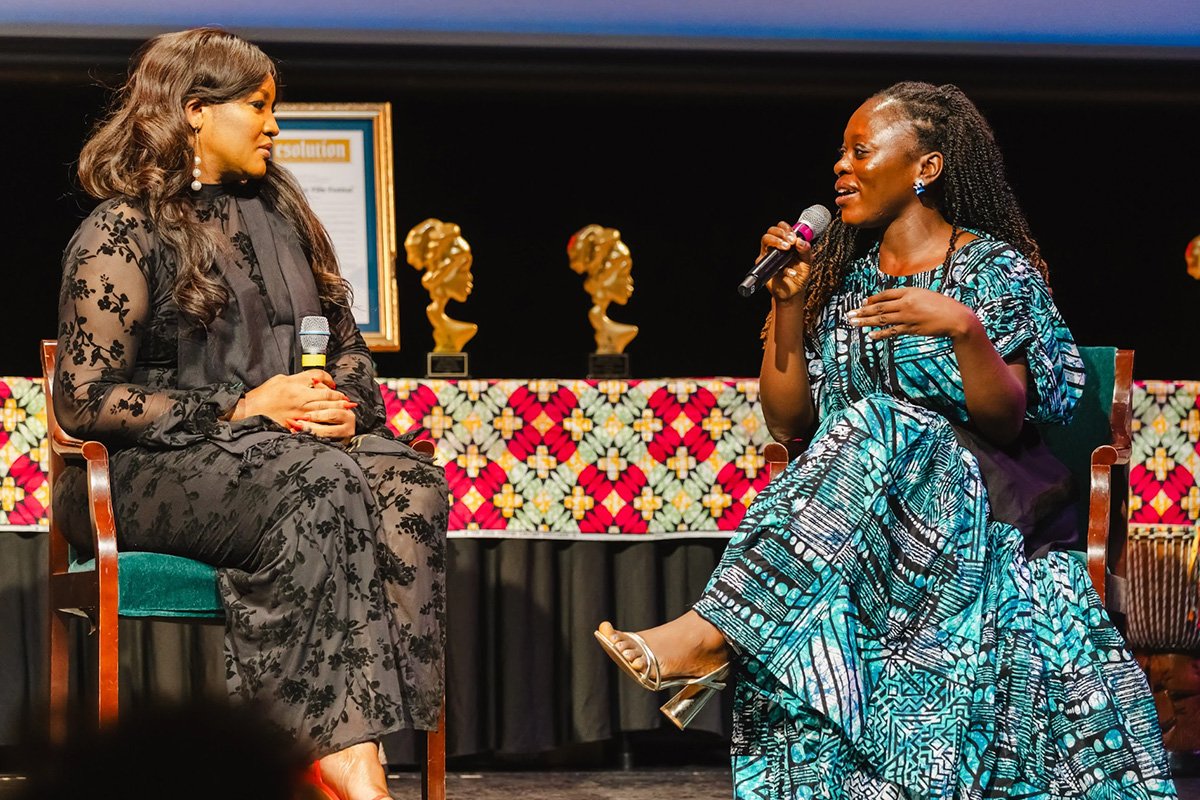
The Silicon Valley African Film Festival (SVAFF) has spent close to two decades building an audience and relationships across Silicon Valley while constantly struggling to afford the people needed to sustain them.
SVAFF returns to San Jose for its 17th edition from Oct. 8-11 and will feature 76 films from 33 countries. Audiences at the Historic Hoover Theatre will experience filmmakers from Africa and its diaspora, with an African market and live performances extending the celebration beyond the screenings.
The festival’s specific location in California also gives visiting filmmakers access to some of the companies whose products they use to make and distribute their work. For the nonprofit behind the festival, however, proximity to technology wealth has brought no guarantee of financial security.
An Invitation to the Real Africa
Jocelyn Dubin is one of five co-chairs of the Black Leadership Kitchen Cabinet of Silicon Valley (BLKC), an all-volunteer coalition whose members meet monthly to address concerns impacting Black residents of Santa Clara County, including housing and health. She has volunteered at the festival and seen the work behind it. Events like SVAFF, she told NPQ, “really are put on because of love and a lot of commitment and not necessarily a large budget.”
SVAFF’s founding director Chike C. Nwoffiah was born in Nigeria and came to Silicon Valley as a graduate student 36 years ago. He worked in the biotech industry before returning to the theatre and film work he had loved since childhood. Along the way, he met Americans surprised that he spoke English, or asking him to speak “African,” displaying their ignorance of the continent’s geography or plethora of languages.
Nwoffiah began teaching African history at a local college, and brought short films by African filmmakers into class. One film, about young women playing a Valentine’s Day prank on a boyfriend, left a student astonished that it had been shot in Addis Ababa, Ethiopia. Women her age were driving cars and going to nightclubs, a version of life that did not fit her understanding of the country.
Nwoffiah wanted to share that experience with the greater community. He recalled his first aim as modest: “Let me curate a Saturday morning.” He selected roughly 10 short films and invited people to watch and discuss them. Afterward, audience members wanted to know when they could return to see and learn more. Several gatherings later, Nwoffiah began formalizing the event.
“We are grateful for every form of support, but there is a difference between corporate engagement and corporate investment.”
SVAFF spent its early years based at the Community School of Music and Arts in Mountain View, CA before relocating to San Jose in 2017. Nwoffiah had long envisioned the move, drawn by the city’s large African immigrant population and greater opportunities for partnerships. An international airport and hotels added to the benefits of the San Jose location.
The festival’s mission is that African filmmakers should decide which stories to tell. Its selection process starts with an open call. Programmers arrange the chosen films into screenings, making connections among them. This year, according to Nwoffiah, nearly 1,000 submissions competed for 76 places. Funding and staffing limit how many films the festival can show.
The opening-night feature, David Mboussou’s Afrotōpia, follows an aspiring filmmaker drawn into his family’s logging business in the Congo Basin, where a plan threatens a sacred forest and an Indigenous community. Another film in the festival, local Bay Area filmmaker Kenan Moos’s Diagnosing Healthcare, examines medical injustice experienced by Black Americans.
Nwoffiah also reaches out to local immigrant communities when the program includes films from their countries. For African immigrants, he said, the festival offers an opportunity to “bask in the glory of their ancestry.” Families arrive dressed for the occasion, grandparents join their children, and people walk the red carpet seeing their cultures celebrated.
The Cost of a Silicon Valley Address
The connections that bring filmmakers into tech offices began through community events. Over time, Nwoffiah has reached employee groups including Adobe’s Black Employee Network, Black@YouTube, and Africans@Google.
SVAFF has brought screenings and cultural programs into hard-to-reach corporate spaces. In return, those ties have generated group ticket purchases and volunteers, along with product donations and hospitality for visiting filmmakers.
Nwoffiah described Adobe visits where filmmakers have seen demonstrations of editing technology and offered feedback to the people developing it. At YouTube, Black employees have hosted filmmakers for lunch and discussions about algorithms. This year’s festival begins with a reception for filmmakers and VIP guests at Adobe’s San Jose headquarters, hosted by its Black Employee Network.
Dubin appreciated the welcome that visiting filmmakers receive from the local community. Although the Black population in San Jose is smaller than in Oakland, CA, she told NPQ, “it’s also a really dedicated Black population.”
That community involvement has helped SVAFF put on the festival, but Nwoffiah said it has generally fallen short of sustained, substantial corporate funding. “We are grateful for every form of support, but there is a difference between corporate engagement and corporate investment,” he said.
He said SVAFF operates on less than $200,000, with no permanent paid staff. Seasonal workers come aboard before the festival and leave after their contracts end. Nwoffiah receives no salary and estimated that he puts in 80 hours a week. His perseverance speaks volumes about his care for his community and this work.
Some artists and vendors assume a Silicon Valley address means the nonprofit festival is flush with funding, which can make affordable rates harder to negotiate.
The festival’s support includes grants from the City of San Jose and the Silicon Valley Community Foundation, according to Nwoffiah. Still, SVAFF has to assemble its funding again each year while paying Silicon Valley prices for space and production services.
The cost of living in Silicon Valley, which is much higher than in the rest of the country, also affects who can keep doing the work. Nwoffiah has lost seasonal staff and volunteers who could no longer afford to remain in the region, taking experience with them that the organization must rebuild. Meanwhile, some artists and vendors assume a Silicon Valley address means the nonprofit festival is flush with funding, which can make affordable rates harder to negotiate.
Sign up for our free newsletters
Subscribe to NPQ's newsletters to have our top stories delivered directly to your inbox.
By signing up, you agree to our privacy policy and terms of use, and to receive messages from NPQ and our partners.
The losses are part of a broader concern for Dubin, who worried whether Black residents can continue to make a life in Santa Clara County. She pointed to Dying to Stay Here, economist and BLKC member Chuck Cantrell’s documentary project about the economic and health disparities confronting the region’s Black residents.
A 2024 analysis by Gabriel Frank-McPheter in connection with the housing nonprofit SV@Home found that, between 1990 and 2000, neighborhoods with higher Black poverty rates were more likely to lose Black residents. The study also found losses in 171 census tracts from 2010 to 2020, even as the county’s Black population, including multiracial residents, grew overall.
A Silicon Valley Institute for Regional Studies analysis of 2019–2023 census data puts homeownership among non-Hispanic Black adults in Santa Clara and San Mateo counties at about 34 percent, compared with 60 percent for non-Hispanic white adults.
SV@Home recommends pairing affordable housing with support for Black-owned businesses and nonprofits, giving residents more influence over the future of their neighborhoods. For Dubin, the festival helps residents celebrate African ancestry and connect with Black artists, including those living locally. But the gathering’s continuation depends on whether its organizers can afford to stay.
Nwoffiah shared with NPQ that he hopes the companies that welcome filmmakers will invest more deeply in SVAFF as a local cultural institution, with the staffing to allow them to operate year-round.
Films That Meet the Community
Education has remained part of SVAFF’s work as the festival has grown, mirroring the founder’s core passions. Through Africa in the Classroom, schools can draw on a library of more than 500 African films. Nwoffiah said the academic team assesses films for age and subject suitability, helping teachers find material for their classrooms.
SVAFF also brings that educational work into the actual festival, welcoming middle school students through its partnership with the Santa Clara County Alliance of Black Educators. Students arrive on school buses Friday morning for selected films and discussion before the staff resets the space for the evening’s red carpet.
The African Cinema Café series takes screenings into smaller community settings throughout the year. An organization might ask for films addressing men’s issues or mental health; SVAFF works with groups to choose relevant titles and brings the screenings to meetings or events.
“I think too often we’re siloed, and we don’t call on each other.”
The same approach has been instrumental in developing the festival’s programming. Nwoffiah recalled a block of four short films exploring mental health and wellness, including schizophrenia and grief. Organizers invited health care professionals to attend. After the filmmakers’ discussion, the house lights came up, and those professionals began standing to offer advice and resources.
“We are using films as a pathway to courageous conversations,” Nwoffiah said.
That cross-field collaboration matters to Dubin and her coalition. BLKC members volunteer at the festival, and this year the coalition is funding 11 tickets for those who could not otherwise afford to go.
“We really wanted to be able to offer it to people who’ve been dedicated to the Black Leadership Kitchen Cabinet, but don’t have the means to attend,” she said.
Calling on Each Other
The partnership also brings Nwoffiah’s experience into BLKC’s work. Dubin said Nwoffiah’s production skills and artist contacts have helped organize Black Family Day, the coalition’s annual event with the county public health department.
Nwoffiah serves on BLKC’s planning committee and hosts a meeting each year, purchasing lunch from a Black-owned restaurant. His input helps influence the agenda, and he introduces the coalition to people who can host or speak at future gatherings.
For other nonprofits, this relationship can offer a practical example of support built through regular participation. BLKC helps people get to the festival; Nwoffiah contributes skills and connections that align with its members’ existing work.
Dubin believes potential supporters could look for places where their missions overlap. A health organization, she suggested, might sponsor a health information booth at the film festival, while an arts funder could provide a creative activity for children at Black Family Day. “I think too often we’re siloed, and we don’t call on each other,” she said.
For SVAFF, years of building trust have brought an audience and people willing to help. The unresolved question is how to secure reliable funding without exhausting those who have kept it going.
At last year’s festival, a group of kindergartners settled onto cushions on the floor to watch animated films. After the fifth film, when it was time to leave, the children refused. They wanted more, even as their parents tried to get them moving. “We had to run to the hard drive and start pulling more films,” Nwoffiah said.
He also remembered a newly arrived Ghanaian grandmother embracing him after an event, crying as she thanked him for creating a place where she could feel at home. Such moments matter to him as much as attendance or box-office figures. “When people believe that your organization belongs to them too,” he said, “they will fight to keep it alive.”