
On March 13, 2026, Secretary of Defense Pete Hegseth held a press conference, where he complained about CNN’s recent coverage of the administration’s unauthorized war on Iran before admitting his anticipation for the day that David Ellison—son of billionaire donor and vocal supporter of Donald Trump, Larry Ellison—takes control of CNN.
His comments came as a direct response to CNN’s recent report, which opened: “The Pentagon and National Security Council significantly underestimated Iran’s willingness to close the Strait of Hormuz in response to US military strikes while planning the ongoing operation.”
“The sooner David Ellison takes over that network, the better,” Hegseth said. “CNN doesn’t think we thought of that. It’s a fundamentally unserious report.”
Following the press conference, a CNN spokesperson told The Hill, “We stand by our reporting.” While this is an important assertion, particularly for news outlets that rely on fact-based reporting rather than coverage influenced by the whims of a billionaire owner, it should be reconsidered in light of who may soon own the Warner Bros. Discovery (WBD) news organizations, including CNN, after David Ellison’s Paramount Skydance recently outbid Netflix to purchase WBD.
The Ellisons’ takeover of WBD isn’t merely a Hollywood merger; it is a signal that narrative control can be—and has been—bought. Turning away from that fact cedes one of the most essential tools for maintaining a democracy to the people actively working to dismantle it.
The Deal
David Ellison, who merged his start-up studio Skydance Media with Paramount in August 2025, is now set to merge again with WBD in a pending $111 billion deal. Effectively, this places the Ellisons in a position to oversee, as The New York Times reported, “an empire that touches nearly every corner of news, entertainment and tech.” The Ellisons will gain a controlling stake in CNN, one of the United States’ most influential news sources, with over 3,000 employees and personalities such as Anderson Cooper, Jake Tapper, Kaitlan Collins, and John King—all of whom have been critical of Trump over the years.
The Ellisons’ takeover of WBD isn’t merely a Hollywood merger; it is a signal that narrative control can be—and has been—bought.
The Ellisons also hold controlling stakes in the tech company Oracle, the source of Larry Ellison’s $175 billion fortune. They work closely with companies such as OpenAI on data centers that are rapidly expanding into communities across the country; TikTok, which about four in 10 US adults use, according to Pew Research, with just over half of adults regularly getting news there; CBS News, now under the controversial editorial leadership of Bari Weiss; and cable networks spanning MTV, Comedy Central, Nickelodeon, BET, HGTV, Discovery, TLC, TBS, TNT, and many others—a net so encompassing that viewers are unlikely to escape it when tuning into most popular cable shows.
The Ellison buyout of WBD is a done deal pending regulatory review. As such, it is an unprecedented media consolidation controlled by one of the world’s wealthiest families, with strong ties to the Trump administration—an administration that is actively weakening democratic practices in the United States.
Editorial Bias
This isn’t merely a hypothetical. In December 2025, CBS News, under Bari Weiss as editor in chief, pulled a 60 Minutes segment on the Trump administration’s actions on immigration hours before it was set to air. Amid the administration’s push for mass deportation, the segment included interviews with Venezuelan men deported to El Salvador’s Centro de Confinamiento del Terrorismo (Center for the Confinement of Terrorism), known as CECOT. Weiss justified her decision in a staff meeting by stating that “it did not advance the ball,” as NPR reported. Yet the deported men interviewed directly criticized the Trump administration, which led to condemnation of Weiss’s decision, including from the segment’s correspondent, who called it a “political” decision.
This came after Donald Trump, in his capacity as a private citizen, filed a $10 billion lawsuit against CBS over a 60 Minutes interview with Kamala Harris. Paramount settled for $16 million in July 2025, arguably to smooth the coming Skydance merger finalized one month later. Such instances show how Trump and those within his sphere of influence view free speech and independent media: Free speech is subjective at best, and independent media is a threat to that subjectivity.
The Pattern, Not the Anomaly
In December 2025, the media advocacy organization Free Press released Chokehold: Donald Trump’s War on Free Speech & the Need for Systemic Resistance, a report examining the Trump administration’s “hostile relationship with dissent and free expression in 2025.” It may be unsurprising to witness the lengths that the sitting president will go to control and preserve the narrative; this is the same president who gloated about his administration’s actions: “We took the freedom of speech away.” Still, it is perhaps difficult to conceptualize how deeply the WBD buyout allows the administration to embed itself in the narrative ecosystem that, historically, allows for free expression and protected dissent.
“Corporate capitulation has fueled a top-down degradation of the information environment.”
Chokehold author Nora Benavidez identifies five recurring methods of attack that undermine these narrative ecosystems: making threats of retribution against would-be opponents; emboldening regulators to exact penalties; supercharging the militarized police state; leveraging heavyweight corporate capitulation; and ignoring facts, removing information, rewriting history, and lying on the record. Of these, the fourth method places the Ellisons’ WBD acquisition in clearest relief. Corporate America and Big Tech will almost always prioritize profits over people, insulating themselves from scrutiny by aligning with whoever is in power. It’s the surest way to build their wealth unimpeded.
As Benavidez wrote, “The biggest billionaire-owned media companies in the country curry favor with Trump to protect their own financial and business interests—which often clash with the journalistic mission of those papers and broadcast stations. Many of the top 35 corporate media companies have compromised journalistic independence in exchange for regulatory favors, financial settlements and political power.”
Sign up for our free newsletters
Subscribe to NPQ's newsletters to have our top stories delivered directly to your inbox.
By signing up, you agree to our privacy policy and terms of use, and to receive messages from NPQ and our partners.
This, in turn, creates an environment where “corporate capitulation has fueled a top-down degradation of the information environment,” as Benavidez put it. If the Ellisons’ acquisition is approved, that degradation can be multiplied tenfold. There is a pattern here that suggests—and solidifies—the symbiotic nature of the relationship between Trump and the Ellisons: Trump’s administration approves the Ellisons’ mergers while the Ellisons promote content that supports Trump’s messaging. Opposing voices get written off by what becomes, in effect, an unofficial nationalized media. This is, as NPQ contributor Zane McNeill noted, part of a “familiar authoritarian playbook: Autocrats consolidate media ownership and blur the line between journalism and state power to control public discourse—a strategy exemplified by Hungarian Prime Minister Viktor Orbán.”
The Orbán Parallel
For authoritarian regimes to control the narrative ecosystem, they need to have a majority of it within their sphere of influence. “Even before Trump’s presidency,” McNeill wrote, “the US media landscape was vulnerable to authoritarian capture due to extreme consolidation.” Back in 2011, only six corporations controlled 90 percent of American media. The mergers and acquisitions since—including the consolidation that produced today’s Paramount Skydance and WBD—have reshuffled those players without meaningfully expanding independence. Although Free Press now tracks “the 35 largest media and tech companies control” in its “Media Capitulation Index,” many show a significant degree of capitulation, signaling a continued erosion of editorial independence.
This information is not moderated or vetted, but it is information all the same, creating the illusion of a functioning information ecosystem where one no longer exists—and the proliferation of AI only makes the trust-building that journalism depends on more precarious.
Hungarian journalist András Pethő captured what’s at stake in The Atlantic in early 2025: “As I watch from afar what’s happening to the free press in the United States during the first weeks of Trump’s second presidency—the verbal bullying, the legal harassment, the buckling by media owners in the face of threats—it all looks very familiar. The MAGA authorities have learned Orbán’s lessons well.” Indeed, at a meeting of the US Conservative Political Action Conference (CPAC) in 2022, the Hungarian prime minister advised that the Republican pathway to power “required having their own media outlets.”
Through the Ellisons’ empire, that outlet becomes another brick in Trump’s pathway to power. And 81-year-old Larry Ellison is poised to carry it further still. At Oracle’s financial analyst meeting in September 2024, he described a future where artificial intelligence helps review footage from cameras placed everywhere. “Citizens will be on their best behavior because we are constantly recording and reporting everything that’s going on,” Ellison said. As a stakeholder in TikTok through Oracle, this vision takes on a darker dimension—one that moves the United States closer to an Orwellian form of technofascism.
The Information Desert
For now, the more immediate impact will be the shrinking of reliable news outlets within an information ecosystem that is—and has for years been—strained. The State of Local News Project at Northwestern University’s Medill School reported last October that there are now 212 US counties with zero locally based news sources, and 1,525 counties with only one remaining. Taken together, one in seven Americans—nearly 50 million people—live with limited or no access to local news. Most news deserts exist in areas that are poorer, less educated, and rural.
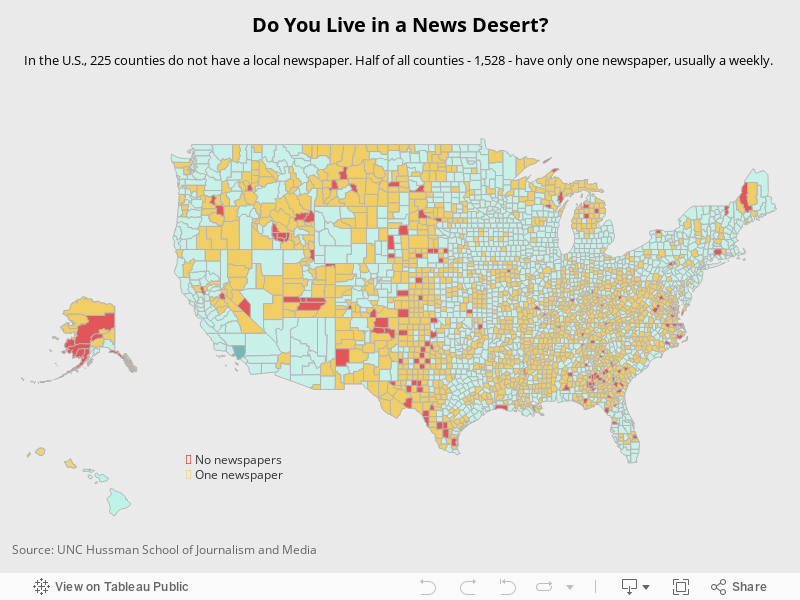
The WBD merger is sure to contribute to this through consolidation and reduced editorial choice. When local news disappears, people turn to what the report called “non-journalistic sources”: Instagram, X, Bluesky, and, most notably, TikTok, in which the Ellisons’ hold a controlling stake and could potentially manipulate the algorithm. In fact, 51 percent of surveyed individuals living in news deserts rely on social media, influencers, family, and friends to get their local news. This information is not moderated or vetted, but it is information all the same, creating the illusion of a functioning information ecosystem where one no longer exists—and the proliferation of AI only makes the trust-building that journalism depends on more precarious.
What the Independent Media Sector Can Do
As I’ve written before, “This is how democracy dies—not just in dramatic coups or contested elections, but in a long series of localized exclusions.” The Free Press report points toward three areas of necessary work: rebuilding broken constitutional promises around free expression; advancing structural solutions that reduce media consolidation and invest substantially in local, diverse, and noncommercial journalism; and emboldening institutions to protect people over profit. None of these is likely to materialize in the near term. But they remain the sector’s North Star, and working toward them consistently is not optional.
As we watch the fracturing of our democracy and our information ecosystems…we must send out our own signal in response to those who attempt to buy out narrative control: We are here—and we aren’t going anywhere.
Consider Trump’s recent post about “reshaping the media,” or the fact that Brendan Carr, chairman of the Federal Communications Commission, has already threatened “to revoke broadcaster licenses over their coverage of the war with Iran.” When civil society is faced with an administration that has hand-picked loyalists to oversee key government functions, the call for independent journalism becomes ever more urgent.
There are independent newsrooms producing high-quality journalism in service of democratic values rather than dismantling them—outlets such as Common Dreams, Drop Site News, NPR, and ProPublica, to name a few. Independent media outlets and advocates for a free press—one detached as much as possible from capitalism, funded by the people and unrestricted philanthropic dollars—can work together to preserve and strengthen democracy in the United States.
Benavidez closes out the Free Press report by emphasizing, “All of us must develop the muscle and courage to resist capitulation under Trump. Solidarity of resistance is essential to prioritizing principle over power. We must cultivate the framework of egalitarian politics, the principles of people over profits. Our very freedoms—all of ours—hang in the balance.”
As we watch the fracturing of our democracy and our information ecosystem amid the expansion of the Ellisons’ empire, we must send out our own signal in response to those who attempt to buy out narrative control: We are here, and we are not going anywhere. We, the independent media, continue to defend democracy, one story at a time.