logo logo
giving banner
Donate
    • Membership
    • Donate
  • Social Justice
    • Racial Justice
    • Climate Justice
    • Disability Justice
    • Economic Justice
    • Food Justice
    • Health Justice
    • Immigration
    • LGBTQ+
  • Civic News
  • Nonprofit Leadership
    • Board Governance
    • Equity-Centered Management
    • Finances
    • Fundraising
    • Human Resources
    • Organizational Culture
    • Philanthropy
    • Power Dynamics
    • Strategic Planning
    • Technology
  • Columns
    • Ask Rhea!
    • Ask a Nonprofit Expert
    • Economy Remix
    • Gathering in Support of Democracy
    • Humans of Nonprofits
    • The Impact Algorithm
    • Living the Question
    • Nonprofit Hiring Trends & Tactics
    • Notes from the Frontlines
    • Parables of Earth
    • Re-imagining Philanthropy
    • State of the Movements
    • We Stood Up
    • The Unexpected Value of Volunteers
  • CONTENT TYPES
  • Leading Edge Membership
  • Newsletters
  • Webinars

The Metropolitan Museum of Art: Facing its Budget Deficit

Sophie Lewis
April 22, 2016

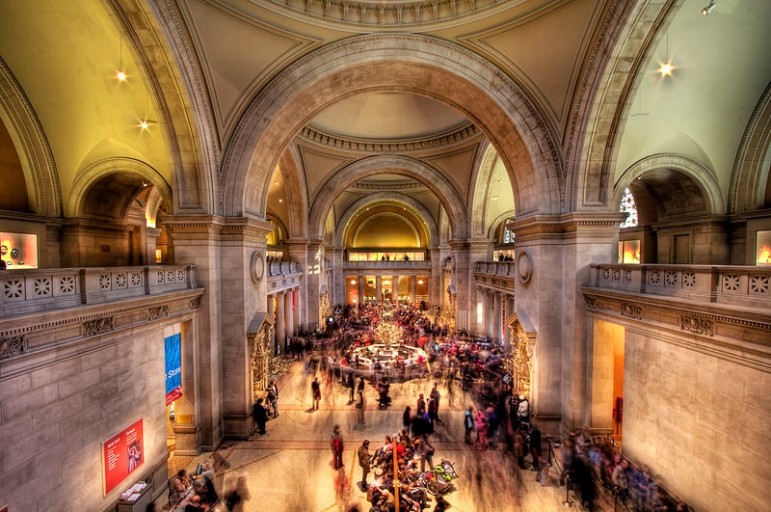
Met-Museum-Art
By Carmelo Bayarcal (Own work) [CC BY-SA 3.0], via Wikimedia Commons
April 21, 2016; New York Times

With ever-expanding collections and programming, it seems as though the Metropolitan Museum of Art is too big to fail. But is it true? Museum officials recently revealed that the Met is facing a deficit of $10 million this year, and that funding gap could widen to as much as $40 million if allowed to go unchecked.

This sobering news comes on the heels of several weeks of excitement for the Met. Just a month ago, the Met Breuer building opened to the public; the museum quietly unveiled its controversially re-branded logo; and NPQ reported about a change in language to a “suggested,” rather than “recommended” donation policy at the door, which officials hope will increase access to the museum for its low-income visitors. How is the museum world supposed to take the news that one of the largest and most influential museums in the world may be on rockier financial footing than we thought?

The news is troubling indeed, but officials at the museum already have a plan to get the Met back on track. Thomas P. Campbell, the museum’s director and chief executive, announced a 24-month financial restructuring plan that will include staff reductions, a slowing of the construction timeline for the planned $600 David Chipperfield-designed wing for contemporary and modern art, and a reduction in programming across all three of the museum’s buildings. The museum will implement a hiring freeze and requesting voluntary buyouts, after which it will begin reducing its headcount over the next twelve months. According to Daniel H. Weiss, the Met’s president, salaries account for 70 percent of the operating budget. One can only wonder whether Campbell himself, whose total compensation was over $1.2 million in 2014 according to the museum’s most recent IRS form 990, will be reducing his own salary in order to balance the books.

Sign up for our free newsletters

Subscribe to NPQ's newsletters to have our top stories delivered directly to your inbox.

By signing up, you agree to our privacy policy and terms of use, and to receive messages from NPQ and our partners.

The museum has experienced lean times before. In 2009, the museum went through a series of layoffs and shrunk its overall work force by 10 percent. That cycle of austerity in the museum’s history was caused primarily by “prospective, significant, and long-term reductions” in annual operating income from its endowment, which was estimated to have lost about $800 million, or 28 percent of its value in 2008–2009. The largest factor for the decline in income from the endowment was the financial crisis of 2007–2008.

This time around, however, the reasons for the Met’s operating deficit are a little less clear. Officials say a combination of factors, including a decline in retail revenue, an increase in salaries, and an annual payment on debt service for $250 million in bonds all contributed to the gap in funding to cover expenses. Regardless of the reasons behind the failure, however, Weiss is quick to say “the driver of this deficit is not related to Breuer,” for which the Met has trained 110 staff members. The Met has taken on custodial duties for the historic building for a period of eight years, and hopes to use the space—in tandem with its proposed new wing—to beef up its contemporary art collection and programming. These new belt-tightening measures include slowing down the Chipperfield construction timeline, as the Met is anxious to balance the budget before it begins asking for additional support for a capital project of this magnitude.

What is the best strategy for early intervention when a museum’s budget begins to get out of hand? Are Campbell and Weiss leading the Met back to firmer financial footing? Let us hope that the museum’s troubles do not get worse before they get better.—Sophie Lewis


Our Voices Are Our Power.

Journalism, nonprofits, and multiracial democracy are under attack. At NPQ, we fight back by sharing stories and essential insights from nonprofit leaders and workers—and we pay every contributor.

Can you help us protect nonprofit voices?

Your support keeps truth alive when it matters most.
Every single dollar makes a difference.

Donate now
logo logo logo logo logo
About the author
Sophie Lewis

Sophie is a New York-based arts nonprofit fundraising professional with experience in major gifts, individual, and foundation giving. She holds a bachelor's degree in Music and English from Barnard College.

More about: Arts and CultureEquity-Centered ManagementNonprofit News
See comments

You might also like
How to Use Art Spaces to Build Civic and Political Power
Tom Tresser
The South’s Got Something to Say: Stories from Black Women in the South
Monica L. Coleman
The Faith of the Dreamer: A Personal Story About Racism, Trauma, and Healing
Gwendolyn Middleton Payton
The End of the NEA
Alison Stine
Rethinking Nonprofit Survival: Why Partnership Is the New Leadership
Michael Anderson, Rumbidzai Mufuka and Adelaide Rohrssen
Can We All Become Nonprofit Consultants?
Michelle Flores Vryn

Upcoming Webinars

Group Created with Sketch.
December 9th, 2:00 pm ET

Nonprofit Safety & Security: Protecting Our People, Data, and Organizations in a Time of Unprecedented Threat

Register
Group Created with Sketch.
January 29th, 2:00 pm ET

Future is Collective

Register

    
You might also like
People listen intently at a community forum held at in at art space with paintings on the wall.
How to Use Art Spaces to Build Civic and Political Power
Tom Tresser
An illustration of four Black woman with different natural hairstyles sitting together on the ground and wearing converses. Behind them, a dripping, golden sun is spray painted on a wall, and a spray paint can sits next to them.
The South’s Got Something to Say: Stories from Black Women...
Monica L. Coleman
An illustration of a Black woman with an Afro leaning her head on her hand, kneeling in front of a monstera plant with a sun glowing behind her.
The Faith of the Dreamer: A Personal Story About Racism,...
Gwendolyn Middleton Payton

Like what you see?

Subscribe to the NPQ newsletter to have our top stories delivered directly to your inbox.

See our newsletters

By signing up, you agree to our privacy policy and terms of use, and to receive messages from NPQ and our partners.

  • About
  • Advertise
  • Careers
  • Contact
  • Copyright
  • Donate
  • Editorial Policy
  • Funders
  • Submissions

We are using cookies to give you the best experience on our website.


Nonprofit Quarterly | Civic News. Empowering Nonprofits. Advancing Justice.
Powered by  GDPR Cookie Compliance
Privacy Overview

This website uses cookies so that we can provide you with the best user experience possible. Cookie information is stored in your browser and performs functions such as recognising you when you return to our website and helping our team to understand which sections of the website you find most interesting and useful.

Strictly Necessary Cookies

Strictly Necessary Cookie should be enabled at all times so that we can save your preferences for cookie settings.