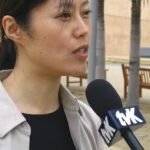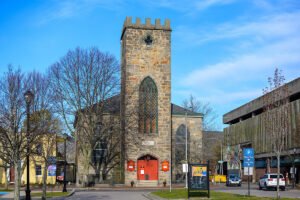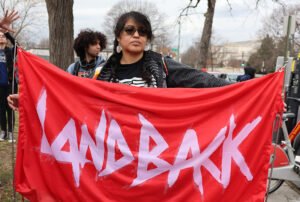

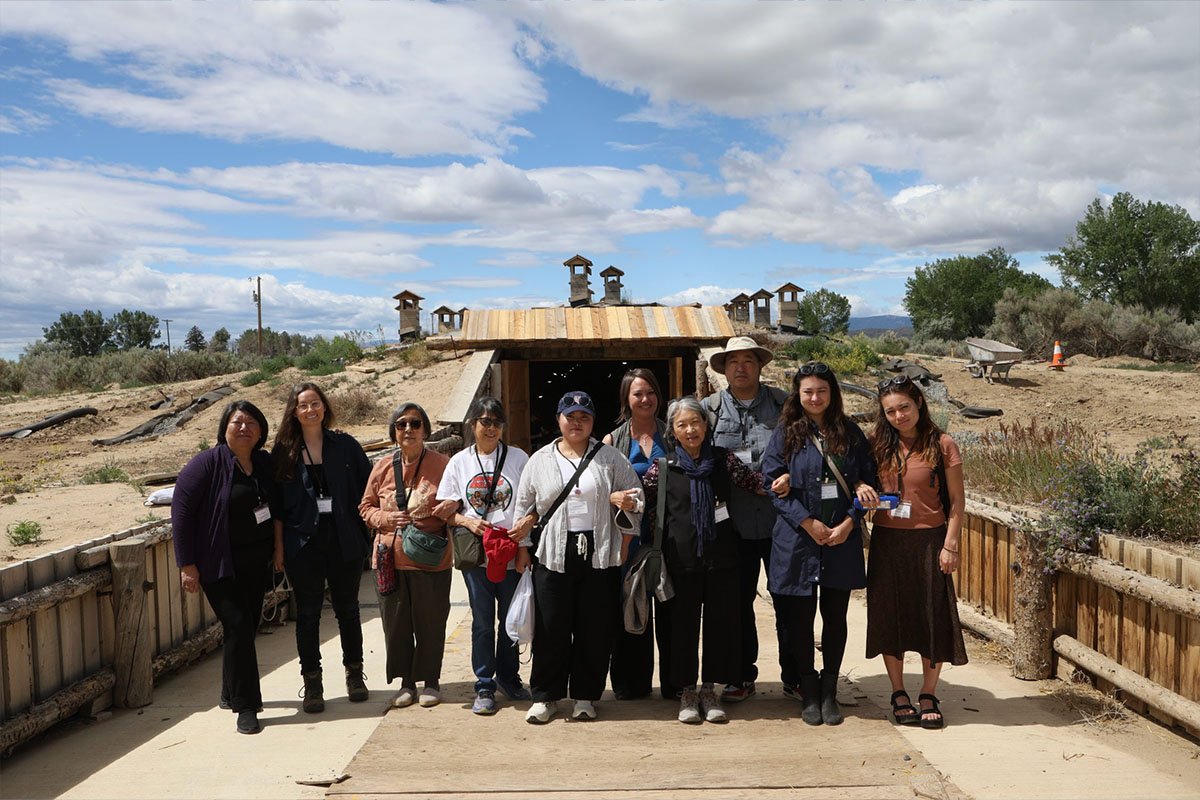
As the country marked 250 years last month, on June 30th, we gathered 125 organizers, artists, donors, and community leaders from 21 states at the foot of Heart Mountain in Powell, Wyoming. We made this pilgrimage to the one of 10 incarceration camps for Japanese Americans to remember a chapter in US history that the current administration would prefer to forget. We named the gathering for words that say plainly what carried our communities through exclusion acts, incarceration, and every attempt to push them to the margins: “We were here before. We will be here after.”
[Image 1 and 2]
Credit: Ming Lai / @humanistfilms
Under Executive Order 9066, Heart Mountain was one of 10 long-term confinement sites where more than 120,000 Japanese Americans living in California and parts of Arizona, Oregon, and Washington State were incarcerated during World War II—without charge, without trial, without cause.
We did not come to stand apart from the anniversary of the United States. We came to observe it in full. Among us were descendants of the Japanese Americans incarcerated at Heart Mountain, where nearly 15,000 Japanese Americans—14,025 to be exact—were held.
Lisa Hasegawa, co-author of this essay, had a father who was held here as a child between the ages of two and five. This was her second time visiting, and the weight of the history—and the people who were there with her—made her weep. The ground had not changed, but the group that came to reflect and learn about one of the United States’ darkest periods against its own citizens meant that she didn’t have to bear witness to her family’s history alone.
A country turning 250 faces a choice about how to tell its story. Heart Mountain stands as an emblem of the story we choose to tell—the fuller and more complicated story that speaks to the founding promises, the betrayals of those promises, and the generations who refused to let those betrayals stand.
“A nation that can hold Heart Mountain inside its founding narrative is harder to deceive, harder to divide, and harder to break.”
Beyond this history of pain, confinement and subjugation, Heart Mountain offers lessons for us as a community—lessons of resistance and defiance, of survival, of organizing, and of caring for one another. This history belongs to a longer arc that includes the dispossession of Indigenous peoples and the enslavement of Black Americans, interwoven expressions of the same logic that has long determined who is protected by this country’s laws and who is targeted by them. A nation that can hold Heart Mountain inside its founding narrative is harder to deceive, harder to divide, and harder to break.
We started at the Heart Mountain Interpretive Center, built to resemble a row of tar-paper-covered barracks, its exhibits tracing the history of incarceration and showing what daily life in the camp looked like. From there, we walked inside an original barracks that once housed multiple families, then followed a trail past the camp’s remaining structures, to the hospital and a reconstructed guard tower. Together, we listened to Johnny Tim, an Indigenous docent, recount that the land was once inhabited by the Crow, Blackfeet, and Shoshone before the federal government seized it, a reminder that dispossession did not begin with EO 9066.
Against the hot sun, we found cool relief at the base of the root cellar built by the incarcerated Japanese Americans to store familiar vegetables, such as daikon radishes, in the dry Wyoming desert. On the Honor Roll monument, we read the names of Japanese Americans who served in the segregated 442nd Regimental Combat Team, one of the most decorated units in U.S. military history, for the country that had imprisoned them.
[Images 3, 4, 5]
Credit: Ming Lai / @humanistfilms
At the museum, we scanned photographs depicting the faces of 63 Japanese American draft resisters sitting in court in the largest mass trial in Wyoming history. These Americans were sentenced in 1944 to three years in federal prison for refusing to serve a country that had questioned their very loyalty.
Sign up for our free newsletters
Subscribe to NPQ's newsletters to have our top stories delivered directly to your inbox.
By signing up, you agree to our privacy policy and terms of use, and to receive messages from NPQ and our partners.
Lisa’s family lived this paradox. Her grandfather’s older brother enlisted in the 442nd and instructed his younger brother to remain with their elderly parents, who they feared would be deported as non-citizens. While one brother fought for the United States, the US government branded the other as “disloyal” and incarcerated him in a federal penitentiary for trying to keep his family together.
The incarceration of Japanese Americans was not an aberration born of wartime panic. After Pearl Harbor, political opportunists singled out Japanese Americans for mass incarceration solely because of their race, even after the Justice Department concluded the foreign enemy threat had been contained. The POWs and foreign nationals held at sites like Fort Lincoln in Bismarck, North Dakota were treated more humanely than U.S. citizens of Japanese descent.
“The communities that carry its hardest chapters are the ones who know best how to keep its promises.”
We do not draw a straight line between 1942 and 2026. History does not repeat itself so neatly, and the people who survived the camps deserve better than a convenient analogy. But the patterns are legible to communities who have lived them before.
The people held at Heart Mountain would recognize the strategy: declare a community a threat, strip protections, and dare the institutions to object. They would also recognize the answer, because they lived it: care for one another, dissent and organize, and stand with every neighbor. That is what the community did.
It took decades for the Japanese American community members to rebuild and win redress. Today, they have mobilized against the Muslim Ban, and mobilized in protection of communities impacted by ICE raids and in support of the campaign for Black Reparations. They are doing the long, arduous work of forcing the country back toward its promises.
[Images 6 and 7]
Cred: AAPI Civic Engagement Fund
Like many funders, the AAPI Civic Engagement Fund has brought local organizers and leaders together each year and those gatherings have served typical functions: organizers sharing lessons from the field, honing skills, and cultivating collaborations. But over time, as our relationships with our grantees deepened, we wanted our gatherings to do more. Asian Americans and Pacific Islanders are more than a census category, and we exercise our convening power to create experiential opportunities that bring organizers to places of meaning, so they can feel history rather than simply study it.
In 2023, we went to the Legacy Museum and the National Memorial for Peace and Justice in Montgomery, Alabama, which documents the history of racial injustice in the U.S from the transatlantic slave trade to the mass incarceration we see today. This year we came to Heart Mountain. In our minds, each step led to the other. We could not come here until we went there.
We chose this site, and in this year marking the 250th anniversary of US independence, deliberately. As we witness the undermining of the rule of law, civic life, and the basic tenets of a democracy, we wanted to remind ourselves of the dangerous path our nation is headed if we do not reverse course.
It is also a time for our communities to act. We needed to bring AAPI communities to Heart Mountain so that this chapter stops being Japanese American history and becomes our collective history, part of the story the country tells itself at 250. We recognize that we cannot build the cross-constituency alliances that this moment urgently demands until we are first united among ourselves.
The 250th anniversary asks something of all of us, including the 26 million Asian Americans and Pacific Islanders who call this country home. Not whether to celebrate this country, but whether we are willing to acknowledge and remember all of it.
A cage fight on the South Lawn is one answer to the question of what the United States is at 250. A reckoning with Heart Mountain is another. The fuller account is the stronger one, and the communities that carry its hardest chapters are the ones who know best how to keep its promises.