August 28, 2018; New York Times and Washington Post
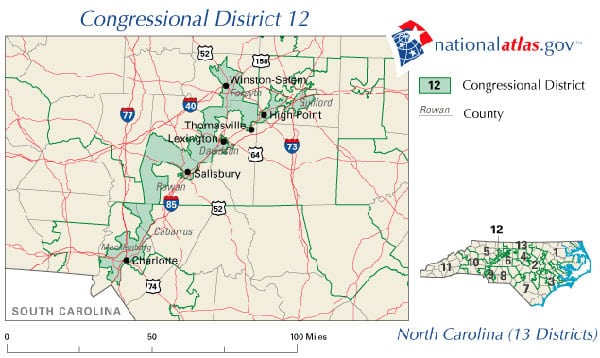
North Carolina has become the poster child for gerrymandering cases that push the envelope. On Monday, August 27th, a three-judge federal panel ruled that the current congressional district map for North Carolina was unconstitutionally drawn to favor Republicans over Democrats and may need to be redrawn before the November elections. This follows a Supreme Court ruling NPQ wrote about in May 2017, in which North Carolina used race as a factor in drawing two of its congressional districts. The court ruled that these districts must be redrawn.
Now, in a state where Republicans currently hold 10 of the state’s 13 House seats in spite of vote totals that are about even, the federal judicial panel declared that something was awry. While the Republicans argued that the Democrats who brought the case did not have standing, the judges did not agree.
Judge James A. Wynn Jr. of the US Court of Appeals for the 4th Circuit, writing Monday for a special three-judge district court panel, said plaintiffs did have standing under the decision in Wisconsin’s Gill v. Whitford, which he said reinforced the judges’ earlier views that the congressional districts were drawn with improper partisan goals.
He said the court was leaning against giving the North Carolina legislature another chance to draw the congressional districts.
“We continue to lament that North Carolina voters now have been deprived of a constitutional congressional districting plan—and, therefore, constitutional representation in Congress—for six years and three election cycles,” Wynn wrote. “To the extent allowing the General Assembly another opportunity to draw a remedial plan would further delay electing representatives under a constitutional districting plan, that delay weighs heavily against giving the General Assembly another such opportunity.”
He proposed several unusual ideas: appointing a special master to draw new districts, holding general elections without party primaries or even turning the November elections into a primary and holding the general election sometime before the new Congress convenes in January.
Sign up for our free newsletters
Subscribe to NPQ's newsletters to have our top stories delivered directly to your inbox.
By signing up, you agree to our privacy policy and terms of use, and to receive messages from NPQ and our partners.
Clearly, time is of the essence in this. The North Carolina Republican party indicates it will ask the Supreme Court for a stay, which, if granted, would mean the midterm elections would be conducted under the partisan map that was just ruled unconstitutional. But there are issues with taking this case to the Supreme Court at this time: The Kennedy vacancy is not yet filled; five votes are required for a stay; the Senate vote on Kavanaugh (an anticipated 5th vote) isn’t expected until the end of September; and ballots need to be mailed to military voters and others before then.
Recognizing the timing dilemma, Justice Wynn requested briefs from both sides with their responses to his options by August 31st. Given the state of technology, the possibility of a new, nonpartisan map being drawn quickly is not so farfetched.
As a practical matter, two experts said on Tuesday, drawing a new House map for North Carolina would take less than a day’s work on a laptop. In a Pennsylvania gerrymandering case decided by that state’s supreme court in January, “our experts produced thousands in a few minutes that all complied with traditional redistricting criteria,” said Mimi McKenzie, the legal director of the Public Interest Law Center in Philadelphia, which won the case.
In the midst of the chaos of North Carolina politics, what may be missing to make this happen is the political will. But there is more at stake here than just the state politics of North Carolina. The entire House of Representatives is in play. And if control of the House shifts from Republican to Democrat, it could hinge on the mapping of districts in North Carolina. So, the eyes and ears of both parties are focused on how this will play out.
In the meantime, chaos rules. Political candidates are unsure of where their districts are or might be. Voters are unsure if they will be having another primary in November with newly drawn districts—one of the options—or voting in the partisan districts that existed before.
State politicians openly admit partisan bias. “I think electing Republicans is better than electing Democrats,” said Rep. David Lewis, a Republican member of the North Carolina General Assembly, addressing fellow legislators when they passed the plan in 2016. “So, I drew this map to help foster what I think is better for the country.”
For those who care about voting rights, much more is entwined. The value of a person’s vote is reflected in the ability to elect people who share their views to leadership positions. When that ability is diminished, whether based on politics or race, it discourages voting. North Carolina shows how gerrymandering can limit those who do not align with one party from having full representation. Given the timing and the possible partisan leanings of our courts, our future voting rights could hang in the balance.—Carole Levine