Generation Citizen opens with a call to reimagine democracy by recognizing youth voice and civic imagination as essential civic infrastructure and makes the case for why expanding youth access to civic opportunities is essential to democracy’s next 250 years. The essays that follow feature personal reflections from young people on the experiences that shaped their civic identities—from advocating for change in their schools to engaging local leaders and organizing in their communities.
Generation Citizen: What is your experience with RISE Vote, and what first drew you to get involved?
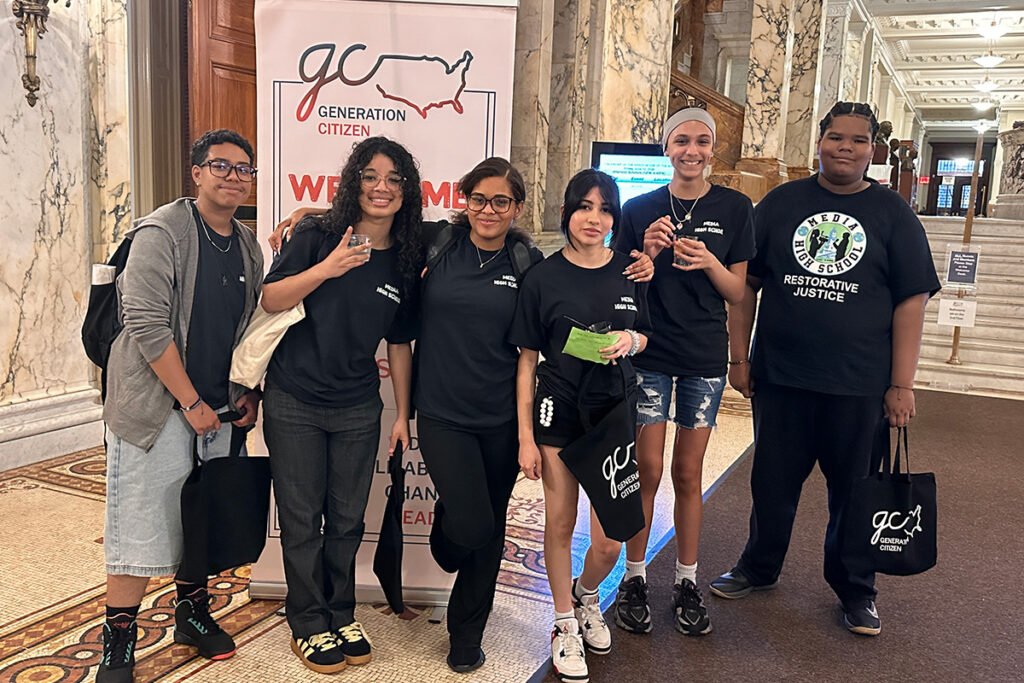
Mia Lopez: I got involved with RISE Vote through Generation Citizen in my class. My experience with RISE Vote has been all about learning how young people can participate in civic life, like getting people registered and raising awareness about local issues. What really drew me in was realizing that local decisions—like how schools are funded, community safety, and local parks—affect us every day. It made me want to understand how we can actually have a say in decisions that affect our community, which is why learning that Rise Vote stands for registering, informing, supporting, and empowering voters made so much sense to me.
Milo Vazquez: It has always been amazing, from talking about how to make communities seen and safer to making important connections. What first drew me was the word civics and how a young person like me has a space to speak and listen to others share their experiences and thoughts on that word and anything adjacent to it.
GC: What have you learned through RISE Vote about the role young people can play in elections?
ML: Through RISE Vote, I learned that young people actually have way more power than most people think. A lot of us assume that because we can’t vote yet, our opinions don’t matter. But young people can organize voter registration drives, talk to friends and family about candidates, and bring attention to issues that older adults might overlook. We can also help inform new voters who might find the process confusing. Even without casting a ballot, youth can build momentum, change conversations in our communities, and influence how people think about important elections.
MV: The role young people have in elections is important. We are the next generation, and we want to lead by example, encouraging people from all age ranges to actually take into account how much power their voice actually holds.
GC: What does meaningful youth participation in democracy look like to you?
ML: To me, meaningful youth participation means taking our concerns seriously, like when we complain about school safety or bad school lunches, people actually do something about it. It also means schools giving us real tools to understand how the government works, so we feel confident getting involved. Meaningful participation looks like students hosting town halls, leading projects, and having direct conversations with lawmakers so that young voices help shape real community decisions.
Sign up for our free newsletters
Subscribe to NPQ's newsletters to have our top stories delivered directly to your inbox.
By signing up, you agree to our privacy policy and terms of use, and to receive messages from NPQ and our partners.
MV: To me, it looks like when students actually share a piece of their mind in relation to how they see their community/environment wherever they are, and how they can use their voice as individuals to express themselves and understand how their voice can make an impact.
GC: What do you hope schools, educators, and communities do differently to help young people feel informed and ready to participate in elections?
ML: I hope schools make civics feel relevant to our daily lives instead of just memorizing facts from a lesson. Teachers could walk us through step-by-step how to register to vote, explain where candidates stand on local issues, and show us how local government works. Communities could also host youth-led forums where students can ask local leaders real questions. Also, that when schools create open spaces to discuss current events, they don’t make it stressful or partisan, because I would feel less confident in what I have to say or ask. This would help us build the confidence we need so that voting for the first time feels like something that we were prepared for.
MV: I hope schools teach students how to vote correctly and locally, teaching them different terms or words that some might not understand, encourage students to vote and encourage the idea of a democracy and how their voice is needed during times like these. I wish communities would separate the fact that just because they’re a community doesn’t mean that everyone has to vote for the same ideas or person.
GC: What would you say to another high school student who thinks their voice or vote won’t really make a difference?
ML: I’d tell them that I understand why they would feel that way, because politics can be confusing. Elections run in schools are usually decided by just a few people, and those results affect stuff we deal with every single day, like our schools, parks, and neighborhood safety. If we don’t vote or speak up, we’re basically just letting adults make all the decisions for us. One vote might feel small, but when young generations unite to fight for common causes, that is impactful because there is power in numbers. If we want things to get better for our generation, we have to step up for ourselves because nobody else is going to do it for us, which is why RISE Vote works to help students overcome that feeling of insecurity and to teach us that our opinions matter.
MV: I would give them the honest truth and say every voice matters, especially now, because your voice is how you will make a living and it’s your generation that will live to see these elections continue to take place. Sometimes having one voice is better than having no voice at all. Also the idea of teaching someone how to stand up for what they believe in will lead them to success later in life.