
logo logo
Donate
    • Membership
    • Donate
  • Social Justice
    • Racial Justice
    • Climate Justice
    • Disability Justice
    • Economic Justice
    • Food Justice
    • Health Justice
    • Immigration
    • LGBTQ+
  • Civic News
  • Nonprofit Leadership
    • Board Governance
    • Equity-Centered Management
    • Finances
    • Fundraising
    • Human Resources
    • Organizational Culture
    • Philanthropy
    • Power Dynamics
    • Strategic Planning
    • Technology
  • Columns
    • Ask Rhea!
    • Ask a Nonprofit Expert
    • Gathering in Support of Democracy
    • Hope in the Dark
    • Humans of Nonprofits
    • Inside the States
    • In Defense of Civil Society
    • The Myth of Heroic Leadership
    • Notes from the Frontlines
    • Notes from the Long Arc
    • Reimagining Philanthropy
    • The Unexpected Value of Volunteers
    • We Stood Up
  • Newsletters
  • NPQ Online Events
    • Learn Out Loud
    • Leading Edge Webinars
    • Partner Events
    • On Demand
  • Leading Edge Membership

Fifty Years Later, Modern Feminism Looks Radically Different

Sheela Nimishakavi
June 23, 2016
Feminism
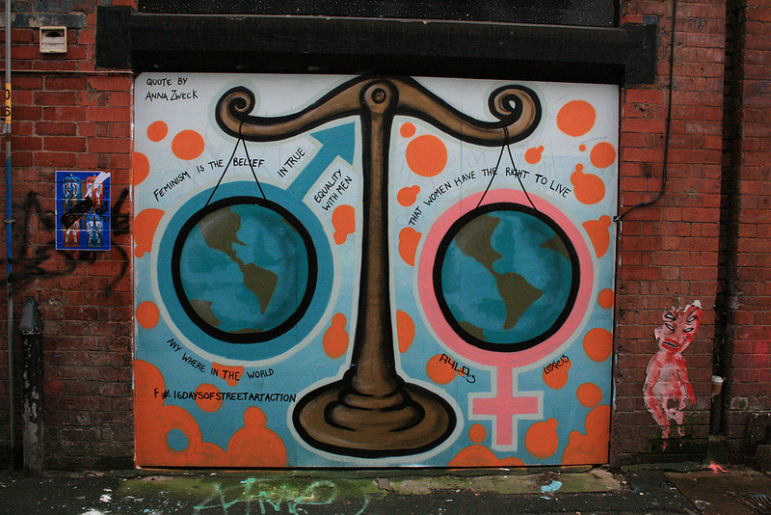
Feminism / KylaBorg

June 19, 2016; Star-Telegram (Fort Worth, TX)

Today marks the 50th anniversary of the National Organization for Women, one of the largest women’s associations in the country. Fifty years into their existence, where does the modern feminist movement stand?

There is little argument that gender equity indicators have moved since the centuries-old movement began. Women have come a long way since the nation’s founding. Before NOW was established, women’s rights to vote, work, and serve in the military were recognized. Yet, after fifty years of NOW, a wage gap still exists—one that is paradoxically worse for women with children. Women’s reproductive rights are constantly under fire, as states restrict access to legal abortions, as Newswire covered earlier this month. Only 20 percent of Congressional seats belong to women, although women make up more than half of the population.

In the midst of this, critique has been aimed at NOW over the years regarding its focus on the liberal policy issues of middle-class women over equity for poor women. This reflects a larger set of criticisms aimed at the women’s movement in general over a generation when it was, perhaps, most centralized.

Fortunately, NOW is not, nor has it ever been the only organization focusing on women’s rights. The scene has changed from one multi-issue association to a multitude of single-issue nonprofit organizations. Because of this change, the nonprofit sector has played a huge role in the ongoing struggle for gender equality over the last five decades. 

To illustrate, a GuideStar search for nonprofit organizations with “women” as a keyword returned 31,778 results. These organizations fall into categories from career advancement for women engineers and women business owners, to reproductive health and family planning organizations. In this model, much of the work that NOW has pioneered is being distributed among these thousands of organizations.

Sign up for our free newsletters

Subscribe to NPQ's newsletters to have our top stories delivered directly to your inbox.

By signing up, you agree to our privacy policy and terms of use, and to receive messages from NPQ and our partners.

This data is consistent with the so-called “new wave of feminism” that the Kaiser Family Foundation and Washington Post studied. They found:

Young women are taking a decades-old movement and making it their own. Their expression of feminism is more…a shared struggle against oppression, more an online sprawl of dialogues than a political mission led by activists.

The poll indicated that 60 percent of women consider themselves feminists, and one third of men do as well. About 70 percent of both women and men agreed that the feminist movement is empowering. Younger women were more likely to identify as strong feminists or feminists, and were less likely to believe that feminism is “outdated.”

When you look to political activity, the majority of men and women report that they have not voted for a political candidate because of their stand on women’s issues. Age-specific data shows that about 50 percent of women aged 50–64 did vote for a candidate supportive of women’s issues, whereas only 37 percent of women aged 18–34 had.

Unfortunately, this idea of a new wave of feminism is not good news for NOW. Since 1992, revenue for the PAC has been steadily decreasing, from about $710,000 to $46,800. The number of staff in the main office in Washington, D.C. has dropped to 11 employees. A decrease in donations and membership has resulted in declining revenue. As more activists act individually or in small groups, the need for one organization to mobilize masses of people has disappeared.

As NOW enters its fiftieth year, the organization has two choices. One would be to find a way to mobilize these thousands of nonprofit organizations, its staff, board members, volunteers, and donors. The other, and perhaps more realistic option is for NOW to find a new place in this new wave of feminism so that it can stay relevant.—Sheela Nimishakavi


Our Voices Are Our Power.

Journalism, nonprofits, and multiracial democracy are under attack. At NPQ, we fight back by sharing stories and essential insights from nonprofit leaders and workers—and we pay every contributor.

Can you help us protect nonprofit voices?

Your support keeps truth alive when it matters most.
Every single dollar makes a difference.

Donate now
logo logo logo logo logo
About the author
Sheela Nimishakavi

Sheela Nimishakavi is a nonprofit finance and operations professional with a passion for creating socially just and inclusive communities. She has held senior management positions at several community based organizations addressing access to healthcare and services for persons with disabilities, currently serving as the Director of Operations of the Brain Injury Association of Virginia. After working in the nonprofit field for over a decade and seeing many organizations struggle with the administrative requirements of running a nonprofit, Sheela founded ThirdSuite, a consulting firm that offers nonprofit administrative services and trainings to help organizations increase their capacity and further their mission. Sheela received an MA/MPH in Health Policy and Management from Boston University School of Public Health, and a BS in Neurobiology, Physiology and Behavior from the University of California, Davis. She currently serves on the boards of the Central Virginia Grant Professionals Association and Empowering People for Inclusive Communities.

More about: FeminismNonprofit NewsReproductive JusticeWomen’s Rights
See comments

Stuffing-1
You might also like
From Boxes to Watercolors: Rethinking Data and Belonging for Multiracial People
Karabi Acharya
A nonprofit bought a grocery market to fund survivor recovery—can the model deliver?
Jason Collins
Domestic violence awareness is not enough—philanthropy must invest in survivor justice
Kavita Mehra
Democracy Must Be Not Only Multiracial, but Also Feminist
Yamani Yansa Hernandez
How Philanthropy’s ‘Advocacy Penalty’ Harms Girls and Gender-Expansive Youth
Chantal Hildebrand
Freedom for Every Body: How Feminist Health Centers Built and Preserved Bodily Autonomy in the United States
Kwajelyn Jackson and Mercedes Sanchez

Upcoming Webinars

Group Created with Sketch.
December 3, 2:00 pm ET

After the Midterms

What’s Next for Nonprofits?

Register
Group Created with Sketch.
January 28, 2:00 pm ET

Nonprofit Unionization

What Are We Learning from Progressive Organizations Who Have Unionized?

Register
You might also like
A watercolor painting of London bridge stretching across the River Thames, connecting two land masses.
From Boxes to Watercolors: Rethinking Data and Belonging for...
Karabi Acharya
A photograph of a colorful produce aisle in a grocery store, with a shallow depth of field.
A nonprofit bought a grocery market to fund survivor...
Jason Collins
A young South Asian woman with hair pinned up, holding her arm over her head in an oversized red sweater. She looks intently into the camera, with her face in shadow.
Domestic violence awareness is not enough—philanthropy...
Kavita Mehra

Like what you see?

Subscribe to the NPQ newsletter to have our top stories delivered directly to your inbox.

See our newsletters

By signing up, you agree to our privacy policy and terms of use, and to receive messages from NPQ and our partners.

  • About
  • Advertise
  • Careers
  • Contact
  • Copyright
  • Donate
  • Funders
  • Editorial Policy
  • Media Relations
  • Privacy Policy
  • Submissions

We are using cookies to give you the best experience on our website.


Nonprofit Quarterly | Civic News. Empowering Nonprofits. Advancing Justice.
Powered by  GDPR Cookie Compliance
Privacy Overview

This website uses cookies so that we can provide you with the best user experience possible. Cookie information is stored in your browser and performs functions such as recognising you when you return to our website and helping our team to understand which sections of the website you find most interesting and useful.

Strictly Necessary Cookies

Strictly Necessary Cookie should be enabled at all times so that we can save your preferences for cookie settings.