
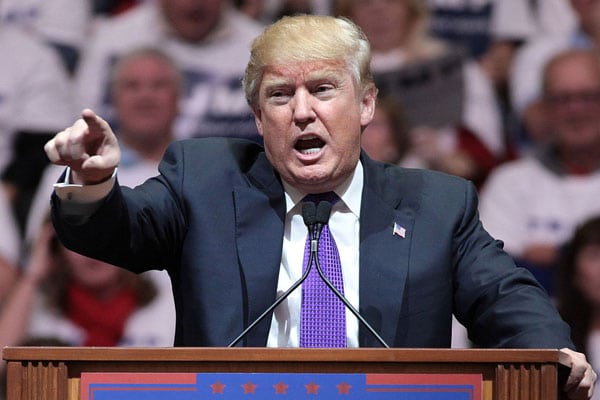
Most people of a certain age are familiar with old Hollywood backlots. Those were the sets created to serve as faux backdrops for movie scenes. Many classic movie scenes were performed in front of buildings or natural vistas that were little more than shells showing a façade or a painted mural. I was reminded of these backlots when New York State Attorney General (AG) Barbara Underwood announced on June 14th that her office was filing a civil suit against the Trump Foundation, calling it “little more than an empty shell.” It appears that the Trump Foundation, like the old movie backlots, served only to create an image of reality. Unlike those harmless movie sets, the Trump Foundation may have committed numerous violations of laws governing the management of nonprofit organizations.
The lawsuit was very blunt. It stated that “the Foundation was little more than a checkbook for payments to not-for-profits from Mr. Trump and entities that he owned. This resulted in multiple violations of state and federal law because payments were made using Foundation money regardless of the purpose of the payment. Mr. Trump used charitable assets to pay off the legal obligations of entities he controlled, to promote Trump hotels, to purchase personal items, and to support his campaign for President.” The suit is asking the state of New York to dissolve the Trump Foundation and distribute its remaining assets to other charitable organizations.
The cautionary tale here for nonprofit organizations is not so much in the New York AG’s salacious findings. I don’t need to detail the alleged spending violations, which have been well documented in other publications. However, the violations cited are the end-product of something more troubling about the Trump Foundation: its complete and abject ignoring of nonprofit corporate governance and the role of the organization’s board of directors. Without what appears to be even a nod to the idea of board governance, the Trump Foundation stands accused of having blithely self-dealt its way through years of reckless spending practices.
“The Foundation’s Board existed in name only” according to the lawsuit, which also stated, “Board members failed to exercise their fiduciary duty to provide oversight and control of the organization for at least nineteen years. The Board has not met since 1999 and has not overseen the activities of the foundation in any way.”
One of the inherent problems with the Trump Foundation board was the inclusion of Trump’s adult children, Donald Jr., Ivanka, and Eric, as board members. All three, as well as the sitting President of the United States, have been named as defendants in the case. The participation of numerous family members in the organization’s board and management created a troubling environment all too common in private foundations often controlled by families. Lesley Rosenthal is the outgoing general counsel of Lincoln Center for the Performing Arts Board and a contributor to the Harvard University Law School’s Forum on Corporate Governance and Financial Regulation. In a study entitled “Nonprofit Corporate Governance: The Board’s Role,” Rosenthal provided a nearly complete definition of what a nonprofit board should be and, by implication, what it should not be:
Board independence and board attention are of paramount importance in good nonprofit governance. The independence of the board is key because of the non-distribution constraint—nonprofits exist to serve the public interest, not to benefit owners or other private parties. Business or family relationships between the organization or its executives and a board member or her firm are frowned upon and should be strictly scrutinized under a conflict of interest policy administered by independent directors. Even absent outright business or family relationships, a common shortcoming of nonprofit boards is that they are too small, too insular, or too deferential to the founder or chief executive.
Sign up for our free newsletters
Subscribe to NPQ's newsletters to have our top stories delivered directly to your inbox.
By signing up, you agree to our privacy policy and terms of use, and to receive messages from NPQ and our partners.
To add an almost comedic note here, the New York AG’s investigation found that the Trump Foundation board’s official treasurer, when questioned by investigators, was not even aware that he held that position.
But finding political points to score here or chuckling at the comedy of errors ignores another blow to the image of charities and mission-based nonprofits. The early 1990s scandals involving lavish spending by United Way of America executives still haunt the charitable-giving world and continue to serve as a reminder of how not to conduct nonprofit business administration. The Trump Foundation gives new life to those memories of bad practices, especially since we are now under the specter of having the President of the United States standing as the accused.
It can and should be a teachable moment for the nonprofit world. It may be a good time for nonprofits to communicate with their donors and describe their own governance procedures. Let your donors know what your organization is doing to prevent the kinds of behavior outlined in the New York suit against the Trump Foundation. And perhaps it’s also a good time for nonprofits to look in the mirror and ask, “Could that be our organization under the microscope?”
This organizational introspection involves both large and small details. What can we do to ensure that our donors and our volunteers will continue to contribute their dollars and time to the fulfillment of our mission? Is our board fully engaged in its fiduciary responsibilities? Are board meeting minutes being properly recorded and approved?
These are questions every nonprofit organization should be asking itself on an annual basis while making sure the organization structure has a good deal more dimension and transparency than those Hollywood backlots—and, apparently, the Trump Foundation.